Severe COVID-19 Cases Reach Record High Again
83.4% Are Seniors Aged 60 and Over
Experts Call for Social Distancing Measures Stronger Than Level 4
Government Communication on Quarantine Rules Also Problematic
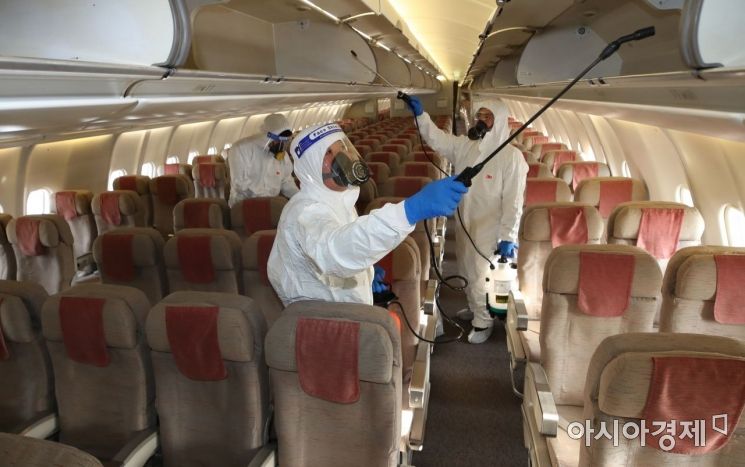 On the 9th, officials are conducting disinfection work inside the A330 aircraft at the Asiana Airlines hangar in Jung-gu, Incheon, to alleviate concerns about the spread of COVID-19. Photo by Moon Honam munonam@
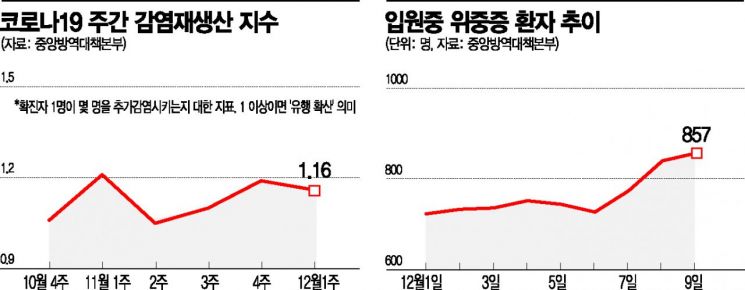
[Asia Economy Reporters Seo So-jeong and Lee Chun-hee] As the number of new COVID-19 cases surged to the 7,000 range for two consecutive days, voices calling for the government to take immediate drastic measures are growing louder. Experts expect the effects of the special quarantine measures, including reductions in private gatherings and expansion of the vaccine pass system, which have been in effect since the 6th of this month, to appear from the latter half of this week. They expressed concern that if the government delays strengthening quarantine measures, a major crisis may already be imminent. During the government's hesitation, severe cases and deaths, especially among the elderly, could surge dramatically.
◆ Severe cases remain in the 800s for the second day = According to the Central Disease Control Headquarters, as of midnight on this day, 7,102 new confirmed cases were added, bringing the cumulative total to 496,584. The number of new cases has been rapidly increasing since the implementation of the 'gradual recovery to daily life' on the 1st of last month, which relaxed quarantine measures. New cases first reached the 4,000 range on the 24th of last month, then surpassed 5,000 on the 1st of this month, and jumped directly to the 7,000 range yesterday, skipping the 6,000 range.
The trend of increasing severe cases is also steep. Today, the number rose by 17 from the previous day to 857, breaking the record once again. Notably, 83.4% (715 patients) of severe cases are elderly aged 60 and above. The number of deaths due to COVID-19 increased by 57 yesterday, with the average fatality rate standing at 0.82%. The number of infections with the new COVID-19 variant, Omicron, increased by 22 in one day, reaching a total of 60. With the surge in COVID-19 cases and the spread of the highly transmissible Omicron variant domestically, quarantine authorities are on high alert. The weekly infection reproduction number, which was 1.06 in the fourth week of October, rose to 1.16 in the first week of this month, indicating worsening quarantine indicators.
◆ "Drastic measures must be implemented immediately" = Experts unanimously agree that drastic measures are necessary as the number of confirmed cases, expected to increase with the gradual recovery to daily life, is rising more steeply than initially anticipated. Professor Baek Soon-young, Emeritus Professor at Catholic University Medical School, emphasized, "Now is not the time to think about balancing the economy and quarantine. If quarantine collapses in the current situation, everything including the economy will collapse." Professor Baek pointed out, "Epidemiological investigations have reached their limits. It is impossible to conduct epidemiological investigations for 7,000 cases a day, leading to gaps and inadequate management of close contacts." He added, "Hospital beds must be created somehow. Increasing beds piecemeal within hospitals as is currently done is just a stopgap measure."
There are also opinions that bans on gatherings at entertainment facilities and restrictions on operating hours of multi-use facilities need to be reinstated. Professor Eom Jung-sik of Gachon University Gil Medical Center argued, "Strong measures are necessary to resolve the situation in a short time," and suggested, "Consider restricting operations after 6 p.m. for about two weeks and applying vaccine passes to religious facilities where cluster infections are increasing." Professor Eom expressed concern, saying, "Since quarantine was significantly relaxed upon entering the recovery phase, it is difficult to reduce the scale of the outbreak without strong measures. Even with drastic measures, reaching 10,000 new cases by the end of the year is inevitable."
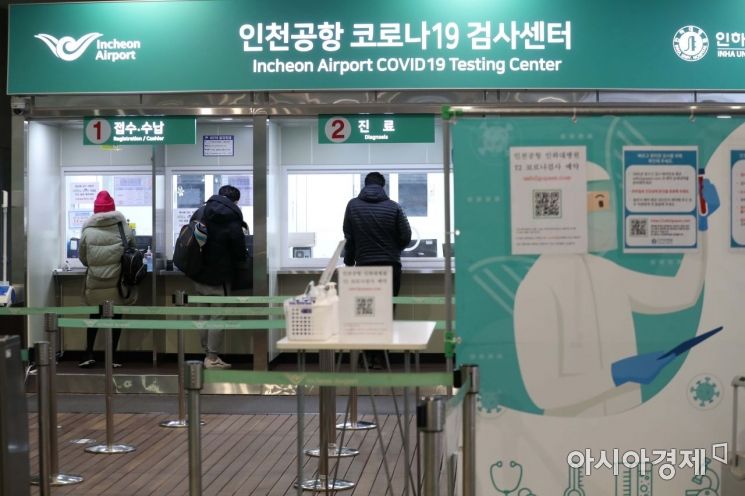 On the 9th, as the spread of COVID-19 continues, citizens are waiting to be tested at the testing center set up in the outdoor space on the west side of the basement level 1 of Terminal 2 at Incheon International Airport. Photo by Mun Honam munonam@
◆ "Stronger social distancing than Level 4 is needed" = Experts also pointed out problems with the government's communication approach. Deputy Research Fellow Jang Young-wook of the Korea Institute for International Economic Policy stated, "Changing the message is most important," diagnosing that "communication failed during the gradual recovery process." Jang said, "Because the message 'If the vaccination rate exceeds 80%, freedom will be granted' was continuously sent, even as the situation changed, the message that quarantine rules must still be followed has not been effectively conveyed," adding, "Mobility is steadily increasing now, so it is a time to pause." He continued, "In the long term, voluntary behavior should be encouraged, but in the short term, regulations are inevitable," and recommended, "Measures stronger than the existing Level 4 social distancing are needed, such as reinstating the four-person limit on private gatherings, restrictions on operating hours, or bans on facilities like entertainment venues."
Professor Kim Yoon of Seoul National University Medical School stated, "Securing hospital beds and medical staff is the top priority as the number of patients waiting for beds is rapidly increasing," and added, "Next week, surgeries and admissions for non-emergency and mild patients at tertiary hospitals should be postponed, and the beds allocated for those patients should be used for COVID-19 patient care, which will also allow the necessary personnel to follow."
© The Asia Business Daily(www.asiae.co.kr). All rights reserved.
![Clutching a Stolen Dior Bag, Saying "I Hate Being Poor but Real"... The Grotesque Con of a "Human Knockoff" [Slate]](https://cwcontent.asiae.co.kr/asiaresize/183/2026021902243444107_1771435474.jpg)


















