Police Officers Subdue Suspect with Live Ammunition
Investigation Confirms Justified Action... Commissioner Commends
Frontline Interest: "More Cases Like This Should Arise"
Calls for Legal Clarification... Amendment Bill Pending in National Assembly
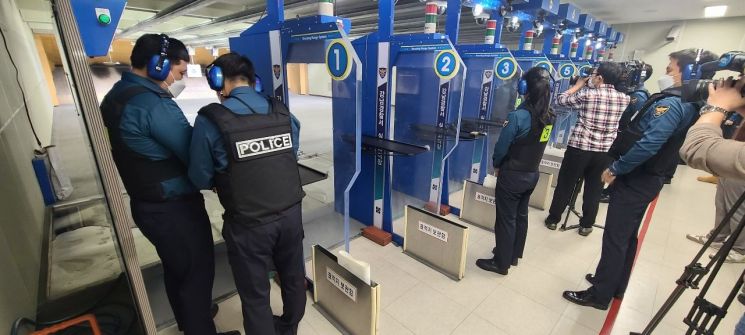
[Asia Economy Reporter Song Seung-yoon] On the 2nd of last month, a citizen reported that a foreign man was rampaging with a weapon in a residential area of Yangpyeong-eup, Yangpyeong-gun, Gyeonggi Province.
Police officers who arrived at the scene used firearms to subdue him. At the time, the police first attempted to restrain him using a baton and a Taser, but the man continued to threaten them with the weapon, and after issuing a warning, they fired live rounds to apprehend him. The Southern Gyeonggi Provincial Police Agency conducted an internal investigation to verify whether the officers' actions were justified, and earlier this month concluded that the use of live ammunition did not violate firearm use requirements and was deemed a lawful act.
According to the Police Officer Duty Execution Act, the conditions for police officers to use weapons include arresting or preventing the escape of a suspect, defending and protecting the life or body of themselves or others, and suppressing acts that interfere with official duties, using weapons within necessary limits. If a suspect wields a weapon and disobeys police orders three or more times while resisting, the use of firearms is permitted. Except in urgent situations, warnings must be given verbally or by firing warning shots beforehand, and when firing, officers should aim at the lower body to minimize life-threatening injuries. The police judged that the officers involved met all these conditions. They were also commended by Kim Won-jun, Chief of the Southern Gyeonggi Provincial Police Agency, on the 16th of the same month.
Given recent controversies over police mishandling, frontline officers showed great interest in this case. A team leader police officer working at a district police station in the Gyeonggi area said, "If cases like this, where officers receive praise rather than criticism after subduing suspects, continue to emerge, field officers will be able to enforce the law appropriately without hesitation."
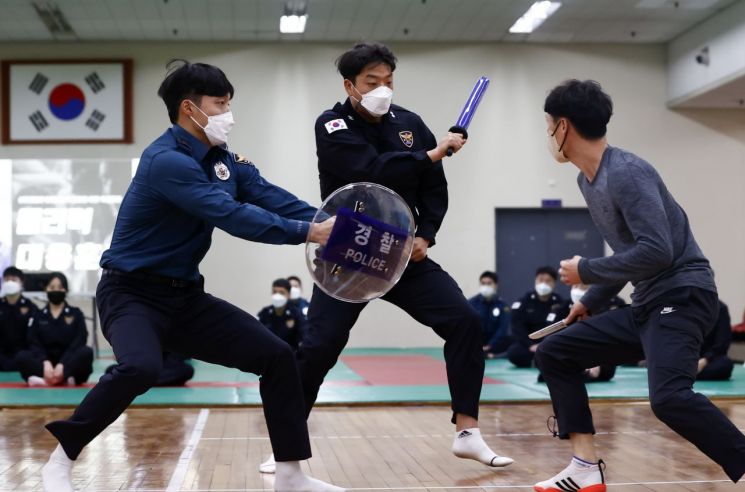
There are also calls for clearly defined regulations. An amendment to the Police Officer Duty Execution Act, which would reduce criminal liability arising from police officers' official duties, was submitted to the National Assembly's Judiciary Committee after passing the standing committee the day before but has yet to be concluded. A police officer at a district station in Seoul said, "This time, due to controversy over poor response, there seemed to be an atmosphere of highlighting the Yangpyeong case as a counterexample. However, without a definite mechanism to protect police officers, hesitation to use equipment out of fear of criticism will continue."
Meanwhile, according to a paper titled "A Study on the Impact of Subject Characteristics on Police Use of Physical Force," published in the autumn issue of the Korean Institute of Criminology and Justice Policy's Korean Criminal Policy Research, among 383 cases of physical force used by traffic and community police under the Seoul Metropolitan Police Agency from December 2019 to November last year, there were no cases involving high-risk physical force such as firearms. This excludes 938 cases with unclear victim status and one case involving the use of force against a wild boar from a total of 1,322 physical force use reports. When the subject launched a lethal attack, 'medium-risk physical force' such as batons or Tasers was used in 52.8% (19 cases), while low-risk physical force (25%, 9 cases) or contact control involving pushing parts of the body (22.2%, 8 cases)?essentially 'bare hands'?accounted for nearly half (47.2%). Even when subjects used violent attacks, low-risk physical force was used in 68.1% (147 cases), and contact control in 22.2% (48 cases), meaning over 90% of responses involved bare-handed measures.
© The Asia Business Daily(www.asiae.co.kr). All rights reserved.

![A Woman with 50 Million Won Debt Clutches a Stolen Dior Bag and Jumps... A Monster Is Born [Slate]](https://cwcontent.asiae.co.kr/asiaresize/183/2026021902243444107_1771435474.jpg)
















