Highest Standard Scores: Korean 149, Math 147
Math up 10 points, Korean up 5 points from last year's CSAT
Korean second hardest since 2005 CSAT
English Grade 1 rate 6.25%, half of last year's rate
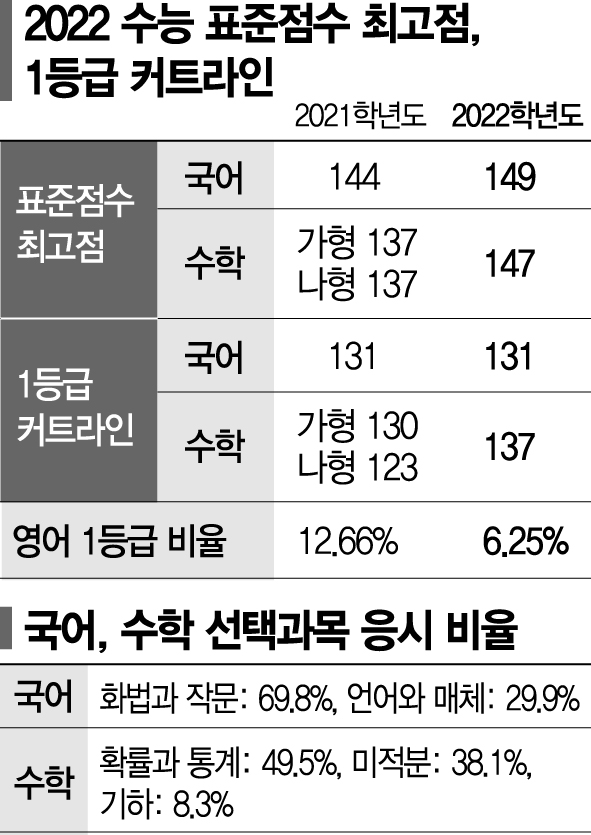
The 2022 College Scholastic Ability Test (CSAT) was a ‘difficult CSAT’ with all subjects?Korean, English, and Mathematics?being harder than last year. According to the scoring results, the highest standard scores for Korean and Mathematics were higher than last year’s CSAT, and the percentage of students achieving the top grade in English was halved.
On the 9th, the Korea Institute for Curriculum and Evaluation announced the CSAT scoring results, showing that the standard scores for Korean and Mathematics rose compared to last year’s CSAT and this year’s mock exams.
The highest standard score in Korean was 149 points, 5 points higher than last year’s 144 points. Korean was the second most difficult since the CSAT was introduced in 2005, approaching the highest score of 150 points in the difficult 2019 CSAT. The highest standard score in Mathematics was 147 points, 10 points higher than last year’s Type A and Type B tests, which were both 137 points. Compared to the June and September mock exams, Korean was 3 and 22 points higher, respectively, and Mathematics was 1 and 2 points higher. The standard score is an indicator showing the difference between a test taker’s raw score and the average score; the harder the test, the higher the top score.
The cutoff for the top grade in Mathematics was 137 points, 7 points higher than last year’s Type A and 14 points higher than Type B. The percentage of students achieving the top grade in English was 6.25%, half of last year’s 12.66%. The percentage for the second grade was 21.64%, an increase of 27,390 students compared to last year. The cutoff for the top grade in Korean remained the same as last year at 132 points. The top grade percentages were 4.01% for Korean, 4.20% for Mathematics, and 37.57% for Korean History.
In the inquiry subjects, the highest score was in Earth Science II (77 points). In social studies, Ethics and Thought, and Society and Culture (68 points) had the highest scores, while Politics and Law (63 points) had the lowest. In science inquiry, Chemistry I and Physics II (68 points) had the lowest scores. Social studies were relatively easier, whereas science inquiry was more difficult, which is expected to create differentiation among science-track students in science inquiry subjects.
The percentage of students achieving the highest standard score was 0.006% (28 students) in Korean, significantly lower than last year’s 0.04% (151 students). In Mathematics, it was 0.628% (2,702 students), lower than last year’s Type A at 0.70% (971 students) but slightly higher than Type B at 0.53% (1,427 students).
This year’s CSAT was the first integrated test for humanities and sciences, with Korean and Mathematics consisting of ‘common + elective subjects.’ Among Korean test takers, the participation rates for Speech and Writing and Language and Media were 70.0% and 30.0%, respectively. Among Mathematics test takers, the participation rates for Probability and Statistics, Calculus, and Geometry were 51.6%, 39.7%, and 8.7%, respectively.
The number of test takers this year was 448,138, 27,104 more than last year’s 421,034. Among them, 318,693 were current students, and 129,445 were graduates or those who passed the qualification exam. Test takers will receive their individual score reports on the 10th.
Although the standard scores and grade cutoffs by elective subjects were not disclosed in this year’s CSAT scoring results, it is analyzed that the highest scores came from subjects chosen by top-ranking students.
Lim Seong-ho, CEO of Jongro Academy, explained, “The number of perfect scorers in Korean sharply decreased compared to last year. It is estimated that all top scorers took Language and Media, making Korean’s differentiation in the humanities track absolute. All perfect scorers in Mathematics are estimated to have taken Calculus, with 1,731 more perfect scorers than last year’s Type A, predicting an extremely close competition among perfect scorers. There was a significant gap between humanities and sciences in Mathematics, raising concerns about cross-application from humanities to sciences.”
© The Asia Business Daily(www.asiae.co.kr). All rights reserved.
![Clutching a Stolen Dior Bag, Saying "I Hate Being Poor but Real"... The Grotesque Con of a "Human Knockoff" [Slate]](https://cwcontent.asiae.co.kr/asiaresize/183/2026021902243444107_1771435474.jpg)
















