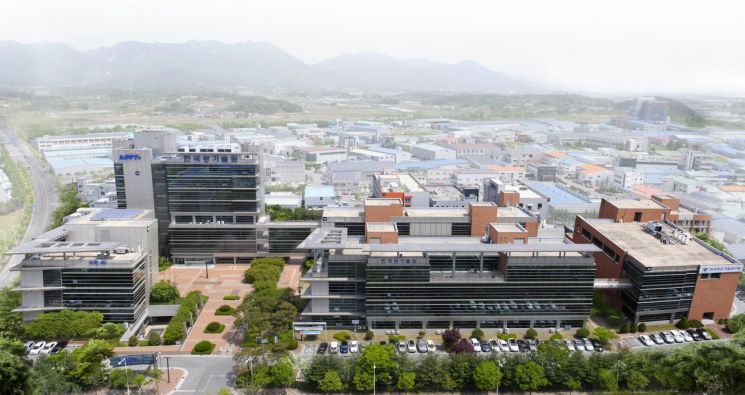
[Asia Economy Honam Reporting Headquarters Reporter Jin-Hyung Park] Sundiode, located in Silicon Valley, USA (CEO James Kim), and the Korea Photonics Technology Institute (Director Yong-Jin Shin) (hereinafter referred to as the ‘research team’) announced on the 8th that they have developed a technology capable of implementing ultra-high-resolution full color (red, green, blue) microdisplays through joint research.
Recently, there has been growing interest in micro-LEDs used in high-resolution microdisplays for implementing augmented reality (AR), mixed reality (MR), and the metaverse.
To implement microdisplays with existing technology, three red, green, and blue LED wafers are each fabricated into chip forms through separate semiconductor processes and then horizontally arranged on the display substrate through a transfer process.
In ultra-high-resolution applications such as augmented reality, the conventional method of densely arranging red, green, and blue micro-LED chips smaller than 10 ㎛, made through individual processes, to form millions of pixels faces several technical challenges.
To address this, Sundiode has promoted research and development of an innovative structure that vertically stacks red, green, and blue micro-LED devices, while the Korea Photonics Technology Institute’s Next-Generation LED Research Center developed stacked LED semiconductor wafer growth using metal-organic chemical vapor deposition (MOCVD) and semiconductor fine patterning processes using photolithography.
Additionally, to independently control the three micro-LED chips, they developed a groundbreaking multi-junction LED process technology, which plays an essential role in achieving excellent color and saturation.
The single pixel developed this time consists of three vertically stacked micro-LED subpixels that can be independently controlled, enabling full-color emission across the entire device area.
One advantage of the developed stacked three-color pixel technology is its compact pixel structure, which reduces or completely eliminates the difficulties of pixel transfer processes required for manufacturing high-resolution micro-LED displays.
Meanwhile, the vertically stacked pixel arrays densely arranged allow for more efficient use of the small pixel areas in microdisplays.
The full-color microdisplay uses a silicon CMOS (Complementary Metal-Oxide Semiconductor) display backplane driving circuit.
The microdisplay developed with a compact structure measures 15.4mm x 8.6mm, has a pixel size of 100 ㎛, a resolution of 200 PPI (Pixels per Inch), and was fabricated without undergoing the pixel transfer process required for microdisplay manufacturing.
The research team stated, “Microdisplays for augmented reality and mixed reality require ultra-high resolution and precise miniaturization,” adding, “The stacked three-color micro-LED pixel technology solves these issues and is expected to accelerate the commercialization of microdisplays.”
© The Asia Business Daily(www.asiae.co.kr). All rights reserved.
![Clutching a Stolen Dior Bag, Saying "I Hate Being Poor but Real"... The Grotesque Con of a "Human Knockoff" [Slate]](https://cwcontent.asiae.co.kr/asiaresize/183/2026021902243444107_1771435474.jpg)
















