[Asia Economy Reporter Jeong Hyunjin] As the government has set the '2030 National Greenhouse Gas Reduction Target' to reduce greenhouse gas emissions by 40% compared to 2018 by 2030, concerns have been raised that South Korea faces more challenging conditions for carbon reduction compared to major countries. It is pointed out that there are accumulated challenges to be addressed, such as a high proportion of manufacturing and carbon-intensive industries, a carbon reduction period about 20 years shorter than major countries, and technological gaps.
The Federation of Korean Industries (FKI) analyzed the conditions for carbon reduction in Korean industries through international comparison on the 9th and revealed that Korea faces five major issues.
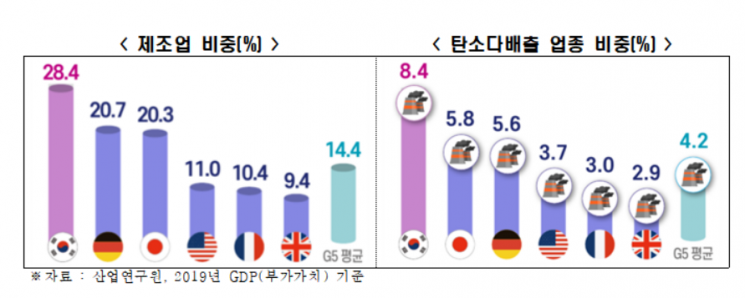
First, the FKI mentioned the unfavorable industrial structure centered on manufacturing. The manufacturing sector accounted for 28.4% of South Korea's Gross Domestic Product (GDP) in 2019, and carbon-intensive industries such as steel, chemicals, refining, and cement accounted for 8.4% of GDP. This is about twice the average manufacturing share (14.4%) and carbon-intensive industry share (4.2%) of the Group of Five (G5) countries. Considering the difficulty of securing breakthrough carbon reduction technologies in the short term, the FKI expressed concern that reducing carbon in the manufacturing sector would require either reducing production volume or relocating plants overseas, which is expected to cause greater economic contraction and job losses.
It was also analyzed that a short reduction period could lead to a high reduction burden. According to the Organization for Economic Cooperation and Development (OECD), the peak year of carbon emissions in South Korea's industrial sector was 2014, resulting in a reduction period of 36 years until 2050. In contrast, the G5 countries had peak years of 1990 for Germany, 1991 for the UK and France, and 1996 for the US and Japan, with reduction periods of 54 to 60 years until 2050. The FKI interpreted this as "South Korea having to pursue carbon reduction within a period about 20 years shorter than the average of G5 countries."
At the same time, it was pointed out as a problem that Korea's major high-emission industries, such as steel and refining, currently possess world-class efficiency based on existing technologies and facilities, leaving little room for additional reductions, and that the level of next-generation core carbon reduction technologies is still insufficient. South Korea's technologies for bio and waste resource energy conversion, which replace conventional fossil fuels, and carbon capture, utilization, and storage (CCUS) technologies for industrial process emissions remain at about 80% of the world's highest level, with a technological gap of approximately 4 to 5 years.
Furthermore, the FKI pointed out that the competitiveness of renewable energy and green hydrogen is still insufficient. According to an analysis of renewable energy power supply stability based on geography and natural environment among 42 major countries, South Korea ranked the lowest due to its small land area and insufficient solar radiation and wind speed. The domestic production potential of green hydrogen, essential for hydrogen reduction steelmaking technology and hydrogen vehicle deployment, is also lower compared to major countries, which is expected to result in significant import costs in the future.
Yoo Hwan-ik, head of the Corporate Policy Office at the FKI, stated, "Korean industry faces unfavorable conditions for carbon reduction compared to major countries due to a high manufacturing share, short reduction period, world-class efficiency, inferior level of next-generation carbon reduction technologies, and lack of renewable energy capabilities." He emphasized, "It is necessary to strengthen policy support for securing breakthrough carbon reduction technologies, expand the use of nuclear power as a zero-carbon energy source, and also reconsider the realism of the 2030 National Greenhouse Gas Reduction Target (NDC)."
© The Asia Business Daily(www.asiae.co.kr). All rights reserved.

















