Ministry of Education Holds Meeting with Students, Parents, and Experts on Vaccination
Criticism Continues Over Changes in Vaccination Policy and Vaccine Pass
Experts: "High Infection Rates in Academies and Schools, Social Harm Dispersion Inevitable"
Questions Raised on Omicron Prevention Rate and Same Dosage for Adults
Yoo Eun-hye: "Seeking Improvements to Vaccine Pass and Coordinating with Relevant Ministries"
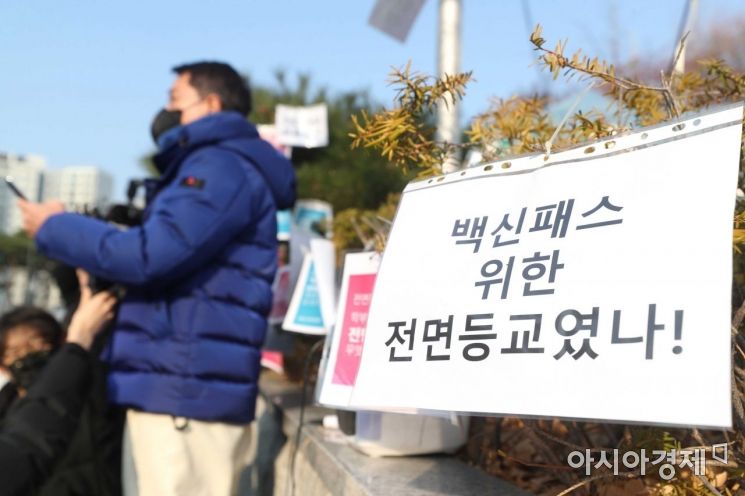 On the 7th, a press conference titled "Demanding Measures for Full School Attendance and Withdrawal of Vaccine Pass" was held in front of the Seoul Metropolitan Office of Education in Jongno-gu, Seoul, hosted by the Seoul Parents Association. Photo by Moon Honam munonam@
[Asia Economy Reporter Han Jinju] "I find it questionable that the vaccine pass is applied to academies and study rooms while being lifted for religious facilities, department stores, and amusement parks." (Shin Yuseung, 3rd year student at Busan International Middle School)
"The vaccine pass is an unavoidable process for normalization such as returning to school. We need to distribute the damage now. If we do not utilize this, it will be difficult to manage the outbreak." (Professor Jung Jaehoon, Gachon University)
At a meeting between the Ministry of Education and students and parents, criticism arose that it is difficult to understand applying the youth vaccine pass to academies and study rooms. Voices also raised concerns about the policy reversal from voluntary to strongly recommended vaccination for children and adolescents. Experts consistently emphasized that the benefits of vaccination outweigh the harms.
On the 8th, the Ministry of Education held an online meeting on COVID-19 vaccination with students, parents, and vaccination experts at Yanghwa Middle School in Yeongdeungpo-gu, Seoul. The participating students and parents asked questions about vaccine safety and the vaccine pass, and Deputy Prime Minister and Minister of Education Yoo Eunhye, Professor Jung Jaehoon of Gachon University’s Department of Preventive Medicine, and Professor Choi Youngjun of Korea University’s Pediatrics Department responded.
Student: "Difficult to understand vaccine pass application after giving vaccination choice"
Yoo Jinseon, a student at Okhyeon Middle School in Ulsan, said, "Vaccine development usually takes 5 to 10 years, but mRNA vaccines started being administered within less than a year without long-term side effect follow-up. Until two months ago, vaccination was voluntary for those under 18, but it is hard to understand why the vaccine pass applies to them in less than two months."
In response, Professor Choi Youngjun said, "Even if we acknowledge some limitations regarding the safety of mRNA vaccines or unverified physiological technology, it is certain that vaccination prevents infection and reduces severe cases, especially in children and adolescents. In the U.S., mortality rates vary by state vaccination rates, and the same pattern is seen in Europe. Based on this, we judged that the risk of COVID-19 infection is greater than the burden from vaccination and recommended vaccination."
Professor Jung Jaehoon said, "Two to three months ago, there was insufficient evidence and confidence to strongly recommend vaccination for children and adolescents. After analyzing data and vaccination effects over the past 2-3 months, we judged it effective considering the infection rate difference between 3rd-year high school students and other grades. Experts and authorities must explain the changed situation well, and as a scholar, I will definitely collect long-term adverse reaction data and honestly report any shortcomings whenever necessary."
Deputy Prime Minister and Minister of Education Yoo Eunhye said, "Regarding the vaccine pass application, we will actively seek improvement measures to increase acceptance on the ground by reflecting concerns without undermining social consensus or principles, and will also coordinate with related ministries."
Parents also say "Youth vaccine pass is practically mandatory vaccination"
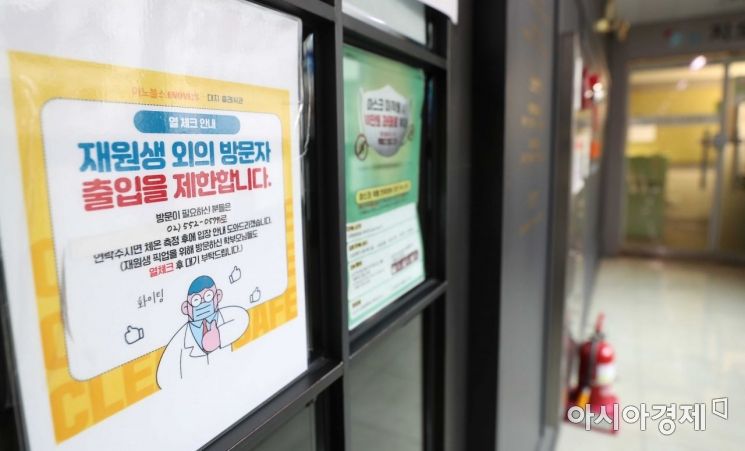 On the 6th, as the quarantine pass (vaccination certificate or negative test confirmation) is newly applied to indoor multi-use facilities such as restaurants, cafes, academies, and PC rooms, there is strong opposition to the application of the quarantine pass to adolescents. On this day, a COVID-19 quarantine-related notice is posted at an academy in Gangnam-gu, Seoul. Photo by Mun Ho-nam munonam@
Among students and parents, criticism continues that applying the vaccine pass to 12-17-year-olds from February next year effectively mandates vaccination. Gong Dongmin, a parent living in Chungbuk, pointed out, "Extending business operation hours would be a more effective and prior guideline than forcing youth vaccination."
Yang Junhyun, a 3rd-year student at Yangdeok Middle School, asked, "Many schools have final exams in December for 2nd-year middle school students, so considering the vaccine pass implementation schedule, there is only about one month left to get vaccinated and prepare by February. Would it be possible to postpone the schedule?"
Deputy Prime Minister Yoo responded to the criticism that the vaccine pass forces youth vaccination by saying, "We strongly recommend vaccination, but those who are not vaccinated are guided to regularly take PCR tests even if it is somewhat inconvenient. Since there may be unavoidable cases where vaccination is not possible, it is not mandatory or compulsory vaccination, but rather an active recommendation with accurate information to increase vaccination rates."
Professor Jung Jaehoon said, "Since the phased return to normal life, confirmed cases have increased by 15% weekly, and as the outbreak progresses beyond the healthcare system’s preparedness, policies to control the scale of the outbreak are inevitable. No single policy can solve this; multiple policies such as business hour restrictions, private gathering limits, and additional vaccinations must be combined."
He added, "COVID-19 is a disaster, and the best available method now is to distribute damage fairly. One such method is the vaccine pass. Although inconvenient and difficult, it must target places where outbreaks concentrate and many infections occur. Analyzing infection data among children and students shows that these places are schools and academies. The vaccine pass is an unavoidable process for returning to school and normalizing daily life. But of course, students cannot just stop going to school."
Experts: "40% of 12-18-year-olds may be infected; benefits of vaccination outweigh risks"
During the meeting, questions were raised about how well COVID-19 vaccines can prevent the Omicron variant.
Professor Jung Jaehoon said, "Omicron has become dominant by displacing the Delta variant, likely because it has higher transmissibility or reduces vaccine effectiveness, or both. It takes time to study the transmissibility and vaccine efficacy against variants, but for Omicron, the infection prevention effect may decrease by 10-20%."
Min Ji-young, a parent of a 3rd-year middle school child, asked, "The UK initially recommended one dose, so what is the basis for administering the same vaccine to children and adolescents as adults?"
Professor Jung replied, "After the Delta variant, the situation worsened rapidly, and within 2-3 years, 40% of 2.8 million 12-17-year-olds could be infected. The UK initially recommended one dose but recently changed to two doses, and most countries consider two doses basic. Infection probability is increasing, and the benefits of vaccination are growing.".
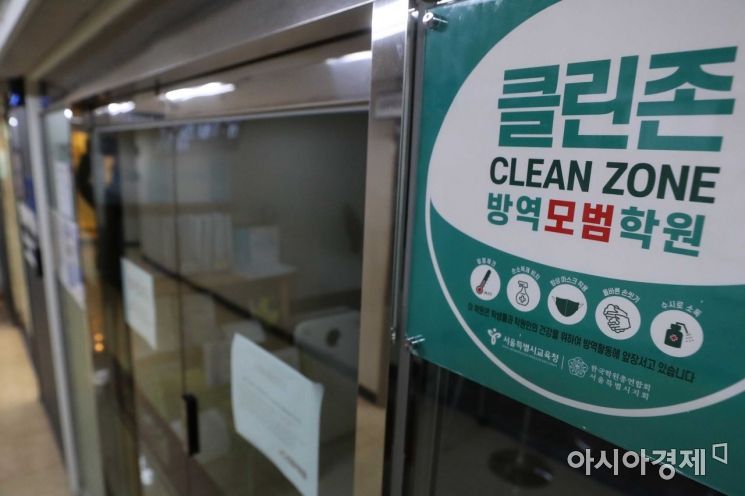 On the 6th, as the quarantine pass (vaccination certificate or negative test confirmation) is newly applied to indoor multi-use facilities such as restaurants, cafes, academies, and PC rooms, there is strong opposition to the application of the quarantine pass to adolescents. On this day, a COVID-19 quarantine-related notice is posted at an academy in Gangnam-gu, Seoul. Photo by Moon Honam munonam@
Regarding whether children and adolescents need booster shots after vaccination, Professor Choi Youngjun said, "Booster shots started for high-risk adults after observing waning vaccine effectiveness 4-5 months post-vaccination. Adolescents have a much lower breakthrough infection rate and better vaccine effectiveness compared to adults. So far, foreign evaluations generally say boosters are unnecessary for adolescents, and we share that view."
Despite the sharp increase in confirmed cases due to the Omicron variant and heightened infection concerns, the Ministry of Education maintains its policy of full in-person schooling.
Lee Sangsoo, Director of School Innovation Support at the Ministry of Education, said, "Over the past two years, remote and in-person classes have been combined, causing social, emotional, and learning deficits. Despite difficulties, we have strengthened school quarantine and are implementing full in-person schooling. We plan to continue full in-person schooling to overcome the side effects and difficulties seen in remote classes as much as possible."
© The Asia Business Daily(www.asiae.co.kr). All rights reserved.
![Clutching a Stolen Dior Bag, Saying "I Hate Being Poor but Real"... The Grotesque Con of a "Human Knockoff" [Slate]](https://cwcontent.asiae.co.kr/asiaresize/183/2026021902243444107_1771435474.jpg)


















