If Electric Vehicles Reach 33% by 2030,
About 35,000 Jobs Will Disappear
and 10% of Related Companies May Go Bankrupt
Global Employment Reduction Inevitable
Due to Vehicle Semiconductor Supply Shortages,
Next Year's Production Also Challenging
Experts Say "Electrification Is the Way Forward
Ensuring Maximum Employment and Maintaining Industrial Competitiveness
Labor and Management Must Find Wise Compromise"
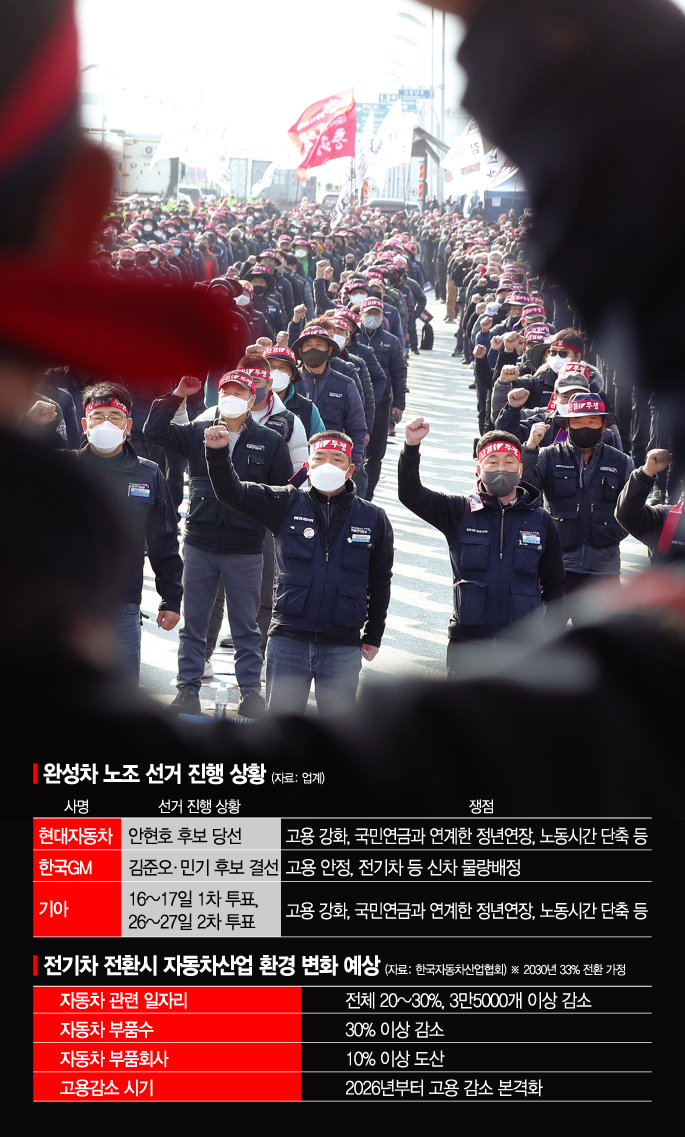
[Asia Economy Reporter Yu Je-hoon] The surge of 'hardline' labor unions sweeping through the domestic complete vehicle industry, including Hyundai Motor Company, is closely linked to job issues arising from the paradigm shift in the automotive industry. As mass production of electric vehicles and hydrogen fuel cell vehicles, which will disrupt the existing internal combustion engine-centered industrial ecosystem, begins in earnest, employment issues inevitably emerge as the biggest point of contention. Industry insiders emphasize that since employment reduction due to electrification is an unavoidable path globally, close cooperation between labor and management in business structure innovation is more necessary than anything else. However, the labor unions in the complete vehicle industry are increasingly shifting to a hardline stance with pledges not to give up jobs and workloads, raising concerns that industrial competitiveness could weaken.
According to the complete vehicle industry on the 8th, the newly elected leadership of the 9th Hyundai Motor Branch of the Korean Metal Workers' Union, including candidate Ahn Hyun-ho (56), comes from the internal field organization 'Metal Solidarity' and is classified as having a hardline tendency. Kim Jun-oh (51) and Min Gi (51), who advanced to the runoff election for the Korean GM labor union branch chief election held until this day, are also classified as hardline. If a hardline leadership is established in the upcoming Kia leadership election scheduled for the first round on the 16th-17th and the second round on the 26th-27th, the hardline faction is expected to become mainstream.
◆ Employment 'Shaken' by Electrification and Future Vehicle Transition... Rough Labor-Management Relations Expected Next Year = The industry cites employment issues arising from the transition to future vehicles such as electrification as the reason for the successive emergence of hardline leadership in the complete vehicle industry unions. In the case of electric vehicles, the number of major parts such as engines is reduced by about 30% compared to existing internal combustion engine vehicles, and the work hours also decrease, significantly impacting employment. Recently, the Korea Automobile Manufacturers Association (KAMA) projected that if the proportion of electric vehicles reaches 33% by 2030, 10% of related companies could disappear, and about 35,000 jobs could be lost.
The Hyundai Motor labor-management also experienced conflict earlier this year over the scale of manpower deployed in the assembly process of the Ioniq 5. Ultimately, labor and management resolved the conflict by reallocating some surplus personnel from Ioniq 5 production to other model production lines, but as electric vehicle production increases, such conflicts are bound to intensify. Hyundai Motor has already decided to expand electric vehicle sales to 1 million units annually by 2025.
In particular, the possibility of local electric vehicle production is rising due to protectionist trends in various countries. Hyundai Motor is also reportedly considering local production of electrified models such as the GV70 in the United States. Accordingly, the new Hyundai Motor union leadership proposed key election pledges including △ eliminating employment insecurity factors such as outsourcing, automation, and volume transfer △ preparing employment measures for the powertrain division and in-house assembly of core eco-friendly vehicle parts △ strengthening union influence over overseas factory operations.
Although the situation differs, the industrial transition response strategy is also a key issue in the Korean GM union leadership election. Unlike Hyundai Motor and Kia, where employment is a problem due to electric vehicle mass production, Korean GM urgently needs to secure volume for survival.
Candidate Kim, who advanced to the runoff in first place, pledged to establish a 'Global Strategy Office' within the union and hire international automotive experts to analyze General Motors (GM)'s policies and trends. Through these efforts, the goal is to secure new car allocations such as electric vehicles and stabilize volume. Candidate Min also proposed mixed production of electric and internal combustion engine vehicles, demands for re-entry into the European market, and a joint response system among the three foreign companies. This aligns with GM's electrification strategy to cease internal combustion engine vehicle production by 2035. Since GM's global strategy was established, Korean GM has yet to receive electric vehicle allocations. Recently, GM clearly stated at a domestic press briefing that there are no plans for electric vehicle production.
◆ "Dilemma Situation, Need to Find Wise Compromise" = The problem is that the reality domestic complete vehicle companies will face next year is not bright. The impact of the vehicle semiconductor supply shortage is significant. According to the Korea Automotive Technology Institute and automotive analysis agency Auto Forecast Solutions, Hyundai Motor produced a cumulative 4,594,000 units from January to September this year, a 14.0% decrease compared to the same period in 2019 before the COVID-19 pandemic. Industry evaluations suggest this situation is likely to continue next year.
Meanwhile, competing countries are accelerating their moves toward future vehicles. Tesla is greatly increasing production capacity by expanding the Shanghai Gigafactory and constructing the German Gigafactory. German companies are also rapidly adapting to changes by establishing new electric vehicle plants (Volkswagen) or retraining workers previously involved in engine production to work on motor production (Daimler).
Experts say that while each union is in a dilemma during the industrial transition, escalating to a hardline stance could negatively affect the competitiveness of the domestic complete vehicle industry. Cho Cheol, senior research fellow at the Korea Institute for Industrial Economics & Trade, said, "From the labor perspective, electrification is an unavoidable future but also a dilemma situation that inevitably leads to employment reduction," adding, "If the hardline path is pursued as the public wishes, it will inevitably impact the competitiveness of the domestic complete vehicle industry."
Jung Man-ki, chairman of the Korea Automobile Manufacturers Association (KAMA), said, "Job reductions and employment issues due to electrification are pains commonly experienced not only by the domestic complete vehicle industry but also by the global complete vehicle industry, but the path forward is clear," adding, "Ultimately, labor and management in the complete vehicle industry must find ways to guarantee employment as much as possible while maintaining competitiveness."
© The Asia Business Daily(www.asiae.co.kr). All rights reserved.
![Clutching a Stolen Dior Bag, Saying "I Hate Being Poor but Real"... The Grotesque Con of a "Human Knockoff" [Slate]](https://cwcontent.asiae.co.kr/asiaresize/183/2026021902243444107_1771435474.jpg)
















