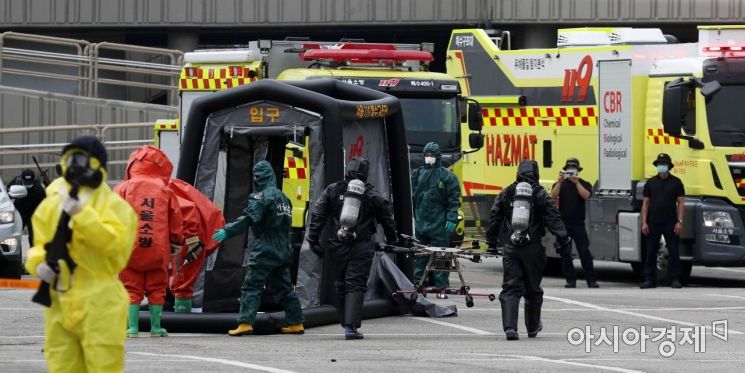
 On the 29th, six public, private, and military organizations conducted a "Field Commander Training and Joint Exercise with Related Agencies to Strengthen Drone Terrorism Response Capabilities" at Jamsil Sports Complex in Songpa-gu, Seoul. The special forces' chemical, biological, radiological, and nuclear (CBRN) team decontaminated and collected toxic chemical substances dispersed by a drone. This exercise was held to establish an organic cooperation system among related agencies by conducting a joint exercise simulating a drone terrorism scenario. Photo by Moon Honam munonam@
[Asia Economy Yang Nak-gyu, Military Specialist Reporter] The Agency for Defense Development (ADD) has independently developed technology capable of detecting North Korea's chemical weapons. If chemical weapons can be detected from a long distance in advance, it will be possible to monitor contamination spread in real time and shorten response time to chemical weapons during wartime.
According to ADD on the 8th, the chemical imaging detection technology that detects chemical weapons in real time has been developed since 2012 through the Defense Acquisition Program Administration's core technology project, based on lightweight hyperspectral imaging devices and intelligent detection algorithms.
This technology analyzes infrared two-dimensional images and spectral information from a long distance to identify contamination spread in real time when a chemical weapon attack occurs. In particular, the chemical imaging detection device can be installed in a mobile manner and can be mounted and operated on various platforms such as manned and unmanned reconnaissance systems of the military.
ADD attempted chemical imaging detection technology because of North Korea's chemical weapons. The department responsible for nuclear and biochemical weapons in North Korea is the 5th Bureau of the 2nd Economic Committee under the National Defense Commission. Regarding chemical warfare, North Korea operates nine facilities under the jurisdiction of the 5th Bureau, including Aoji Chemical Plant, Chongjin Chemical Plant, and Hamhung 28 Vinylon Plant. Military authorities estimate that these sites can independently cultivate and produce biochemical weapons such as anthrax, smallpox, and cholera.
According to the 'Northeast Asia Security Situation Analysis' published by the Korea Institute for Defense Analyses (KIDA), if all 2,500 to 5,000 tons of chemical agents possessed by North Korea are made into chemical shells, 625,000 to a maximum of 1,250,000 shells can be produced. This calculation assumes 4 kg of chemical agent per chemical shell. 5,000 tons of chemical agents is enough to contaminate an area of 2,500 km², which is four times the size of Seoul.
The equipment that our military has to detect North Korea's biological weapons includes three types: biological toxin monitoring systems, biological reconnaissance vehicles, and portable weapon diagnostic kits. The Chemical Defense Research Institute under the Republic of Korea Chemical, Biological, Radiological, and Nuclear Defense Command can analyze all 13 types, but it has been pointed out that it takes a long time to analyze chemical weapon components.
© The Asia Business Daily(www.asiae.co.kr). All rights reserved.

















