Self-Employed Citizens Lower Credit Scores by Taking Card Loans and Seeking Loan Sharks
Distortion Arises from Overlapping Total Volume Regulation and Preferential Policies for Low-to-Mid Credit Borrowers
"A World Where High Credit Borrowers Deliberately Become Low Credit"
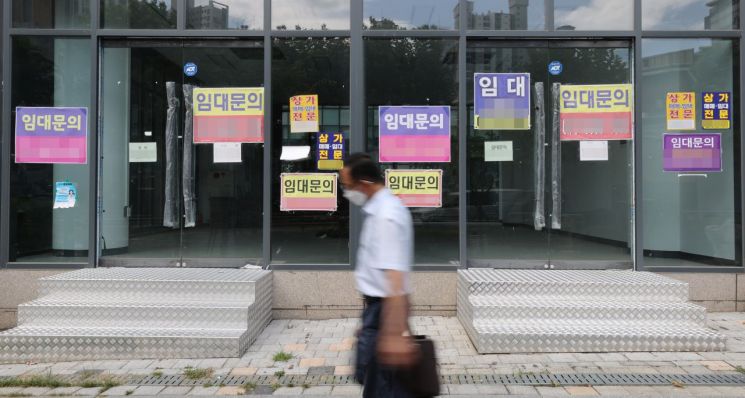
[Asia Economy Reporter Kim Jin-ho] Kim Dae-hee (47, pseudonym), who runs a chicken restaurant in Seoul, is deliberately lowering his credit score to receive a government-supported loan. This is to qualify for the "low-credit small business loan." Unable to pass the heightened bank thresholds due to stringent total volume regulations, Kim is desperate for this loan. After reading a post titled "How to Lower Your Credit Score" on a self-employed community, he has been following the advice exactly. Despite lowering his credit score by 100 points through multiple cash advances, he needed to reduce it by another 30 points to qualify, leading him to eventually seek out private lenders. Kim lamented, "It’s so absurd that I have to lower my credit score just to get a loan that it makes me laugh."
As the loan freeze continues due to financial authorities' total volume regulations, a clear "distortion phenomenon" is emerging in the market where financial common sense is breaking down. High-credit borrowers are intentionally lowering their credit scores to access loans. This side effect has arisen because, unlike high-credit borrowers who are blocked from loans, the loan thresholds for medium- and low-credit borrowers have significantly lowered.
According to the financial sector on the 7th, inquiries about whether credit scores can be temporarily lowered by taking loans from credit card companies or private lenders have been increasing recently. Several posts daily appear on major self-employed communities, not only asking such questions but also sharing methods to lower credit scores.
The increase in people wanting to lower their credit scores is due to the government offering loans targeted at low-credit self-employed individuals. Since the 24th of last month, the government has been accepting loan applications to support low-credit self-employed people struggling due to COVID-19. To use this product, the credit score must be 779 points or below (grade 5) based on NICE Information Service at the time of application. Borrowers can receive up to 20 million KRW at a fixed annual interest rate of 1.5%.
Consequently, self-employed individuals urgently needing lump sums have started lowering their credit scores to meet loan conditions. Given the low interest rate and high limit, there is no reason to refuse. Methods to lower credit scores vary, from repeatedly taking cash advances or delaying utility payments to, in cases where loan limits are fully used, even knocking on private lenders' doors.
Especially on self-employed communities, there are posts sharing tips that using card loans is better than cash advances for lowering credit scores because recovery is slower with cash advances. These posts advise applying for a loan once the credit score reaches the eligible level through card loans, then withdrawing the loan approval to recover the credit score. This exploits the loan application withdrawal right activated by the Financial Consumer Protection Act.
The extreme measure of deliberately lowering credit scores taken by self-employed individuals is largely due to the financial authorities’ stringent "loan tightening." Considering that total volume regulations have closed loan doors not only at banks but also at secondary financial institutions, this loan represents their "last hope."
The distorted market phenomenon favoring medium- and low-credit borrowers over high-credit ones is also closely related to this situation. Major banks and internet-only banks have mostly lowered unsecured loan limits for high-credit borrowers to 50 million KRW, while granting up to 100 million KRW limits to medium- and low-credit borrowers.
It is also reported that unsecured loan interest rates for salaried workers are sometimes higher than those of policy-based low-income financial products. This means that people with higher credit pay more interest than those with lower credit. Particularly, due to the balloon effect of total volume regulations, high-credit borrowers with grade 1-2 who borrowed from banks are now knocking on doors of savings banks and other secondary financial institutions, pushing truly cash-strapped low-income people toward illegal private loans.
A financial industry official said, "Even those with high credit scores are facing a disappearance of places to borrow money, causing these side effects," and criticized, "The situation where high-credit borrowers intentionally become low-credit borrowers is incomprehensible by financial common sense." He added, "The comprehensive loan regulations combined with policies favoring medium- and low-credit borrowers have created market distortions."
© The Asia Business Daily(www.asiae.co.kr). All rights reserved.

















