Decrease in First-Time Real Estate Buyers
Sharp Drop in Apartment Purchases by 30s in Seoul
Increased Uncertainty in Housing Market Due to Interest Rates and Loans
"Not Choosing Not to Buy, But Unable to Buy" Diagnosis
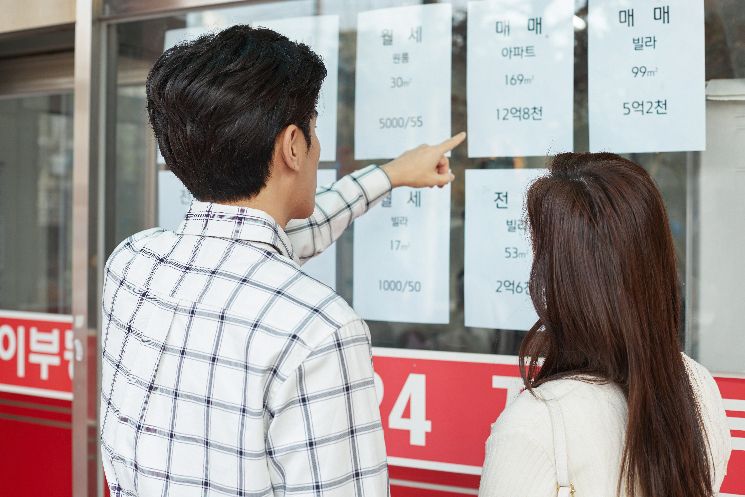
The proportion of first-time real estate buyers, which had been increasing alongside rising housing prices, has recently plummeted. The share of buyers in their 30s, who had led the first-time purchase trend, has also sharply declined. This is attributed to growing uncertainties in the housing market due to visible interest rate hikes and loan regulations, as well as a decrease in purchasing power.
According to the Court Registry Information Plaza on the 7th, the number of first-time real estate (collective buildings) acquirers nationwide last month was 37,143. This figure represents the number of buyers who applied for ownership transfer registration through sales and acquired real estate for the first time in their lives.
The number of first-time acquirers began to surge sharply from last year when housing prices soared steeply. The number of first-time real estate acquirers, which was around 35,800 at the beginning of last year, steadily increased to reach 58,586 by the end of the year, marking the highest point under the current administration. In the first half of this year, the number fluctuated between 45,000 and 54,000, consistently showing higher figures compared to the same months of the previous year.
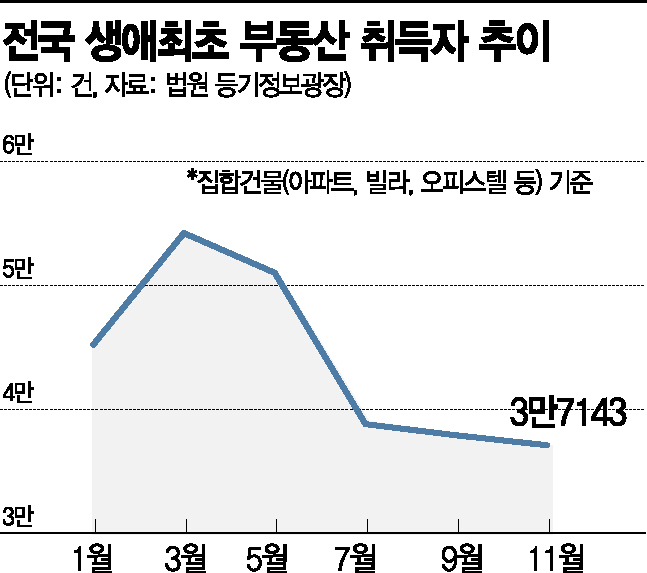
However, the buying trend sharply declined in the second half of the year. The number of first-time real estate acquirers, which was 51,046 in May, dropped drastically to 36,984 in June and has since remained in the 30,000 range. The proportion of first-time acquirers among all sales transactions also decreased from an average of 36% in the first half to 33% in the second half.
The contraction of first-time buying is evaluated to be related to the behavior of buyers in their 30s, who had driven 'panic buying.' As government loan regulations and weakened buying sentiment became more pronounced, the 'all-in' apartment purchases by people in their 30s gradually decreased.
According to monthly buyer age group statistics released by the Korea Real Estate Board, the share of apartment sales transactions by people in their 30s in Seoul was 34.02% in October, marking the lowest point this year. Compared to last month (38.84%), it fell by 4.82 percentage points, and the difference is significant compared to January and July this year when the transaction share approached 40%. The combined purchase share of buyers in their 20s and 30s also recorded 40.02% in October, the lowest level this year except for April (39.27%).
In Seoul, where the market price for 84㎡ (exclusive area) units in outer areas exceeds 700 to 800 million KRW, the burden of purchase has increased. Recently, the government has strengthened loan regulations and raised interest rates, creating an atmosphere of weakened buying sentiment among young people. Online, there are many posts expressing concerns about interest burdens after 'all-in' purchases. Since they take out loans excessively while having relatively low income and assets to buy apartments, they are inevitably more vulnerable to interest rate hikes.

Meanwhile, it has been previously diagnosed that people in their 30s and 40s who currently do not own homes dream of owning their own house but are unable to buy one due to already skyrocketing housing prices and loan regulations.
In September, the Korea Research Institute for Construction Industry released a report titled "Analysis of Housing Purchase Capacity of Non-Homeowners in Their 30s and 40s in the Seoul Metropolitan Area," based on housing buyer data from the credit rating agency Korea Credit Bureau (KCB). The report stated, "The remaining non-homeowner group in their 30s and 40s currently does not have sufficient housing purchase capacity, especially non-homeowners in Seoul and Gyeonggi Province."
The report analyzed their purchasing power comprehensively by considering current assets of non-homeowners, total debt service ratio (DTI), loan-to-value ratio (LTV), and the amount that can be procured under current loan regulations. Purchasing power is defined as the sum of the maximum equity capital that can be raised to purchase a house and the amount that can be borrowed from financial institutions under the current level of financial regulations.
© The Asia Business Daily(www.asiae.co.kr). All rights reserved.



















