Controversy Over 'No Middle-Aged Zone' Campsites Not Accepting Reservations from Middle-Aged Couples
Increasing Number of Businesses Restricting Certain Age Groups
"Owner's Rights" vs "Promoting Discrimination" Sparks Public Debate
Experts Say "We Must Move Toward a Society Where Discomfort Coexists"
 A camping site that refuses to accept reservations from middle-aged couples has sparked controversy. The photo is unrelated to specific expressions in the article / Photo by Yonhap News
[Asia Economy Reporter Lim Juhyung] So-called 'No OO Zones' that prohibit entry by certain age groups are increasing. This time, controversy has erupted over a 'No Middle-Aged Zone' camping site that has set a usage rule refusing reservations from couples aged 40 and above.
The origin of 'No OO Zones' was the No Kids Zone. It emerged as some cafes and restaurants blocked entry of infants and toddlers, citing inconvenience to other customers. The problem is that such 'No OO Zones' have become grounds for 'discrimination' by excluding specific age groups. There are also concerns that 'No OO Zones' based on other criteria such as gender or identity could arise.
◆Middle-aged reservation ban? ... Controversy over 'No Middle-Aged Zone' camping site
Recently, controversy arose on social media and online communities over a notice from a 'No Middle-Aged Zone' camping site located in Seoul. According to the notice, "To provide a quiet and pleasant camping service, reservations are not accepted from groups, mixed-gender groups, female groups of five or more, male groups, and other guests outside the specified users," explaining that "this reservation restriction is taken for a desirable camping culture even at the cost of unavoidable business losses."
In particular, the company stated, "Even couples, except family members, aged 40 and above are not suitable and thus reservations are restricted." The camping site was designed to suit the tastes of young women in their 20s and 30s, and the damage caused by some middle-aged customers is so significant that other guests suffer, which is the reason given.
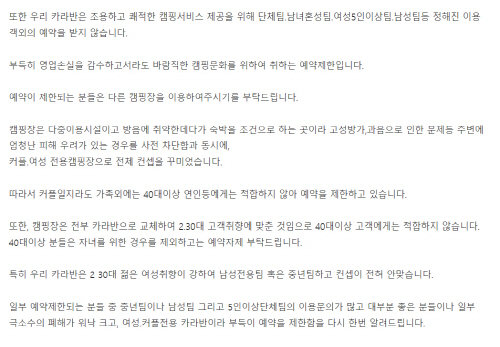
Netizens' reactions to this notice were divided. Some supported it, saying, "It seems to mean blocking adulterous couples," "It’s uncomfortable to have middle-aged people at the camping site," and "If you don’t like it, go somewhere else." On the other hand, some expressed discomfort, saying, "Are all older people a nuisance?" "They single out middle-aged people. It feels very unpleasant," and "Don’t generalize."
◆From infants to teenagers to middle-aged... Various types of 'No OO Zones'
The number of 'No OO Zones' that do not serve customers of certain age groups is increasing. There are various forms of 'No OO Zones,' such as 'No Middle-Aged Zone' that does not accept middle-aged customers, and 'No Teenager Zone' that does not accept teenage customers.
The origin of such businesses was the 'No Kids Zone.' It is a term referring to establishments that restrict entry of infants, children, and customers accompanied by them, a neologism coined in 2014.
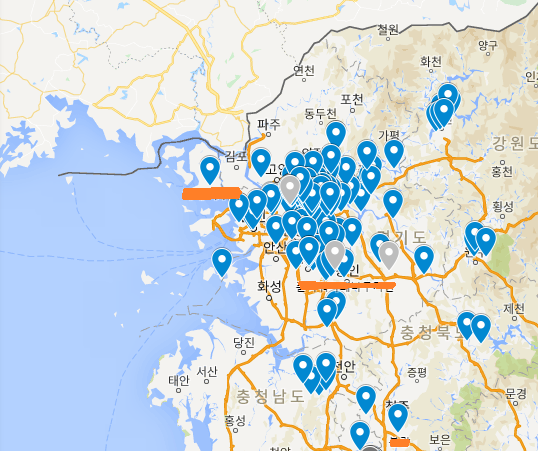 Domestic No-Kids-Zone businesses marked on Google Maps' 'No Kids Zone Map.' As of the 6th, more than 410 locations have been confirmed. / Photo by Internet homepage capture
No Kids Zones have been steadily increasing. According to the 'No Kids Zone Map,' which shows only No Kids Zone businesses on Google Maps, the number of No Kids Zones has grown from about 240 in 2017 to over 400 recently.
No Kids Zones are mainly set by cafes and restaurants that emphasize a quiet and cozy atmosphere. The purpose is to create a space for adults only by restricting children who run around or sometimes cry inside the store.
However, there is criticism that 'No OO Zones,' including No Kids Zones, promote discrimination. Critics point out that simply excluding customers of certain age groups is no different from 'discrimination.' There are also concerns that 'No OO Zones' based on gender, income level, or identity could permeate daily life.
Public reactions to 'No OO Zones' are sharply divided.
A 30-year-old office worker A said, "Just as consumers can choose the businesses they want, business owners also have the right to serve the customers they want. If you don’t like No Kids Zone cafes, why not go to cafes that allow children?"
Another 20-year-old office worker B said, "It is true that some irresponsible parents do not properly take care of their children," adding, "Because of a very small number of rude people, not only business owners but also many consumers suffer. It is wiser to create No Kids Zones to prevent such situations in advance."
On the other hand, a 30-year-old office worker C, who has young children, expressed concern, saying, "When I take my children to restaurants or cafes, I naturally feel scrutinized," and "If general stores are like this, I worry that the increase of places like No Kids Zones will justify discrimination against children."
◆Expert: "A good society is one where people different from me coexist"
Earlier, the National Human Rights Commission of Korea (NHRCK) ruled in 2017 that restricting store use based on age constitutes discrimination against children.
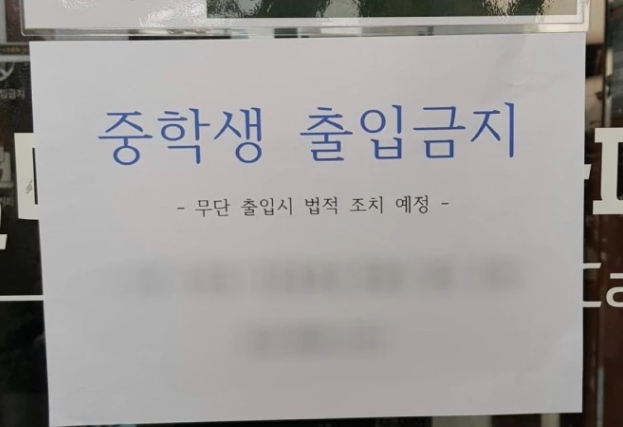 A 'Not Teenager Zone' study cafe with a notice prohibiting middle school students / Photo by Twitter capture
According to the current National Human Rights Commission Act, discrimination based on gender, religion, age, appearance, etc., without reasonable grounds is defined as a 'violation of the right to equality.'
Regarding this, the NHRCK pointed out, "Freedom of business is not unlimited," and "Not all guardians accompanying children cause great harm to business owners or other users, and there are other users who cause harm to others through rude behavior."
It added, "Completely excluding children and their guardians from using restaurants generalizes some cases without objective and reasonable grounds." However, the NHRCK’s ruling is only a 'recommendation' and has no legal binding force.
Experts urge the creation of a civil society that embraces a wider variety of people, even if it means tolerating some inconvenience.
Kim Jihak, director of the Korea Diversity Research Institute, said, "No Kids Zones and similar issues relate to the right not to be discriminated against, and also involve issues like the freedom of small business owners, so it is not easy to resolve," but pointed out, "Excluding customers based on specific identities such as age is a negative direction."
He continued, "Rather than simply blocking entry of customers of certain age groups, if businesses first set guidelines and ask customers to follow those standards, discriminatory elements would be greatly reduced," emphasizing, "Even if there are some inconveniences, sharing space with people different from oneself is a better space and a way to move toward a better society."
© The Asia Business Daily(www.asiae.co.kr). All rights reserved.



















