Starting February Next Year,
Vaccination Pass Applied to Ages 12-18 Sparks Controversy
Prime Minister Kim: "Unvaccinated Students
May Serve as Virus Transmission Vectors"
Canada's Vaccination Completion Rate for Ages 12-17
Exceeds 83%, Highest Rate
Israel Promotes Third Dose Vaccination
UK Joint Committee on Vaccination
Recommends Receiving Second Dose
[Asia Economy reporters Seo So-jeong and Lee Chun-hee] As the government decided to apply the vaccination certificate and negative test confirmation system (quarantine pass) to adolescents aged 12 to 18 in Korea starting next February, controversies have intensified, prompting the government to recommend vaccination for adolescents by citing overseas cases. With the severe domestic COVID-19 outbreak and the spread of the new Omicron variant, the government believes vaccination for adolescents can no longer be delayed.
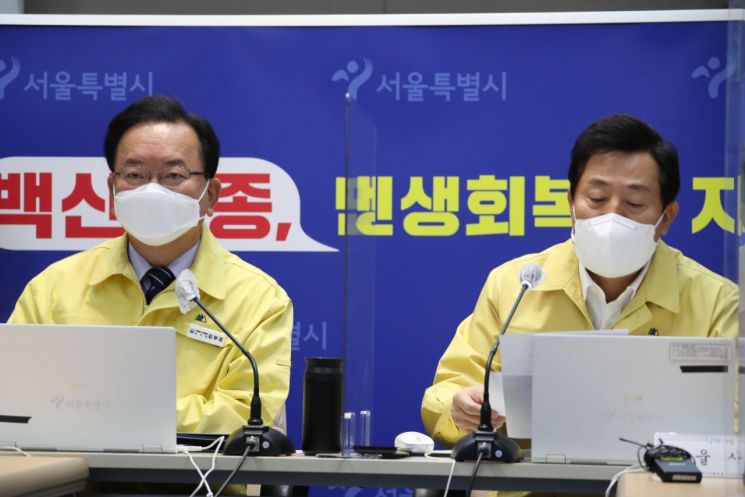
◆Government's all-out effort for adolescent vaccination= On the 6th, Prime Minister Kim Boo-kyum, in an interview with KBS radio, addressed opposition voices against the government's plan to expand the quarantine pass to adolescents, stating, "Unvaccinated students can act as vectors for virus transmission," and urged active cooperation for vaccination. Prime Minister Kim explained, "There seems to be distrust among parents, but foreign countries have reached the conclusion that vaccinating adolescents helps overcome difficulties, so they are doing the same."
He said, "When vaccinations were conducted for this year's college entrance exam candidates, there were almost no serious aftereffects," adding, "One person died about 80 days after vaccination, but that student had acute leukemia." Prime Minister Kim emphasized, "There is no need to worry too much about aftereffects," and "The vaccine supply and medical institutions are sufficiently prepared to allow vaccinations after final exams."
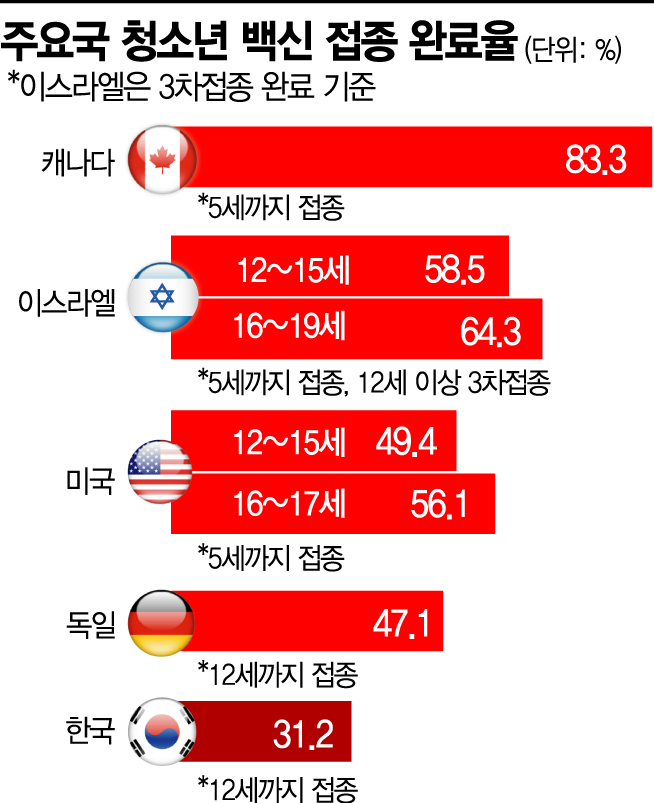
According to the Central Disease Control Headquarters, among 2.77 million adolescents aged 12 to 17 in Korea, 1.34 million have received the first dose of the COVID-19 vaccine. The vaccination rate is 48.3%, which has not yet exceeded half. The completion rate is also only 31.2%.
Vaccination rates in major overseas countries show considerable variation. Canada, which approved the Pfizer vaccine for those aged 16 and over in December last year and expanded the vaccination age to 12-15 in May, shows the highest vaccination rate. As of the 27th of last month (local time), the first-dose vaccination rate for those aged 12 to 17 reached 88.0%, and the completion rate rose to 83.3%.
On the other hand, the vaccination rate in the United States, which started vaccinations for those aged 16 and over and 12-15 around the same time, is somewhat lower. According to the U.S. Centers for Disease Control and Prevention (CDC), as of the 2nd, the first-dose vaccination rate for adolescents in the U.S. is 59.4% for ages 12-15 and 65.6% for ages 16-17. The full vaccination rates are 49.4% for ages 12-15 and 56.1% for ages 16-17.
◆Israel proceeds with third dose vaccination= Israel, which started vaccinating those aged 12-15 in June and announced in August that it would administer a third dose five months later to this group, has completed the third dose for 58.5% of those aged 12-15 and 64.3% of those aged 16-19. Germany, which began vaccinating adolescents with underlying conditions in June and expanded the target to all adolescents aged 12 and over due to the spread of the Delta variant, has vaccinated 47.1% of those aged 12-17.
On the 29th of last month, the UK's Joint Committee on Vaccination and Immunisation (JCVI) recommended that adolescents aged 12-15, who have only received the first dose, receive a second dose at a 12-week interval. The UK had decided to administer only one dose to adolescents in September due to concerns about myocarditis and pericarditis side effects. However, with the spread of the Omicron variant, they decided to restore the number of doses to the original plan.
The United States is considering a third dose for adolescents following Israel. Currently, Pfizer has applied to the U.S. Food and Drug Administration (FDA) for emergency use authorization (EUA) for a third dose for adolescents aged 16-17. The U.S. began vaccinating children aged 5-11 with the Pfizer vaccine last month. Canada is expected to start vaccinations for this age group around next month.
Additionally, Cuba began vaccinating children aged 2 and over with its domestically developed vaccine 'Soberana02' starting in September, marking the first vaccination for infants and toddlers. China also started vaccinating children aged 3-11 in October, planning to complete vaccinations for approximately 160 million children in this age group within this year.
© The Asia Business Daily(www.asiae.co.kr). All rights reserved.
![Clutching a Stolen Dior Bag, Saying "I Hate Being Poor but Real"... The Grotesque Con of a "Human Knockoff" [Slate]](https://cwcontent.asiae.co.kr/asiaresize/183/2026021902243444107_1771435474.jpg)

















