The Top Individual Net Buyer This Month Is 'KODEX20SeonmulInverse2X'
350 Billion KRW Net Purchase for 3 Consecutive Trading Days... 3 Times More Than 2nd Place
Judged That KOSPI Trend Has Not Reversed Amid COVID-19 and Economic Policy Uncertainty
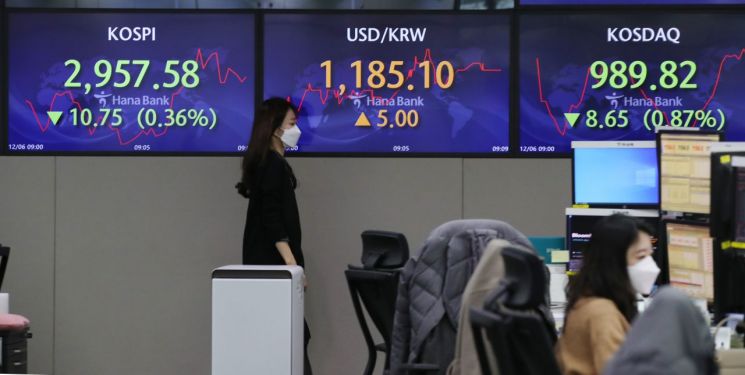 On the morning of the 6th, KOSPI started lower in early trading as employees were working in the Hana Bank dealing room in Jung-gu, Seoul.
 [Image source=Yonhap News]
[Asia Economy Reporter Minwoo Lee] This month, the stock most purchased by individual investors was the ‘Multiply Inverse’ product that profits when the KOSPI falls. Although the KOSPI rebounded after hitting a yearly low at the end of last month, individual investors appear to have taken short-term measures due to ongoing uncertainties from domestic and international factors such as the new COVID-19 variant ‘Omicron’.
According to the Korea Exchange on the 6th, the most purchased stock by individual investors through the 3rd of this month was ‘KODEX 200 Futures Inverse 2X’. This product moves inversely at twice the rate of the KOSPI 200 index?if the index rises 1%, the product falls 2%, and if the index falls 1%, the product rises 2%. It is commonly called ‘Gopbus’ (Multiply + Inverse). Individual investors bought a total of 325.6 billion KRW worth of this exchange-traded fund (ETF) over three trading days. This amount is nearly three times more than the second highest net purchase by individuals, SK Square, which was 114.2 billion KRW during the same period.
After hitting a yearly low of 2,822.73 during trading on the 30th of last month, the KOSPI rose for three consecutive trading days to reach the 2,900 range, but it is still considered not to be a trend reversal. This is because the fundamental conditions that would justify expectations for economic improvement have not yet recovered. In fact, the November employment data released by the U.S. Department of Labor on the 3rd (local time) was somewhat confusing. Nonfarm payrolls increased by 210,000, falling far short of the expected 573,000 and the previous month’s 546,000. On the other hand, the unemployment rate dropped sharply to 4.2% from 4.6% the previous month, and the labor force participation rate reached 61.8%, the highest since March last year.
Nevertheless, many Federal Reserve officials, including Chairman Jerome Powell, continue to express hawkish views, wary of inflation. Given the mismatch between the economy and monetary policy, it is analyzed that a trend reversal after the domestic and international stock markets pass their lows will be difficult. Daishin Securities expects the stock market turning point to occur in the first quarter of next year when economic recovery becomes visible or hawkish monetary policy retreats. Researcher Kyungmin Lee of Daishin Securities explained, "It will be effective to approach the low 2,800 range with a short-term trading perspective and reduce stock holdings as it approaches the 3,000 level."
© The Asia Business Daily(www.asiae.co.kr). All rights reserved.

















