From October, 57% of Bidders in Seoul Region Offered Over 900 Million KRW
Apgujeong Shin Hyundai 183㎡ Sold for 6.532 Billion KRW... About 106.5 Million KRW per Pyeong
No Obligation for Actual Residence or Funding Plan Guidance upon Auction Winning
[Asia Economy Reporter Ryu Tae-min] Recently, due to the government's loan regulations and the increased comprehensive real estate tax burden on multi-homeowners, a preference for a ‘smart single property’ has become prominent even in the auction and public sale markets. High-priced apartments exceeding 1.5 billion KRW are already subject to loan bans, so they are relatively less affected by loan regulation shocks. Additionally, winning an auction frees buyers from related regulations such as the Land Transaction Permission System and the obligation to submit a Fund Procurement Plan, making them highly popular.
According to Gigi Auction, a court auction specialist company, among bidders in auctions held in Seoul during October and November, 57% bid on apartments priced at 900 million KRW or more. This figure was relatively low at an average of 29.7% from January to September this year but has surged recently. This phenomenon appears to be influenced by the government's strengthened regulations on multi-homeowners, such as the comprehensive real estate tax, intensifying the preference for a ‘smart single property’ among high-net-worth individuals.
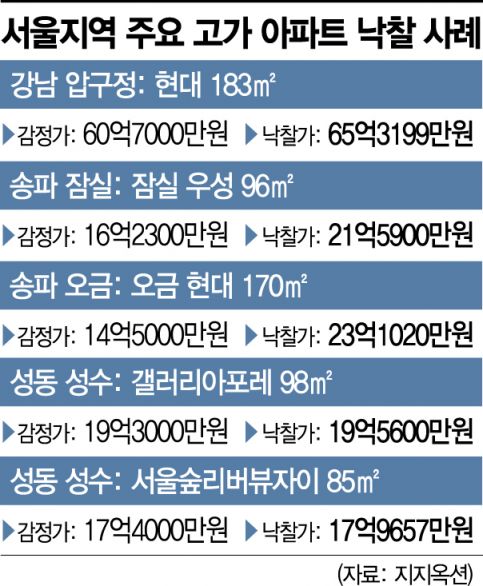
Looking at actual winning cases, a 183㎡ (exclusive area) apartment in Shinhyundai, Apgujeong-dong, Gangnam-gu, Seoul, was sold for 6.532 billion KRW at an Onbid public sale on the 11th of last month. This amount is 462 million KRW higher than the appraised value of 6.07 billion KRW, which translates to about 106.5 million KRW per pyeong. Currently, the asking price for this size in the market is between 6.5 billion and 7 billion KRW.
On the 8th of last month, 28 bidders participated en masse in the auction of a 170㎡ Hyundai Apartment in Ogeum-dong, Songpa-gu, Seoul, held at the Seoul Central District Court. Due to fierce competition, the property was sold for 2.3102 billion KRW, which is 860.2 million KRW higher than the appraised value of 1.45 billion KRW.
In Seongdong-gu, a 98㎡ unit in Galleria Foret, Seongsu-dong 1-ga, was sold for 1.956 billion KRW on the 15th of last month. Nearby, an 85㎡ unit in Seoul Forest Riverview Xi, Haengdang-dong, was also sold above the appraised value at 1.79657 billion KRW on the same day.
One major reason is that winning an auction exempts buyers from various regulations such as land transaction permission and fund procurement plans. Unlike general sales, auctions are not subject to the Land Transaction Permission System, so there is no obligation for actual residence after winning. Since it is not subject to actual transaction registration, there is no need to submit a separate fund procurement plan. For example, a 96㎡ unit in Woosung 4th Apartment, Jamsil-dong, Songpa-gu, Seoul, was sold for 2.159 billion KRW on the 15th of last month, which is 536 million KRW higher than the appraised value of 1.623 billion KRW. Currently, Jamsil-dong is designated as a land transaction permission zone, and this complex is undergoing a reconstruction project.
Lee Joo-hyun, senior researcher at Gigi Auction, explained, “Due to government regulations on multi-homeowners, bids on mid- to low-priced apartments in the auction market have decreased, while demand has concentrated on high-priced complexes, causing polarization. Especially, auctions are free from the Land Transaction Permission System and the obligation to submit fund procurement plans, so they seem to be highly preferred by investors and actual buyers.”
© The Asia Business Daily(www.asiae.co.kr). All rights reserved.


















