Agreement Signed to Support Digital Transformation and Carbon Neutrality in the Food Sector
Introduction of Smart Factories and Smart HACCP... Collaboration on Joint Research and New Business Initiatives
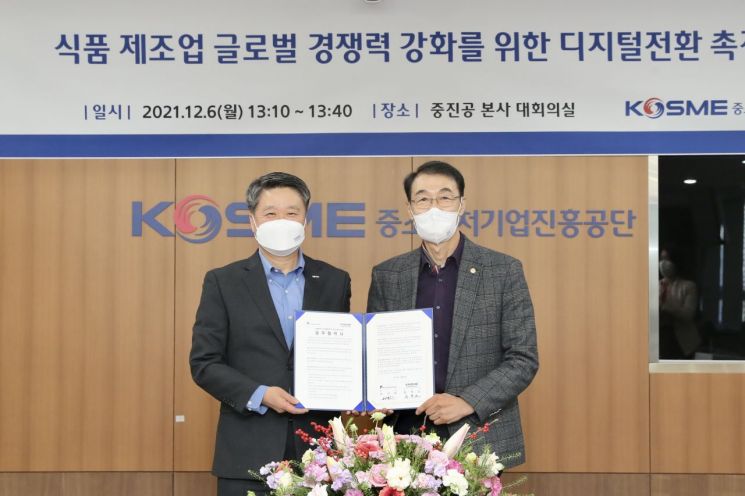 On the 6th, at the Korea SMEs and Startups Agency-HACCP Certification Institute business agreement ceremony, Kim Hak-do, Chairman of the Korea SMEs and Startups Agency (left), and Jo Gi-won, Director of the HACCP Certification Institute, are posing for a commemorative photo.
[Asia Economy Reporter Kim Cheol-hyun] The Small and Medium Business Corporation (Chairman Kim Hak-do, hereinafter referred to as SBC) announced on the 6th that it has signed a 'Digital Transformation and Carbon Neutrality Support Agreement in the Food Sector' with the Korea Food Safety Management Certification Institute (Director Cho Ki-won, hereinafter referred to as HACCP Certification Institute) to strengthen the competitiveness of K-Food.
Both parties agreed to cooperate in supporting the digital transformation of small and medium venture enterprises in the food sector by introducing and managing smart factories and smart HACCP, and to establish an integrated support system through sharing business status and data of both organizations. In addition, they plan to secure competitiveness and lay the foundation for sustainable growth by promoting new projects such as joint research in the food industry, performance analysis, and development of diagnostic evaluation models.
Prior to this, SBC conducted a research project in August on the digital transformation performance of the food industry. As a result, the sales growth rate before and after the introduction of smart factories in food manufacturing companies was 13.9%, which was higher compared to 3.42% in general manufacturing. Even when comparing only the food sector, it was confirmed that the 5-year average annual growth rate and employment rate of companies that introduced smart factories were better than those that did not, indicating that the food sector has significant effects from digital transformation.
Chairman Kim Hak-do said, "Although the level of performance improvement due to digital transformation is higher compared to other industries, the proportion of food manufacturing companies that have introduced smart factories is low at 1.78%. SBC will enhance the effectiveness of policy support by providing customized linkage support tailored to the characteristics of the industry, such as post-management of smart factories, and will lead the digital transformation and carbon neutrality of small and medium enterprises."
© The Asia Business Daily(www.asiae.co.kr). All rights reserved.

















