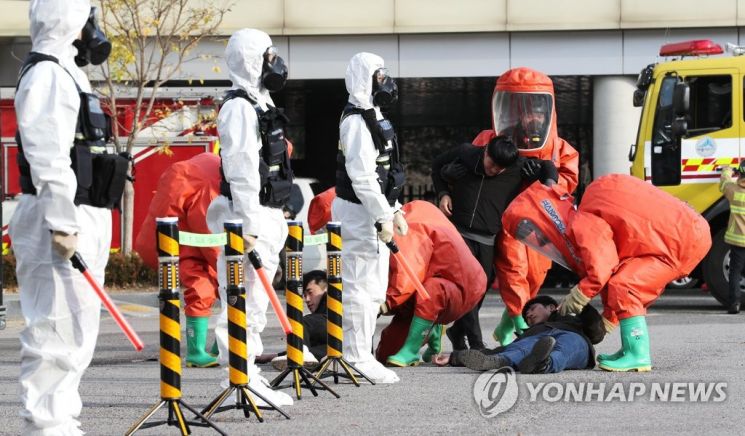
 On the afternoon of the 26th of last month, firefighters conducted a chemical, biological, radiological, and nuclear (CBRN) terrorism response drill at the Sejong Police Agency Mobile Unit within the Government Complex Sejong in Sejong City during the '2021 Government Complex Sejong Anti-Terrorism Comprehensive Drill.'
 [Photo by Yonhap News]
[Asia Economy Reporter Seoyoung Kwon] The 'mental health' of firefighters who face disasters has been revealed to be at a very concerning level.
On the 5th, the National Fire Agency announced the analysis results of the '2021 National Firefighter Mental Health Survey,' conducted in collaboration with the Bundang Seoul National University Hospital Public Medical Project Team between March 3 and 22. This survey was conducted on 53,980 firefighters nationwide (92.6% of all firefighters) through the 'Firefighter Health and Safety Management System.'
According to the survey, 22.8% of respondents reported sleep disorders due to work-related stress and other issues, which, although lower than in 2019 (25.3%) and 2020 (23.3%), remains at a high level. Additionally, 5.7% of respondents reported symptoms of post-traumatic stress disorder (PTSD). This is similar to the level in 2019 (5.6%) and higher than last year (5.1%). The percentage of respondents experiencing depressive symptoms was 4.4%, an increase of 0.5 percentage points from 3.9% in last year's survey.
PTSD and depression showed a sharp increase during the first to fourth years of firefighter service, followed by a gradual rise thereafter. Respondents with problematic drinking habits accounted for 22.7% of the total, and those in the high-risk group with frequent thoughts of extreme behavior made up 4.4% of respondents.
The National Fire Agency analyzed that the increase in firefighters reporting PTSD and depression is related to the prolonged COVID-19 pandemic. In particular, 1.4% of respondents said they needed immediate help due to stress and trauma from COVID-19 duties. Stress-inducing factors related to COVID-19 duties included discomfort with personal protective equipment (46%), physical fatigue (26%), and dealing with civil complaints (22.1%).
※ If you have difficult-to-talk-about concerns such as depression or know family or acquaintances experiencing such difficulties, you can receive 24-hour professional counseling at suicide prevention hotlines ☎1577-0199, Hope Phone ☎129, Lifeline ☎1588-9191, and Youth Phone ☎1388.
© The Asia Business Daily(www.asiae.co.kr). All rights reserved.

















