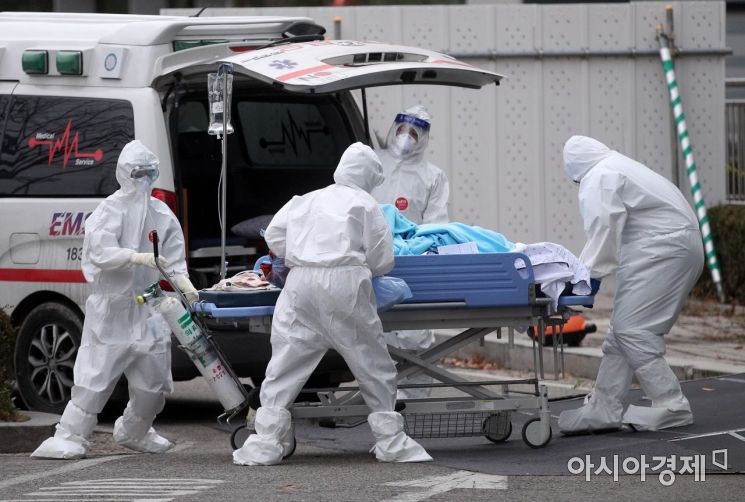
 As the number of critically ill COVID-19 patients continues to reach record highs daily, medical staff at Seoul Medical Center in Jungnang-gu, Seoul, are transferring patients on the 2nd./Photo by Kim Hyun-min kimhyun81@
[Asia Economy Reporter Kwon Seoyoung] As the operation rate of beds dedicated to severe COVID-19 patients has significantly increased, citizens undergoing home treatment are expressing their suffering.
On the 5th, the Central Disaster and Safety Countermeasures Headquarters of the Ministry of Health and Welfare announced that as of 5 p.m. the previous day, there are 1,237 beds nationwide dedicated to severe patients, of which 978 beds (79%) are in use, leaving only 259 beds available for admission. The ICU bed utilization rate in Seoul is 91.1%, with 318 out of 349 beds in use. Incheon also recorded 91.1% (72 out of 79 beds in use), while Gyeonggi Province was slightly lower at 79.0% (289 out of 366 beds).
Currently, the Central Disaster and Safety Countermeasures Headquarters is transferring patients to non-metropolitan areas if it is judged difficult to allocate beds within the metropolitan area. However, the nationwide ICU bed utilization rate is also high at 79.1%, with only one bed remaining each in the Gyeongbuk, Gangwon, Chungbuk, and Chungnam regions. Additionally, the infectious disease dedicated treatment bed utilization rate in the metropolitan area is 76.9% (4,097 out of 5,326 beds in use), and the operation rate of living treatment centers is reported to be 69.4%.
The number of patients waiting for bed allocation is also considerable. As of midnight on that day, the number of patients in the metropolitan area waiting for bed allocation for more than a day is 954, of whom 299 have been waiting for more than four days. Furthermore, 418 have been waiting for more than one day, 164 for more than two days, and 73 for more than three days. The number of patients waiting for beds outside the metropolitan area increased by 19 from the previous day to 23.
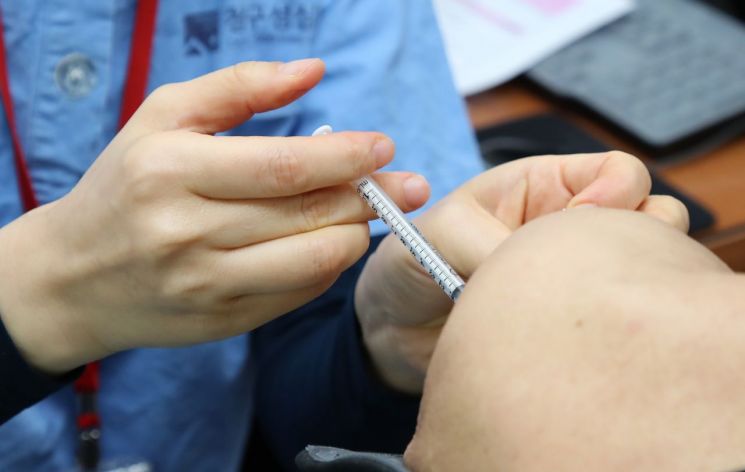 On the morning of the 4th, an elderly person is receiving the third booster shot of the Pfizer vaccine at Cheonggu Seongsim Hospital in Eunpyeong-gu, Seoul.
 [Photo by Yonhap News]
According to the Central Disaster and Safety Countermeasures Headquarters, the number of COVID-19 patients undergoing home treatment nationwide is 14,944. However, due to the policy shift focusing on home treatment, voices of suffering among citizens undergoing home treatment are emerging.
On the 3rd, various online communities posted complaints from COVID-19 patients and their families about the inconveniences of home treatment. One poster, who was diagnosed last month, said, "I am still not recovering and am undergoing home treatment, but I have stomach pain and feel like vomiting," adding, "I get anxious every night fearing the symptoms will worsen."
Another poster, who said they are undergoing home treatment with their pregnant wife in her eighth month and their three-year-old child, lamented, "Neither my child nor I can be admitted to a hospital; we feel like we are going to die."
Another writer, whose family of three all tested positive for COVID-19, recalled, "It was a harrowing 20 days." They added, "My cough worsened the day after isolation ended, but no hospital would accept me," and complained, "There are three people undergoing home treatment, but only one set of home treatment supplies was provided." They also claimed, "Food past its expiration date by three days was delivered, and since I had lost my sense of smell, if I had eaten it without checking, it could have been a serious problem."
Regarding this situation, Professor Jung Jaehoon of Gachon University’s Department of Preventive Medicine explained, "With measures such as strengthening social distancing, we need to buy as much time as possible over the next four weeks to reorganize the insufficient system, including home treatment and securing beds." Additionally, Professor Cheon Eunmi of the Respiratory Medicine Department at Ewha Mokdong Hospital expressed concern, saying, "If the home treatment system is maintained at the current level without support for medical personnel and beds, a situation where deaths occur frequently will soon arise."
© The Asia Business Daily(www.asiae.co.kr). All rights reserved.
![Clutching a Stolen Dior Bag, Saying "I Hate Being Poor but Real"... The Grotesque Con of a "Human Knockoff" [Slate]](https://cwcontent.asiae.co.kr/asiaresize/183/2026021902243444107_1771435474.jpg)

















