Among 13 Regions, 5 Increase Classes but Decrease Teacher Allocation Quotas
Seoul, Daegu, Gwangju, Gangwon See Greater Teacher Decrease than Class Decrease
Proportion of Temporary Teachers Rises from 3.3% in 2001 to 12.5% in 2021
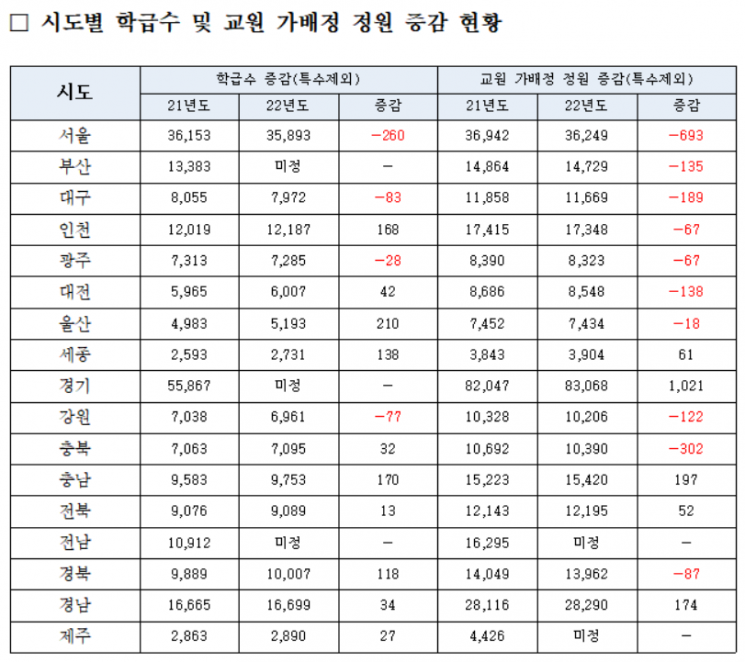 Number of Classes and Changes in Tentative Teacher Quotas by 13 Cities and Provinces. Excluding Busan, Gyeonggi, Jeonnam, and Jeju (Source: Korea Teachers and Education Workers Union, Office of Assemblyman Kim Byung-wook)
[Asia Economy Reporter Han Jinju] Concerns have been raised that regular teachers need to be increased as many regions are experiencing a decrease in teacher quotas despite an increase in the number of classes next year.
On the 5th, the Korea Federation of Teachers' Associations (KFTA) announced, based on the '2022 Status of Class Numbers and Teacher Quota Changes by City and Province' data submitted by 13 metropolitan and provincial offices of education to Assemblyman Kim Byung-wook's office, that in five regions (Incheon, Daejeon, Ulsan, Chungbuk, Gyeongbuk), the number of classes is increasing while the teacher quotas are decreasing.
In Seoul, Daegu, Gwangju, and Gangwon, the decrease in teacher quotas is significantly larger compared to the reduction in the number of classes.
In Seoul, the number of elementary classes decreases by 109, with a reduction of 369 teachers, and secondary classes decrease by 151 with a reduction of 324 teachers. In Daegu, elementary classes decrease by 63 with a reduction of 83 teachers, and secondary classes decrease by 20 with a reduction of 106 teachers.
In the case of secondary schools, where there is a shortage of teachers due to the introduction of the high school credit system, teacher quotas are decreasing in seven regions (Busan, Incheon, Gwangju, Daejeon, Ulsan, Chungbuk, Gyeongbuk).
The KFTA stated, "While the number of students per class was supposed to be reduced to 20 or fewer to improve classroom conditions, only regular teachers are being cut," and urged, "The government, Ministry of Education, and metropolitan and provincial offices of education must expand the number of regular teachers in proportion to the increasing number of classes."
They added, "If the number of classes increases but teacher quotas decrease, it will inevitably be filled with non-regular teachers such as part-time and temporary teachers, which raises serious concerns about the decline in education quality due to the increase in itinerant teachers and reduction of subject-specialized teachers."
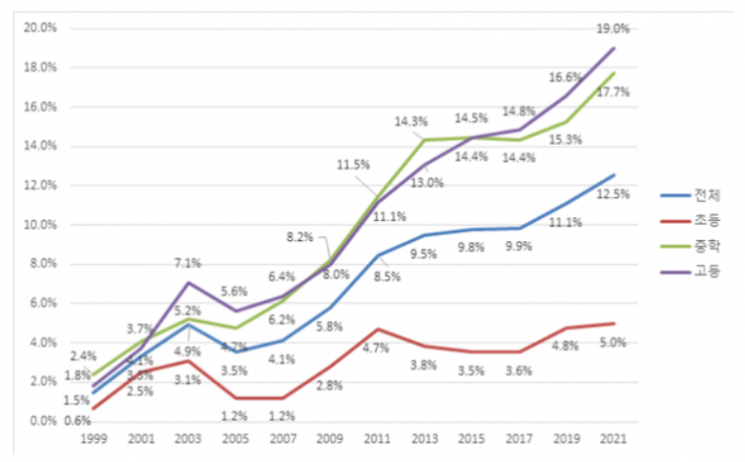
According to the Korea Educational Development Institute, the ratio of temporary teachers to regular teachers increased from 3.3% in 2001 to 12.5% this year. In high schools, 19% of teachers are temporary non-regular teachers, meaning 1 in 5 teachers, and in middle schools, 17%, or 1 in 6 teachers, are temporary non-regular teachers.
According to data submitted by the Ministry of Education to the National Assembly, among 103,188 classes in elementary, middle, and high schools in the metropolitan area, 55.9% (57,675 classes) have 25 or more students.
The KFTA pointed out, "According to research by the Korea Educational Development Institute and others, to properly implement the high school credit system as intended, about 88,000 more teachers are needed than currently."
The KFTA emphasized, "To protect students from COVID-19 and to provide individualized future education, the number of students per class must be reduced, and fundamental measures for teacher supply and demand are essential to realize policies such as the high school credit system."
© The Asia Business Daily(www.asiae.co.kr). All rights reserved.


















