3-Car Train Sets, Total 12 Sets Operating... Spacious Passenger Connection Corridors, Capable of Transporting Up to 130,000 Passengers Daily
Lines 1, 2, 7, and 9 Connected, Greatly Improving Transportation Convenience in Southwest Seoul... Travel from Saetgang Station to Seoul National University in Just 16 Minutes
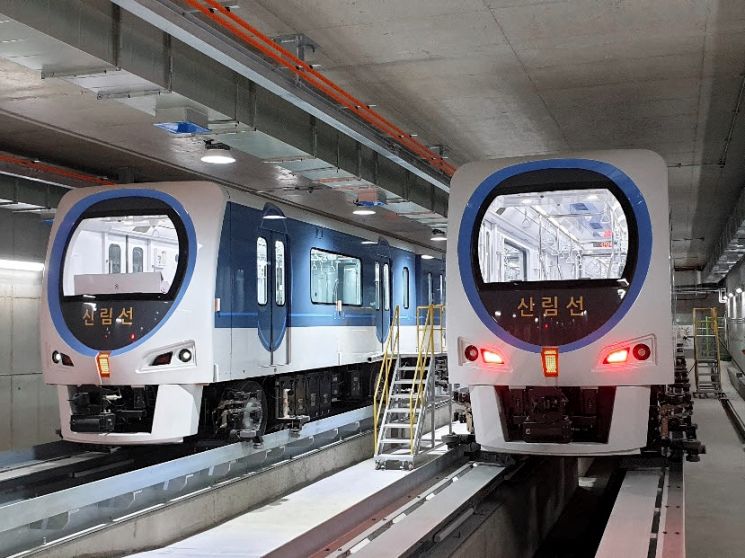
[Asia Economy Reporter Lim Cheol-young] Seoul City announced on the 6th that it will actively promote the comprehensive railway test operation for facility verification tests and commercial trial runs across the entire section in line with the opening of the Sillim Line urban railway in May next year.
The comprehensive railway test operation consists of a ‘facility verification test,’ which involves deploying trains to check track structures and vehicle connectivity, and a ‘commercial trial run,’ which verifies the train operation system, railway workers’ proficiency, and commercial services.
The ‘Sillim Line urban railway’ is a route connecting a total length of 7.8 km from Saetgang Station on Line 9, passing through Daebang Station on Line 1, Boramae Station on Line 7, and Sillim Station on Line 2, to Seoul National University. It includes one train depot and four transfer stations, with a total of 11 stations. Trains will operate with 12 sets of 3-car formations, designed with open gangways between cars and an integrated driver’s cabin and passenger compartment to provide a sense of openness for passengers.
The headway will be 3.5 minutes during rush hours and 4 to 10 minutes during normal times, with a maximum operating speed of 60 km/h, capable of transporting up to 130,000 passengers per day.
The ‘Sillim Line urban railway’ will be the first in Korea to introduce the next-generation unmanned operation system using the domestically developed signaling system (KRTCS·Korea Train Control System). Without a driver, train departure, stopping, route control, vehicle doors, and screen doors can be adjusted and controlled from the integrated control center, reducing train accidents and malfunctions caused by human errors of drivers.
Additionally, the Sillim Line is equipped with an LTE-based train wireless communication network (LTE-R), enabling simultaneous wireless voice, video, and data communication among the integrated control center, maintenance personnel, and other train operation staff, enhancing safety and convenience. In particular, it is linked with the national disaster safety communication network (PS-LTE), allowing rapid response with related disaster agencies such as police and fire departments during emergencies like fires, further ensuring passenger safety.
Each station is equipped with air purification devices applying a five-stage filtering system capable of capturing ultrafine dust down to PM-2.5 (50㎍/㎥) to provide passengers with a comfortable and clean indoor environment. Inside the trains, ultrafine dust sensors measure air quality and automatically operate the air purification system.
Lee Jung-hwa, Director of Seoul City’s Urban Infrastructure Headquarters, said, “Connecting with Seoul Metro Lines 1, 2, 7, and 9, the Sillim Line will greatly improve transportation convenience in the southwestern region of Seoul.” He added, “The travel time from Yeouido Saetgang Station to Seoul National University is only 16 minutes, allowing much faster travel to the same destination compared to existing subways or buses.”
© The Asia Business Daily(www.asiae.co.kr). All rights reserved.

















