An open space accessible from any direction, spanning 1,662㎡ (502 pyeong) across basement level 1 to ground level 3... A 'Lakibium-type library' serving as a complex cultural space combining library, archive, and museum functions
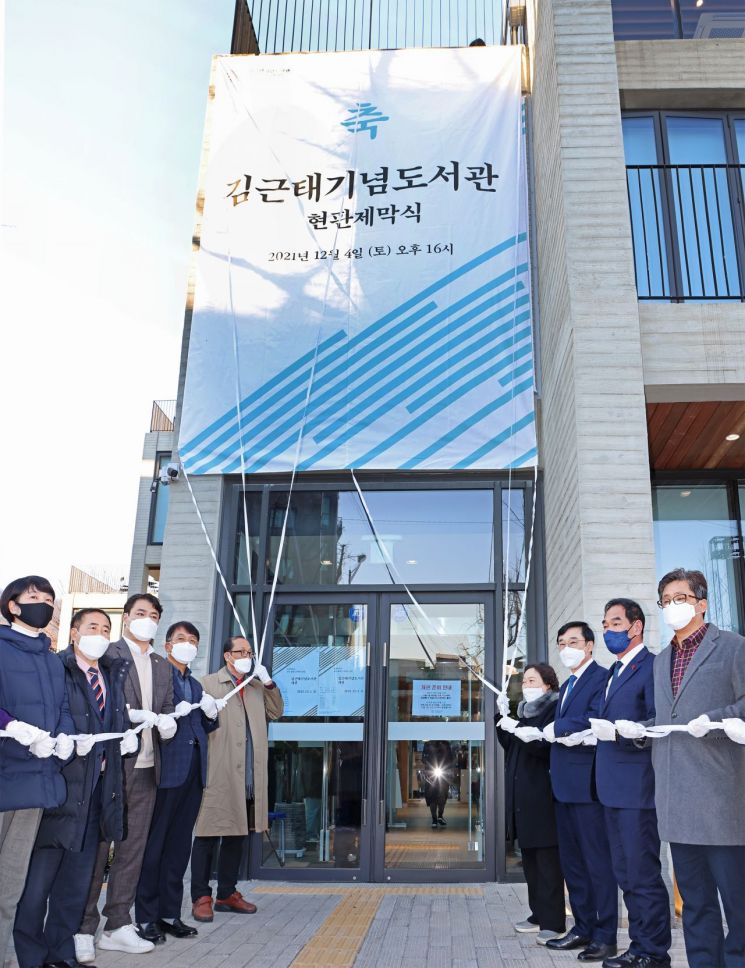
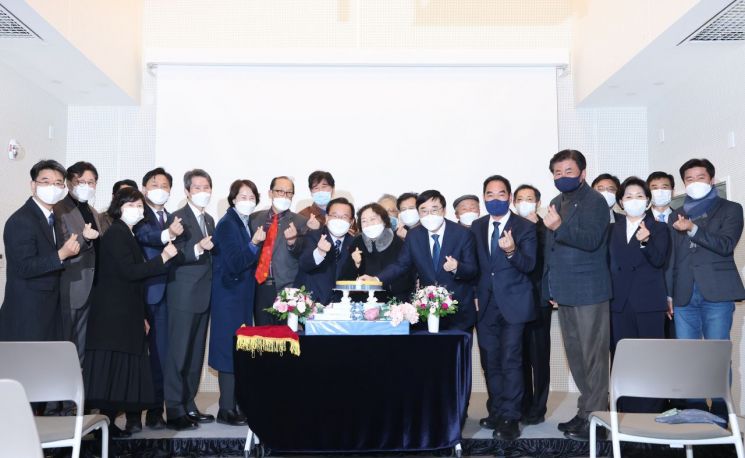
[Asia Economy Reporter Park Jong-il] The 'Kim Geun-tae Memorial Library,' a democracy and human rights specialized library honoring the late Kim Geun-tae, a symbol of South Korea's democratization movement, opened its doors on the 4th.
Located at the foothills of Dobongsan Mountain in Dobong-gu (14 Dobongsan-gil, Dobong-gu), the Kim Geun-tae Memorial Library held an opening ceremony at 3 p.m. attended by Prime Minister Kim Boo-kyum, Dobong-gu Mayor Lee Dong-jin, members of the National Assembly, and city and district council members. The event included a plaque unveiling and ribbon-cutting, followed by tours of the interior and exterior with local residents.
The Kim Geun-tae Memorial Library is operated under the vision of "a democracy and human rights specialized library realizing a warm community culture" to remember the late Kim Geun-tae, who was awarded the Robert F. Kennedy Human Rights Award in 1987 and recognized as a conscience prisoner worldwide by the Hamburg Foundation in Germany in 1988 for his dedication to democracy and human rights. It also features a 'Lachivium-type library,' a complex cultural space that functions as both an archive and a museum preserving and exhibiting records related to democracy.
The library is built on a site area of 1,361㎡ with a total floor area of 1,662㎡ (502 pyeong), consisting of three above-ground floors and one basement floor. It was designed as an open space accessible from any direction, embodying the spirit of the late Kim Geun-tae, who sought communication with many people.
The interior of the library is divided into the ‘Main Building,’ which includes planned exhibitions, reading rooms, a multipurpose auditorium, and storage rooms, and the ‘Exhibition Hall,’ where permanent exhibitions are held.
First, the basement floor of the main building houses ‘Sangsanggot,’ a space for clubs, supporters, and makerspaces supporting creative activities, as well as ‘Storage Room 2,’ which collects and preserves democracy and human rights-related records.
On the first floor of the main building are ‘Democracy Playground,’ a reading and educational space for children (infants and toddlers), and ‘Saenggakgot 1,’ a general reading room. The second floor includes ‘Space, Maru,’ an exhibition, performance, and lecture hall; ‘Saenggakgot 2,’ another general reading room; and ‘Geuntae Saenggakgot,’ a specialized bookshelf featuring works on Kim Geun-tae and democracy themes. The third floor houses ‘Saenggakgot 3,’ a general reading room.
The ‘Main Building’ emphasizes social science collections appropriate for a democracy and human rights specialized library. It uses book classification names inspired by Kim Geun-tae’s democratic values, such as “Courage to Converse” (General Works), “Dream of Democracy” (Social Sciences), “Peace is Food” (Language), and “Hope is Strong” (Literature). These phrases are attached as spine labels on all books to embody the library’s identity.
Next, the ‘Exhibition Hall’ is a space for ongoing exhibitions related to democracy and human rights. The first and second floors serve as ‘Memory Places 1 and 2’ for permanent and planned exhibitions of records, while the third floor features ‘Memory Place 3,’ an exhibition space exploring the life of Kim Geun-tae as a human being, along with ‘Storage Room 1’ for records.
Exhibitions are operated as planned and permanent. The first planned exhibition commemorates the 10th anniversary of the late Kim Geun-tae with the memorial exhibition “The Future to Come, Kim Geun-tae.” Participating artists illuminate Kim Geun-tae’s life and spirit from various perspectives, recreating them through video, installation, sculpture, and painting in their own visual languages. The permanent exhibition consists of displays expressing South Korea’s democratization, marked by Kim Geun-tae’s records and his lifelong dedication to the cause.
The library operates from 9 a.m. to 8 p.m. on weekdays and from 9 a.m. to 5 p.m. on weekends, closed every Monday and on legal holidays. On the opening day, visitors can experience democracy and human rights-related events throughout the library, including “Human Rights through Books,” “Making Human Rights Respect Badges,” and “Drawing Human Rights.”
Dobong-gu is preparing community facilities centered on peace and culture, including the Kim Geun-tae Memorial Library. A representative example is ‘Peacecho Park,’ a 5,118㎡ outdoor music venue located at 1-8 Dobong-dong. This outdoor amphitheater, shaped like a sunken round bowl, amplifies sound through natural reverberation without audio equipment, making it an eco-friendly structure.
This facility was a key project initiated by Dobong-gu Mayor Lee Dong-jin, who had been considering ‘carbon neutrality’ and ‘revitalization of performance culture.’ Inspired by a naturalistic performance hall in Wonju, Gangwon Province, the project began in August 2019 and is scheduled for completion in December this year.
Located next to the Peace Culture Base, this facility commemorates the noble sacrifices of 16 countries that participated in the Korean War, symbolizing a call to sing and dance for peace on the site marked by the war’s aftermath.
After the completion of ‘Peacecho Park,’ the district plans to hold outdoor music performances for local residents and use the space for various stage genres such as music and dance.
Additionally, to promote the two newly introduced facilities and raise awareness of Dobong-gu’s cultural foundation, a press briefing was held on November 24, inviting Seoul-based reporters. Accompanied by the press corps, Mayor Lee Dong-jin toured the facilities, explaining their purpose and progress, and provided an opportunity to experience them firsthand.
Mayor Lee Dong-jin of Dobong-gu stated, “With the sequential completion of meaningful cultural facilities based on Dobong-gu’s history within this year, the capacity of ‘Cultural City Dobong’ has been further strengthened. Through the Lachivium-type ‘Kim Geun-tae Memorial Library,’ which combines the functions of a library, archive, and museum, and the eco-friendly music performance facility ‘Peacecho Park,’ I hope Dobong-gu will emerge as a hub where local cultural artists gather and interact.”
© The Asia Business Daily(www.asiae.co.kr). All rights reserved.
![Clutching a Stolen Dior Bag, Saying "I Hate Being Poor but Real"... The Grotesque Con of a "Human Knockoff" [Slate]](https://cwcontent.asiae.co.kr/asiaresize/183/2026021902243444107_1771435474.jpg)

















