Recent Attention on the Return of Foreign Workforce Supply
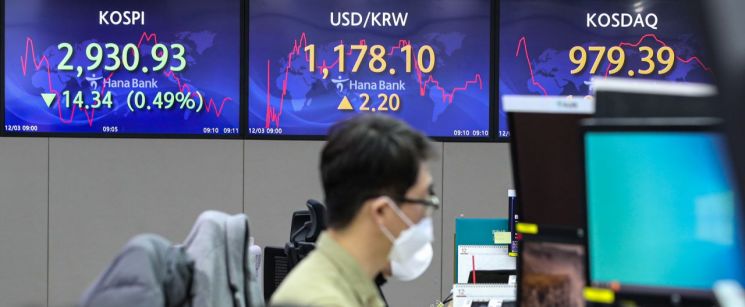 On the morning of the 3rd, the KOSPI, KRW/USD exchange rate, and KOSDAQ indices were displayed on the screen of the Hana Bank dealing room in Jung-gu, Seoul. [Image source=Yonhap News]
[Asia Economy Reporter Minwoo Lee] It is forecasted that the uncertainty phase caused by the new COVID-19 variant 'Omicron' will continue until mid-month. Despite adverse domestic and international conditions, the value appeal of the domestic stock market remains valid, and it is analyzed that this should be used as an opportunity.
On the 4th, Samsung Securities diagnosed the current stock market situation as such. Although the financial market has somewhat stabilized after the first wave of Omicron, there is a possibility of being shaken again if the absolute number of infections increases. Therefore, in the short term, high volatility is expected in the stock market during the two weeks while the nature of the virus is identified and the applicability of existing vaccines is confirmed. Meanwhile, the U.S. Federal Reserve (Fed) is also scheduled to hold the last Federal Open Market Committee (FOMC) meeting of the year next week. It is anticipated that the market may become more sensitive to negative news than positive ones.
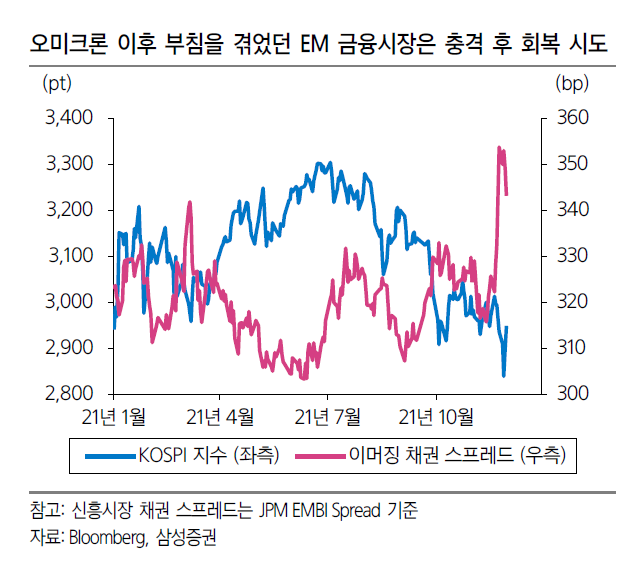
There is an analysis that this uncertainty should be used as an opportunity. In the case of the domestic stock market, it is judged that the valuation burden is significantly low despite considering various risk factors. Seojung Hoon, a researcher at Samsung Securities, explained, "The KOSPI 2900 level is a range where the return is negative compared to the beginning of the year, which is equivalent to excluding all the performance accumulated by domestic companies this year," adding, "If a marked recession is expected next year, this might be somewhat convincing, but the consensus on domestic economic growth and corporate earnings remains high."
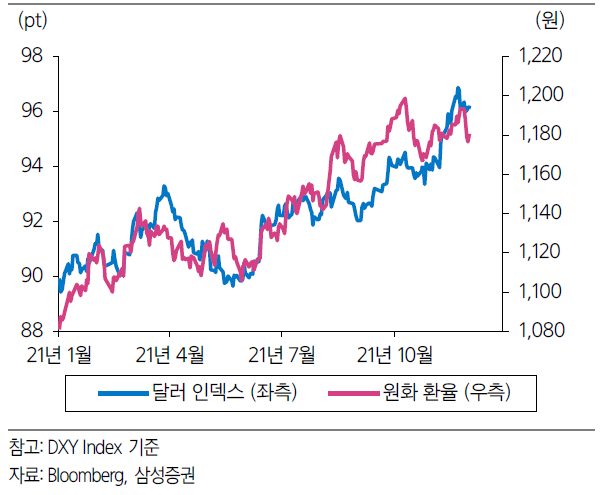
He also emphasized that macroeconomic conditions are not entirely negative. Researcher Seo said, "Despite the Fed's tightening pace accelerating, the dollar index, which is important in emerging market financial conditions, is limited on the upside," and added, "The 10-year U.S. Treasury yield is also following a similar trajectory, which supports the liquidity environment."
The bottleneck issues and resulting inflationary pressures, which were the main causes of pressure on the domestic stock market before Omicron, are gradually easing. Among the detailed items of the Manufacturing Purchasing Managers' Index (PMI) released by the U.S. Institute for Supply Management (ISM) on the 1st, signals of having passed the peak were confirmed in the supplier delivery index and input price index, which had been soaring.
Researcher Seo diagnosed, "Considering that this is a period when the surge in pre-demand for the year-end consumption season is gradually resolving, these inflation indicators are likely to decline further this month," adding, "Additionally, major logistics costs such as container freight are decreasing, and with the decision to increase production by OPEC+?the consultative group of the Organization of the Petroleum Exporting Countries (OPEC) and oil-producing countries?and West Texas Intermediate (WTI) crude oil prices below $70 per barrel, this will help alleviate the stagflation concerns (economic recession accompanied by inflation) that have prevailed in the market."
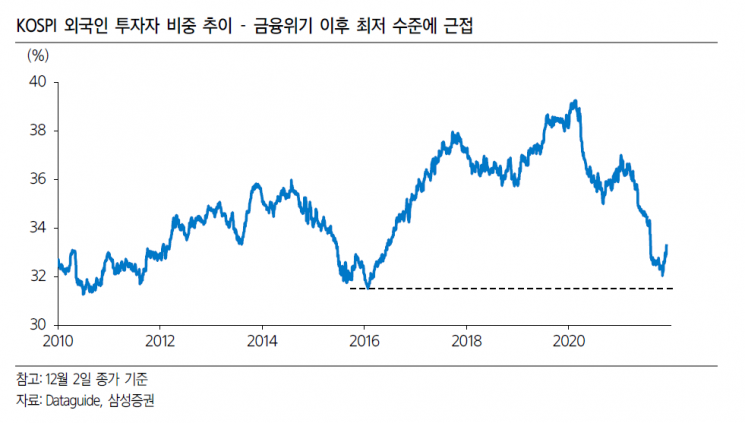
The continued buying trend by foreign investors this month is also interpreted as a recognition of this trend. According to the Korea Exchange, foreign net purchases amounted to 1.979 trillion won from the 1st to the 3rd. Researcher Seo advised, "Considering that individual trading volume is decreasing and customer deposits are stagnant, foreign investors will be the main source of market demand for the time being," adding, "Interest in large-cap stocks preferred by them remains valid, and attention should be paid to sectors such as electronics, transportation equipment, finance, and healthcare, where relative price incentives still exist."
© The Asia Business Daily(www.asiae.co.kr). All rights reserved.



















