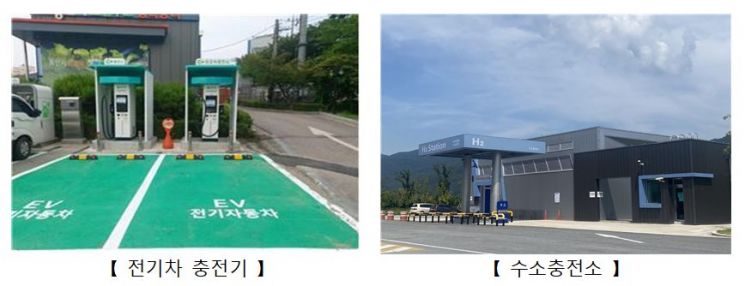
By the end of next year, the number of electric vehicle chargers on highways will increase to around 1,000. Hydrogen charging stations are also expected to expand to 43 units.
The Ministry of Land, Infrastructure and Transport and Korea Expressway Corporation announced on the 5th that they will continuously expand charging facilities on highways to enable convenient use of eco-friendly vehicles such as electric and hydrogen cars.
As of the end of last year, there were 435 electric vehicle chargers operating on highways, but by the end of this year, about 730 chargers will be built and operated. More than 300 additional chargers will be installed next year.
The number of hydrogen charging stations currently operating on highways is 12, but it is expected to increase to 43 next year and more than 52 in 2023.
Previously, the government announced that it would supply 4.5 million electric and hydrogen vehicles by 2030 to achieve '2050 Carbon Neutrality.'
As eco-friendly vehicles increase, the number of customers using charging facilities on highways rose from 700,000 last year to 872,351 as of October this year. It is expected to reach about 1 million by the end of the year.
To respond to the growing demand for charging, the government plans to significantly increase electric vehicle chargers and hydrogen charging stations on highways.
In addition, Korea Expressway Corporation is gradually increasing the amount of power generated on highways through new and renewable energy sources. The goal is to produce more electricity than is consumed by streetlights, tunnel lighting, and other highway uses by 2025.
Currently, 104 MW of solar power generation facilities are operating on highways, and an additional 76 MW of generation facilities will be added by 2023.
Furthermore, fuel cell power generation, which is more efficient than solar power and requires less space, is also being promoted. By 2025, facilities with a capacity of 48 MW will be built on three idle highway sites.
Hwang Seong-gyu, the 2nd Vice Minister of the Ministry of Land, Infrastructure and Transport, said, "Expanding charging infrastructure is a prerequisite for the spread of eco-friendly vehicles," adding, "We will continuously expand charging infrastructure for electric and hydrogen vehicles to achieve carbon neutrality by 2050."
© The Asia Business Daily(www.asiae.co.kr). All rights reserved.

















