Holding the Sangsaeng Development Committee... Agreement to Promote 9 Projects Including Reflection in Next Government's National Tasks and Cooperative Projects
[Asia Economy Honam Reporting Headquarters Reporter Yoon Jamin] Jeonnam Province and Gwangju Metropolitan City have joined hands for "mutual development" through super-regional cooperation.
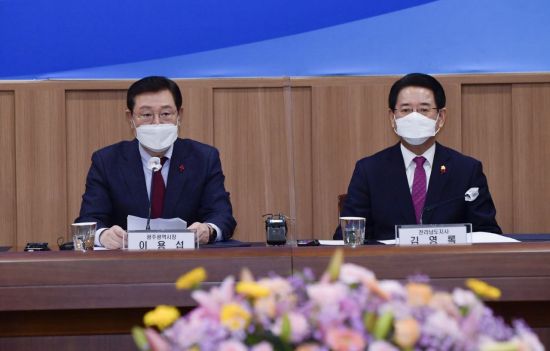
On the 3rd, the two local governments held the "2021 Gwangju-Jeonnam Mutual Development Committee" attended by Kim Young-rok, Governor of Jeonnam Province, and Lee Yong-seop, Mayor of Gwangju, and agreed to jointly promote nine new tasks including reflecting them in the next government’s national agenda and super-regional cooperation projects for mutual growth.
First, the two local governments agreed to jointly strive to include ▲ early commencement of Dalbit High-Speed Railway and Jeolla Line High-Speed Railway ▲ restoration of the Mahan cultural area and registration as a World Cultural Heritage in the next government’s national agenda.
The super-regional cooperation projects for a "bigger and stronger Jeonnam-Gwangju" include four projects: ▲ creation of Bitgoeul Smart Mega City ▲ establishment of the Southern Coast Southern Region Super-Regional Mega City ▲ establishment of Honam RE300, a super-regional energy community in the Honam area ▲ creation of a Well-Aging Human Healthcare Valley.
In addition, new cooperation tasks include ▲ fostering Namdo Dalbam art travel destinations ▲ cooperation for hosting COP33 and the 2038 Asian Games ▲ joint cooperation for institutional improvement of national balanced development.
On this day, the city and province also agreed to cooperate to resolve pressing regional issues and included the contents in the announcement.
They agreed to jointly urge the Korea Disease Control and Prevention Agency to promptly proceed with the establishment of the National Cardiovascular and Cerebrovascular Center in the Jangseong Nano Industrial Complex within the Gwangju Research and Development Special Zone, which is a national agenda item.
Regarding the relocation of the Gwangju military airport, an important national defense facility, Jeonnam and Gwangju agreed to jointly strive to have it promoted under national leadership in a way that allows mutual growth.
They also agreed to open a new era of the Yeongsan River by building an ecological, historical, cultural, and tourism belt centered on the Yeongsan River.
Governor Kim Young-rok said, "Since the Mutual Development Committee in December last year, Jeonnam and Gwangju have achieved meaningful results in various fields such as the passage of the Korea Energy Engineering University Act in the National Assembly, joint response to COVID-19 infectious diseases, joint discovery of super-regional cooperation projects, and inclusion of Dalbit High-Speed Railway and Jeolla Line High-Speed Railway in the 4th National Railway Network Plan."
He added, "We will continue to actively promote future-oriented mutual development tasks for the balanced growth of the two local governments while responding together to the concentration in the metropolitan area."
Mayor Lee Yong-seop said, "If the citizens of Gwangju and the residents of Jeonnam unite their strength, there is no mountain too high to climb and no river too wide to cross," and added, "Let’s leap forward to a bigger and stronger Gwangju-Jeonnam and open a new era."
The Gwangju-Jeonnam Mutual Development Committee has discovered 55 cooperation tasks so far and completed 34 of them. They are also working together to ensure that the 21 ongoing tasks bear fruit.
© The Asia Business Daily(www.asiae.co.kr). All rights reserved.

















