Passage of the '2022 Budget and Fund Operation Plan' in the Plenary Session on the 3rd
4.9% Increase Compared to the 2021 Original Budget
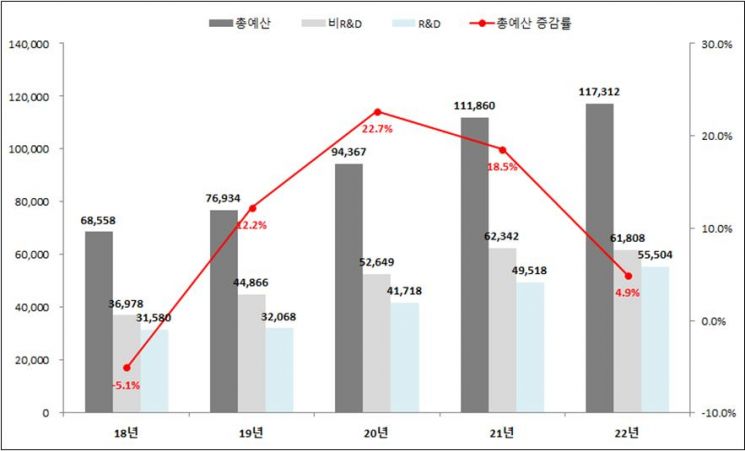
[Sejong=Asia Economy, Reporter Ju Sangdon] The Ministry of Trade, Industry and Energy's budget for next year was finalized at 11.7312 trillion KRW on the 3rd. The budget focuses on supporting the process transition of manufacturing and energy companies to achieve carbon neutrality by 2050.
The Ministry announced that the '2022 Budget and Fund Operation Plan' was finally approved in the National Assembly plenary session on the same day.
Next year's budget increased by 4.9% compared to this year's original budget (11.186 trillion KRW). However, during the National Assembly review process, the Ministry of Trade, Industry and Energy's budget and fund size was increased by 194.6 billion KRW and decreased by 276.9 billion KRW compared to the government's proposal (11.8135 trillion KRW), resulting in a net decrease of 82.3 billion KRW.
An official from the Ministry explained, "The whole-of-government stance reflecting the need for an active fiscal role to achieve strong economic recovery and leap to a global powerhouse after COVID-19 was incorporated," adding, "From next year, the 'Climate Crisis Response Fund' project will be operated, focusing on supporting the process transition of manufacturing and energy companies to achieve carbon neutrality by 2050."
Specifically, 5.9026 trillion KRW will be spent on 'Eco-friendly and Digital-based Industrial Innovation and Enhancing Competitiveness of Promising New Industries,' which is 805 billion KRW more than this year. The budget for technology development of materials, parts, equipment, and strategic core materials was expanded to reduce overseas dependence on key materials and secure supply chain stability. Additionally, the Ministry plans to strengthen support for root industries by designating and supporting specialized complexes, promoting technological cooperation and exchanges, and developing intelligent process systems.
Support for BIG3 industries such as semiconductors, bio-health, and future cars will also be strengthened. To foster system semiconductors, comprehensive support from semiconductor design (fabless) to product manufacturing will be expanded, and a new budget for next-generation intelligent semiconductor technology development was allocated. Furthermore, during the National Assembly review, the need to support timely construction and smooth operation of the Yongin Semiconductor Cluster, designated as a specialized materials, parts, and equipment complex, was raised, leading to the establishment of a new project to support power infrastructure construction.
To secure global competitiveness in the bio-health industry, the joint inter-ministerial budget for new drug and medical device research and development (R&D) was significantly expanded. A new project was also established to build a global vaccine hub aimed at rapid and large-scale vaccine production and creating a vaccine industry ecosystem within a short period.
A budget of 4.728 trillion KRW was allocated for 'Energy Transition and New Energy Industry Promotion' to accelerate the shift to low-carbon and distributed energy, innovate the entire energy system, and induce job creation through fostering new industries.
To expand renewable energy, loan budgets were increased for solar power facilities targeting farmers, livestock farmers, and fishermen, as well as for solar power facilities utilizing idle land in industrial complexes and factory rooftops, investment funds for renewable energy projects by local residents, and solar power facilities on idle urban sites (such as building rooftops). In addition, R&D for securing core technologies related to renewable energy was also expanded.
The budget for the hydrogen distribution infrastructure project, which was 3.6 billion KRW this year, was increased to 12.8 billion KRW next year, significantly expanding the budget for early realization of the hydrogen economy. The Ministry plans to build an ecosystem covering the entire cycle of production, distribution, and utilization based on the enforcement of the Hydrogen Act and prepare safety standards for hydrogen charging station facilities and equipment in line with the private sector’s large-scale liquefied hydrogen shipment schedule.
The Ministry allocated 939.1 billion KRW to expand effective policies to enhance export competitiveness and strengthen trade security and response capabilities.
An official from the Ministry said, "Since the budget for next year was increased to promote innovative growth of companies and economic vitality after COVID-19, the Ministry will also thoroughly prepare for budget execution, including establishing project plans, to ensure prompt budget spending."
© The Asia Business Daily(www.asiae.co.kr). All rights reserved.
![Clutching a Stolen Dior Bag, Saying "I Hate Being Poor but Real"... The Grotesque Con of a "Human Knockoff" [Slate]](https://cwcontent.asiae.co.kr/asiaresize/183/2026021902243444107_1771435474.jpg)
















