Next Year's Ministry of Land Budget at Record High
SOC Sector 22.7 Trillion, Welfare Sector 38.8 Trillion
Increased Transportation Budget for GTX, Shinbundang Line to Accelerate
COVID-19 Recovery, Increased Budget for Housing Stability Support
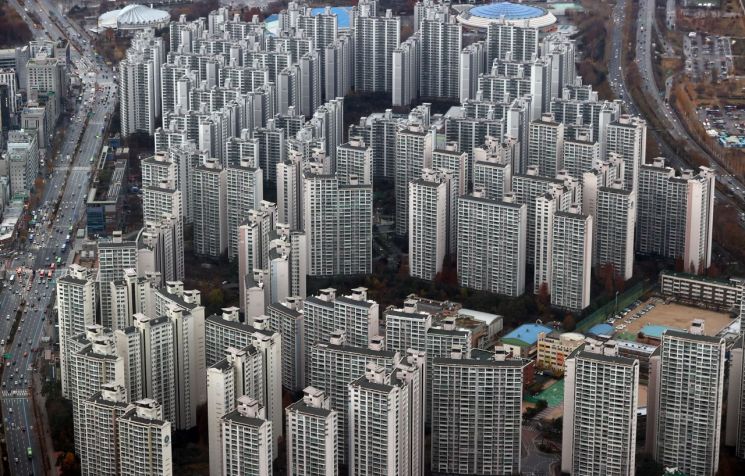
Next year's Ministry of Land, Infrastructure and Transport (MOLIT) budget has exceeded 60 trillion won for the first time, marking the largest scale ever. Analysts attribute the budget increase to both ruling and opposition parties significantly boosting allocations for social overhead capital (SOC) sectors ahead of the presidential and local elections, as well as the government's strengthening of public-led real estate policies.
MOLIT announced that the 2022 budget proposal and fund management plan under its jurisdiction were finally confirmed at 60.7995 trillion won through the National Assembly plenary session on the 3rd. This represents an increase of 3.742 trillion won (6.6%) compared to this year's main budget of 57.0575 trillion won, making it the largest budget in MOLIT's history.
During the National Assembly review process, 425.1 billion won was added for strengthening the public nature of metropolitan buses, while 565.6 billion won was cut for urban regeneration support, resulting in a net reduction of 140.5 billion won compared to the government proposal.
Among next year's budget, the SOC sector accounts for 22.7913 trillion won, and the housing and basic living welfare sectors account for 38.0082 trillion won. Considering the deepening polarization caused by the prolonged COVID-19 pandemic, investments were increased in support for housing-vulnerable groups and basic livelihood security.
In particular, the SOC sector increased by more than 1 trillion won from 21.6 trillion won this year to 22.8 trillion won next year. This is interpreted as a result of large-scale budget allocations for national balanced development, regional hub cultivation, and transportation network expansion ahead of next year's elections. Consequently, concerns have been raised that the ruling and opposition parties' regional pork-barrel spending could exacerbate wasteful budget management.
National Balanced Development Budget Doubled
First, next year, many projects aimed at revitalizing the regional economy, which has been depressed due to the phased recovery from COVID-19, and supporting national balanced development have been allocated. The national balanced development project, exempt from preliminary feasibility studies, was allocated 809.6 billion won, more than double compared to this year, and projects such as the Pyeongtaek-Osong double-track railway, Daegu industrial line railway, and Southwest Coast tourist road will be actively promoted.
To foster regional hubs, investments of 79.6 billion won for renovating aging industrial complex infrastructure, 21 billion won for campus innovation parks, and 24 billion won for innovative city construction will be made to invigorate the stagnant regional economy. To connect regional economic hubs with major arterial transportation networks, budgets of 670.6 billion won for the Seoul-Sejong Expressway and 114 billion won for the construction of Ulleung Airport were also allocated.
Supporting Future Innovative Growth in Preparation for the Post-COVID Era
Budgets have also increased to prepare for climate change, carbon neutrality, and the post-COVID-19 era. A total of 833 billion won was allocated for MOLIT's carbon neutrality response, including 480.6 billion won for green remodeling of aging public rental housing, 224.5 billion won for green remodeling of public buildings, and 24.5 billion won for hydrogen pilot cities.
The logistics infrastructure support budget is 30.7 billion won next year. Timely investments are expected to be possible to improve the quality of logistics services through the renovation of outdated logistics centers and to respond to the rapidly increasing logistics demand in preparation for the post-COVID era. To support scale-up of small and medium-sized venture companies with innovative technologies, the MOLIT Innovation Fund will continue to operate at a scale of 20 billion won, and research and development (R&D) in mobility and other areas will be promoted with a budget of 578.8 billion won.
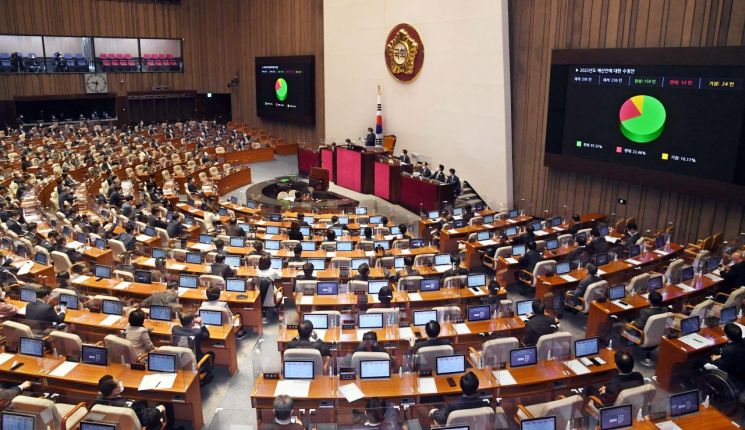 On the morning of the 3rd, at the 13th plenary session of the 391st National Assembly (regular session) held at the National Assembly in Yeouido, Seoul, an amendment to the 2022 budget proposal is being passed.
 [Image source=Yonhap News]
Increasing Rental Housing to Strengthen Housing Safety Net
The budget and funds were significantly expanded to increase housing benefits and quality public rental housing. The housing benefit budget was increased by 194 billion won to 2.1819 trillion won, up from 1.9879 trillion won this year due to expanded eligibility criteria.
To achieve the housing welfare roadmap of supplying 210,000 public rental housing units next year and to provide quality rental housing in good locations, 3.1539 trillion won more than this year was allocated, totaling 22.7613 trillion won.
To alleviate housing insecurity among young people, 82.1 billion won was allocated for the special youth monthly rent support project, which provides up to 200,000 won per month for a maximum of 12 months. Additionally, 9 billion won was newly reflected for a public owner-occupied housing pilot project to provide homeownership opportunities tailored to income and asset levels for low-income, homeless citizens.
Increased Transportation Budget for GTX, Shinbundang Line, etc.
Budgets were also increased for the metropolitan area residents' high-interest projects such as the Metropolitan Express Railway (GTX). To ensure smooth progress of metropolitan and urban railway construction projects including GTX-A, B, and C lines and the Shinbundang Line, the metropolitan and urban railway project budget was increased by 546.2 billion won compared to this year, totaling 1.9278 trillion won.
The quasi-public operation project for metropolitan buses to eliminate transportation blind spots was increased from 5.2 billion won this year to 37.8 billion won next year, and 15.6 billion won will be invested to promote five metropolitan BRT lines.
Ha Dong-su, Director of Planning and Coordination at MOLIT, emphasized, "Next year is a time when the role of fiscal policy is necessary to put our economy back on a normal track," adding, "We will revitalize the depressed regional economy through the largest-ever 2022 MOLIT budget confirmed by the National Assembly."
© The Asia Business Daily(www.asiae.co.kr). All rights reserved.
![Clutching a Stolen Dior Bag, Saying "I Hate Being Poor but Real"... The Grotesque Con of a "Human Knockoff" [Slate]](https://cwcontent.asiae.co.kr/asiaresize/183/2026021902243444107_1771435474.jpg)

















