Payment Only Possible Upon Hospitalization According to Terms
Insurance Industry Embarrassed Due to Lack of Legal Basis
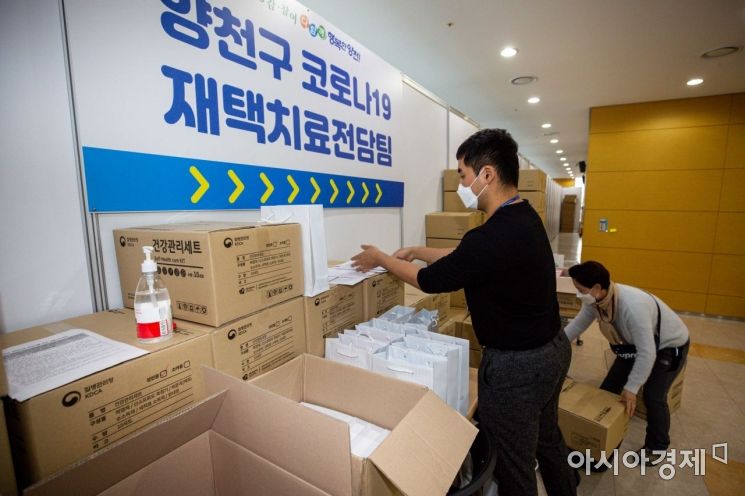 Officials from the Yangcheon-gu COVID-19 Home Treatment Task Force are packing health management kits for home treatment patients, which include oxygen saturation monitors, at Haenuri Town in Yangcheon-gu, Seoul, on the 2nd. Photo by Jinhyung Kang aymsdream@
[Asia Economy Reporter Oh Hyung-gil] As the management of COVID-19 confirmed cases shifts to home treatment, controversy has arisen over whether hospitalization insurance benefits should be paid to those undergoing home treatment. Although the conditions for insurance benefit payments are not met according to the insurance policy terms, insurance companies are in a difficult position due to the stance of health authorities.
According to the insurance industry on the 3rd, the financial authorities convened insurance industry officials last week to discuss whether hospitalization insurance benefits should be paid to home treatment patients. It is reported that insurance companies expressed the opinion that they could not make such payments at this meeting.
Hospitalization insurance, also known as daily hospitalization allowance insurance, is a product that pays a daily allowance of about 10,000 to 50,000 KRW according to the contract when the insured is hospitalized in a medical institution. Whether the insured is hospitalized, which is the criterion for insurance benefit payment, is important. The Enforcement Rules for Insurance Business Supervision define hospitalization as "a case where a doctor recognizes that the insured requires treatment due to illness or injury, and it is difficult to treat at home, so the insured stays in a medical institution or an equivalent recognized medical institution for more than six hours while receiving treatment under the observation and management of a doctor."
On the other hand, the insurance industry argues that home treatment cannot be considered hospitalization because it takes place at home rather than in a medical institution, and there is no observation or management by a doctor.
So far, considering the COVID-19 situation, the insurance industry has broadly interpreted the meaning of medical institutions in the policy terms and has paid hospitalization insurance benefits not only to hospitals but also to residents of living support centers, which are not medical institutions. However, they believe it is unreasonable to consider home treatment as a target for insurance benefit payments.
The financial authorities conveyed this to the health authorities, but the issue became more complicated as the health authorities requested a re-examination. On the 1st, Son Young-rae, head of the Social Strategy Division of the Central Disaster and Safety Countermeasures Headquarters, stated, "There has been controversy regarding the payment of hospitalization insurance benefits to home treatment patients, so we decided to conduct an additional review," adding, "We will make a conclusion after further reviewing the interpretations of the insurance industry and related laws."
It is not easy for the financial authorities or the insurance industry to find a solution. If the authorities interpret the law to allow exceptional payments, they would be contradicting the law themselves. Even if new policy terms are created immediately, retroactive application to existing insurance is impossible.
Even if insurance companies decide to pay benefits from a public interest perspective, there is no proper legal basis. An insurance industry official lamented, "Insurance is a contract made with the subscriber, and we cannot arbitrarily create grounds to pay hospitalization insurance benefits."
© The Asia Business Daily(www.asiae.co.kr). All rights reserved.

















