KOSME Policy Newsletter Issue 5 Published
Support for Supply Chain Information Platform Construction and Commercialization of Core Materials and Components Technologies
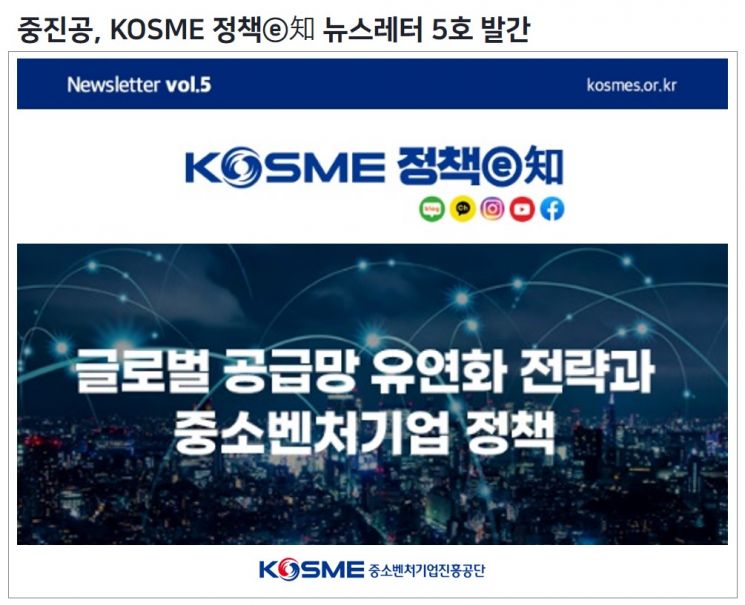
[Asia Economy Reporter Kim Cheol-hyun] The Small and Medium Business Corporation (Chairman Kim Hak-do, hereinafter referred to as KOSME) announced on the 3rd that it has published the 5th issue of the policy newsletter 'KOSME PolicyⓔKnowledge (Easy)' containing mid- to long-term directions for responding to the global supply chain of small and medium-sized ventures and five major support strategies for supply chain diversification.
In the special article "Global Supply Chain Flexibility Strategy and Small and Medium Venture Business Policy," KOSME presented the following directions for stabilizing the supply chain: ▲expanding policy support to alleviate corporate cost burdens due to inventory strategy shifts ▲diversifying supply chains to reduce dependence on imports from specific countries ▲localization of key parts and materials.
The five major support strategies for diversifying the supply chain of small and medium-sized ventures are ▲providing supply chain information and consulting support ▲establishing integrated governance ▲supporting commercialization of core technologies ▲diversifying supply chains ▲establishing production bases for key materials.
First, KOSME emphasized the necessity of building an information-sharing platform to solve the problem of lack of global supply chain information. It plans to use overseas bases such as the Export Business Incubator and K-Startup Center as major information channels to provide the latest information on the supply chain status by country, raw material prices, and resource trends.
They also proposed providing consulting for establishing supply chain flexibility strategies to assist in diversifying imports, preparing export region policy responses, developing alternative technologies, and forming expert advisory groups to resolve short-term issues such as legal and customs procedures. Regarding the establishment of integrated governance, they suggested a control tower role where the government directly monitors the supply status of key raw materials and adjusts supply in case of crises.
For commercialization of core technologies, they explained the need for policy funds, export marketing, and workforce package support for material and component companies. They also anticipated that building a collaboration system between domestic export companies and overseas local technology research institutes, as well as supporting technology exchange between domestic and global companies, would be helpful.
As a new supply chain construction and diversification measure, they proposed linking overseas cooperation projects such as Official Development Assistance and economic development sharing projects. As a strategy for localization of key materials, they cited attracting manufacturing technology and R&D facilities domestically, strengthening incentives such as policy funds, subsidies, and tax benefits for essential strategic item production companies, and creating regional clusters of key parts and materials companies.
Jung Byung-ok, head of KOSME's Policy Research Office, said, "Due to Korea's trade structure, it is vulnerable to external risks such as inter-country trade conflicts, nationalism, and strategic materialization," adding, "At this time, policy support is needed to stabilize the supply chain and strengthen self-reliance, such as providing global supply chain information and supporting commercialization of core technologies, to minimize damage to domestic small and medium ventures caused by these risks."
© The Asia Business Daily(www.asiae.co.kr). All rights reserved.

















