Government Announces 'Youth Support Policies in the Era of Digital Transformation'
4,000 Internships for Students and Job Seekers, 1,000 Job and Startup Mentoring
Digital Transformation Education for 4,000 Young Small Business Owners
Priority Digital Residence Opportunities for Youth Startups
[Asia Economy Reporter Eunmo Koo] The government is strengthening support policies for young people in line with the accelerating digital transformation across the economy and society. It plans to create domestic and international internship opportunities for 4,000 students and job seekers next year, and provide digital transformation education to 4,000 young small business owners. Support for startups will also be enhanced by prioritizing the construction of cutting-edge 5G 28GHz communication networks and offering priority residency opportunities at the Seoul Magok Youth Residence.
The Ministry of Science and ICT (MSIT) announced the 'Youth Support Policy in the Era of Digital Transformation' on the 2nd through a joint event with related ministries titled 'Digital Korea, Drawing the Future with Youth.'
Through this support policy, the government aims to establish a solid foundation for challenges. Based on the digital education programs expanded so far, such as Software (SW)-centered universities and Innovation Academies, it plans to provide tailored educational courses covering majors, non-majors, and regional talents, offering various opportunities for employment, entrepreneurship, creation, and research.
Additionally, the government will provide digital resources necessary for youth growth and establish a support system based on public-private cooperation. It will also strengthen support for digital innovation in non-digital sectors to offer a larger stage for growth. Furthermore, it plans to create a hub attracting global digital talents and startups to expand opportunities for young people to enter the global stage.
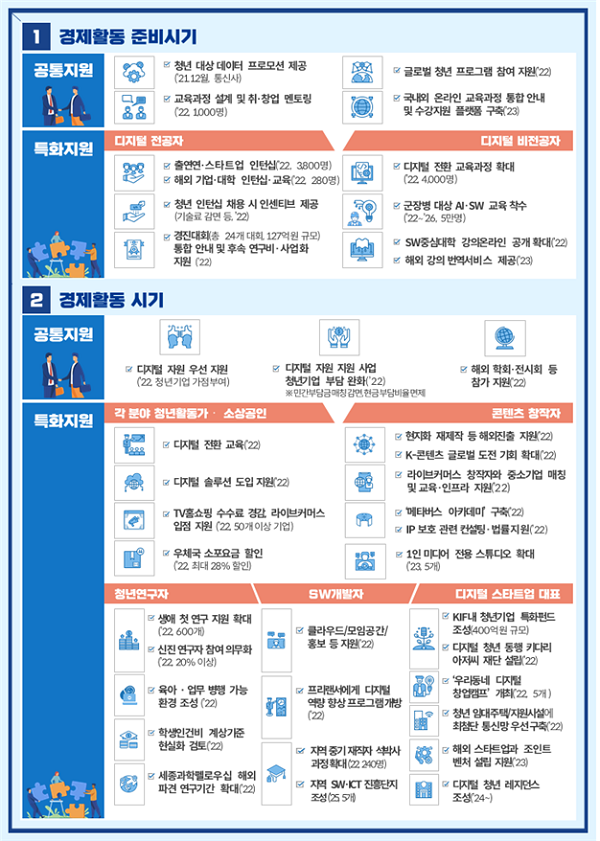
The government intends to provide differentiated support according to the stage of economic activity preparation. First, for students and job seekers preparing for economic activities, data promotions such as exemption from data usage fees and additional data provision for job search sites will be implemented starting this month. Moreover, from next year, 1,000 individuals will have opportunities to receive education program design and employment/entrepreneurship mentoring from seniors in various digital fields such as developers, planners, and one-person media creators.
Students and job seekers will also receive different support measures based on whether they are digital majors or non-majors. For digital majors, practical skill enhancement opportunities will be expanded based on specialized educational programs such as 41 SW-centered universities, 10 Artificial Intelligence (AI) graduate schools, and 51 university ICT research centers. Specifically, from next year, 4,000 people will be offered internships and global internship and education opportunities at government-funded research institutes and startups. For digital non-majors, educational opportunities will also be diversified. The digital transformation curriculum within digital learning centers will be expanded to 4,000 people, and AI and SW education for military personnel will begin from next year through 2026, targeting 50,000 individuals.
Support measures are also prepared not only for students and job seekers but also for young entrepreneurs, creators, and researchers currently engaged in economic activities. Young companies and researchers will be prioritized for digital resources such as data, AI, and cloud, and participation burdens for young companies in digital resource provision support projects will be reduced.
Specialized support plans will also be prepared for employed youth by target group. First, digital technology will be added to youth support projects such as job training and job search support for youth activists and small business owners in various fields, as well as rural settlement and revitalization of traditional markets, to accelerate innovation. Specifically, digital transformation education such as online promotion, big data, and AI utilization training, and support for the introduction and demonstration of cloud-based digital solutions to solve regional issues will be provided.

For content creators such as one-person media, production infrastructure and educational programs will be expanded. Support for overseas expansion, including localization and re-production, will be promoted, and opportunities for K-content global challenges linked with domestic app market companies will be expanded. Consulting and legal support related to intellectual property (IP) protection will also be provided.
For young researchers, institutional foundations will be strengthened to improve treatment and expand research opportunities. Participation of early-career researchers will be mandated at over 20% in excellent group research support, and the payment system for student labor costs will be improved by reviewing the standards for calculating student labor costs. For female researchers, an environment enabling work-life balance with childcare will be created, and education in new industry fields will be strengthened.
A more detailed support system will also be established for employed and freelance software developers. Support will be provided to SW developer communities for cloud resources, meeting spaces, promotion, and conference expenses, and digital competency enhancement programs mainly for university students and employed workers will be opened to freelance developers as well. Doctoral and master's programs for employees of regional small and medium enterprises will also be expanded.
Finally, for digital startup workers, existing startup support projects such as entrepreneurship education, funding, investment, marketing, and overseas expansion support will be made more accessible and specialized support strengthened so that young startups can actively utilize them. First, a 40 billion KRW-scale youth company specialized fund will be established within the Korea IT Fund (KIF), and a public-private collaborative support system will be built, including support for establishing the 'Digital Youth Companion Kind-Hearted Uncle Foundation' by senior digital entrepreneurs.
In addition, cutting-edge communication networks such as 5G 28GHz, public Wi-Fi, and ultra-high-speed (100Mbps-class) internet will be prioritized for installation in youth rental housing and regional youth activity support facilities. Furthermore, youth entrepreneurship and housing will be simultaneously supported by utilizing job-linked youth rental housing. Existing digital education and startup support programs will be introduced in youth rental housing districts, and priority residency opportunities will be provided to young startup CEOs and employees in areas such as the Seoul Magok district, scheduled for occupancy in 2024.
© The Asia Business Daily(www.asiae.co.kr). All rights reserved.



















