Personnel and Wage Systems Should Be Reformed to Reflect the Value and Performance of Work and Corporate Results
[Asia Economy Reporter Ki-min Lee] It has been pointed out that in order to innovate corporate productivity and strengthen competitiveness, the seniority-based wage system should be lowered and reorganized into a personnel and wage system that reflects performance and achievements.
The Korea Employers Federation (KEF) made this claim in a report titled "International Comparison and Implications of Wage Gaps by Length of Service in Korea, Japan, and the European Union (EU)" released on the 2nd.
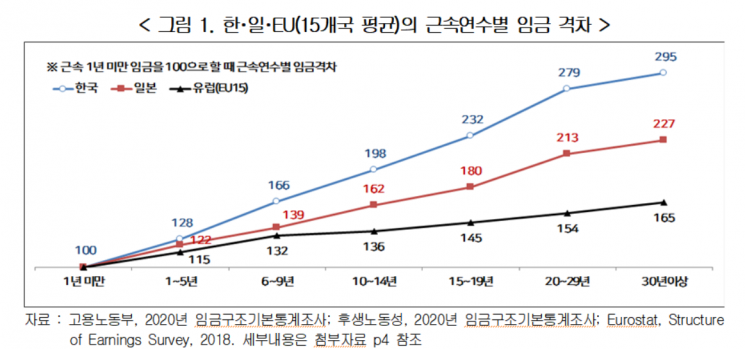
According to KEF, the average total monthly wage of workers with more than 30 years of service in Korea was 6,971,000 KRW, which is 2.95 times higher than the average total monthly wage of workers with less than one year of service, which was 2,365,000 KRW. This is significantly higher than Japan's 2.27 times and the EU (average of 15 countries) at 1.65 times.
The slope of the wage gap in the less than 10 years of service segment is also steepest in Korea. Compared to the wage of workers with less than one year of service, the wage level of those with 6 to 9 years of service was 1.66 times in Korea, higher than Japan's 1.39 times and the EU's 1.32 times.
KEF explained that especially compared to 2001, Korea's wage levels have significantly increased across all length-of-service segments last year, whereas Japan showed only a slight increase in the low seniority segment and a decrease of 3.8% to 10.9% in the high seniority segment.
Although the wage gap according to length of service in Korea has gradually decreased since 2000, the size of the gap due to seniority remains the highest compared to Japan and the EU. The wage ratio of workers with more than 30 years of service to those with less than one year of service decreased from 3.72 times in 2006 to 3.03 times in 2018 in Korea, and from 2.67 times in 2006 to 2.4 times in 2018 in Japan. The EU showed little change during the same period, from 1.63 times to 1.65 times.
Ha Sang-woo, head of KEF's Economic Research Department, said, "Although our wage seniority is gradually decreasing, it is still significantly higher than that of competing countries such as Japan and the EU. This is presumed to be because many companies still operate wage systems and personnel systems strongly based on seniority." He pointed out, "Uniform compensation based on length of service rather than the value and performance of work hinders fairness, motivation, and productivity innovation, and can greatly weaken corporate competitiveness."
He continued, "Recently, Samsung's announcement of a personnel system innovation plan that significantly relaxes seniority seems to stem from this awareness of the problem," and emphasized, "It is urgent to reorganize the personnel and wage system to reflect the value and performance of work and corporate achievements, and active efforts by labor and management are necessary for this."
© The Asia Business Daily(www.asiae.co.kr). All rights reserved.
![Clutching a Stolen Dior Bag, Saying "I Hate Being Poor but Real"... The Grotesque Con of a "Human Knockoff" [Slate]](https://cwcontent.asiae.co.kr/asiaresize/183/2026021902243444107_1771435474.jpg)
















