
[Asia Economy Reporter Yoojin Cho] The Wall Street Journal (WSJ) reported on the 1st (local time) that Silicon Valley billionaires and Wall Street heavyweights Bill Gates and George Soros are leading the nuclear fusion boom. According to the report, U.S. nuclear fusion startup Commonwealth Fusion Systems recently succeeded in raising $1.8 billion (about 2.125 trillion KRW) in a funding round. This is the largest amount raised from private funding.
The investment was led by Gates, the founder of Microsoft (MS), and Soros, chairman of Soros Fund Management. Alphabet, Google's parent company, as well as venture capital firms such as Time Ventures, founded and chaired by Salesforce founder and chairman Marc Benioff, and DFJ Growth, were also listed among the investors. Gates had previously made a large-scale investment in the company through Breakthrough Energy Ventures (BEV), which he established, in February.
Founded in June 2018, the company plans to build a commercial nuclear fusion power generation facility (fusion reactor) by 2025 and commercialize it in the early 2030s. The funds raised this time will be used for company operations and technology development costs.
Nuclear fusion power, which is attracting attention as a next-generation energy source surpassing nuclear power plants, is receiving massive funding from Silicon Valley and Wall Street. By leading private investment in nuclear fusion power, which had been stagnant under public sector leadership for decades, expectations are rising that the commercialization timeline of nuclear fusion power, known as the dream energy, can be accelerated.
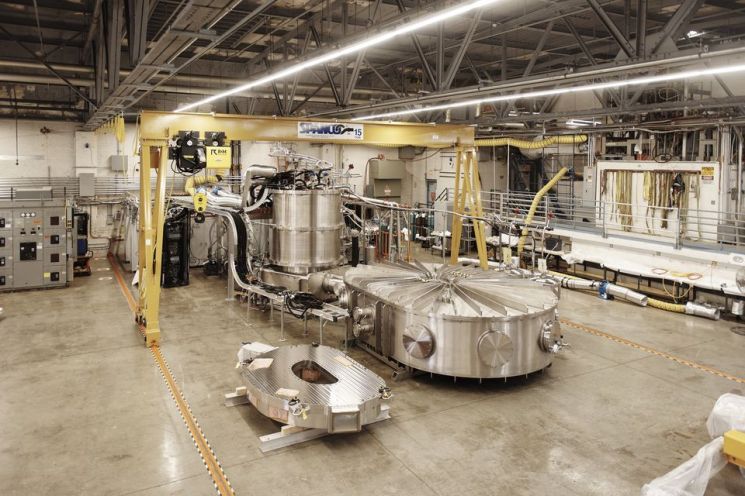
Helion Energy, a U.S. company invested in by Dustin Moskovitz, co-founder of Facebook, also succeeded in raising $500 million in early last month. Helion attracted attention as the first private company to achieve a plasma temperature of 100 million degrees.
Canadian General Fusion, which received a large investment from Amazon founder Jeff Bezos, also succeeded in raising $130 million this week. The investment amount exceeded the initial target, led by institutions such as pension funds and hedge fund Segra Capital Management. Christopher Mowry, CEO of General Fusion, described this fundraising as "a sign that nuclear fusion power is beginning to grow as an industry."
Foreign media analyzed that huge amounts of money are pouring into this field as interest in alternative energy sources surges due to carbon neutrality goals and energy crisis situations. According to data released by the UK Atomic Energy Authority, recent private investment in nuclear fusion startups has already exceeded the cumulative total amount (1.9 billion dollars) to date. The nuclear fusion market, which had been stagnant under public sector leadership for decades, is accelerating development speed through private sector participation.
Nuclear fusion power is a technology that obtains energy by utilizing the principle of the sun continuously emitting light and heat, and is also called an artificial sun. It uses hydrogen gas heated to an ultra-high temperature plasma state of over 100 million degrees, where deuterium and tritium fuse into helium, releasing enormous energy.
It is called a next-generation energy source surpassing nuclear power plants because raw materials are easy to obtain, and unlike nuclear fission power, it does not produce waste or pose risks of major accidents. However, there is also considerable skepticism about its commercialization potential. This is because achieving the stability of fusion reactors that induce fusion reactions is considered a technical challenge.
Tony Donn?, research director of Eurofusion, a nuclear fusion project jointly conducted by 28 European Union (EU) countries, said, "While we welcome the industrial approach of private companies, realistically, it will take about 20 to 30 years to build fusion reactors and supply power."
© The Asia Business Daily(www.asiae.co.kr). All rights reserved.


















