Promotion of Small Modular Reactor (SMR) Construction Applying Sodium-cooled Fast Reactor (SFR) Technology in Alberta, Canada
Participation of Specialized Companies and Institutions from Both Countries in SFR Developed with Korean Government Funding
SFR Attracts Attention as Next-Generation Nuclear Technology with Higher Power Density and Reduced Spent Nuclear Fuel Compared to Light Water Reactors
Hyundai Engineering is set to actively engage in the construction project of Small Modular Reactors (SMRs), emerging as a game changer in the green energy sector.
On the 2nd (Thursday), Hyundai Engineering announced that it signed a Memorandum of Understanding (MOU) remotely with the Korea Atomic Energy Research Institute (KAERI), Gyeongsangbuk-do Province, Handong University, the Government of Alberta, Canada, the University of Calgary, and CKBC to promote the 'Small Reactor Construction Project in Alberta, Canada.'
Four domestic companies and institutions including Hyundai Engineering, along with three Canadian institutions, plan to build a 100MWe-class small reactor in Alberta, Canada, utilizing Sodium-cooled Fast Reactor (SFR) technology. They will also pursue technological development cooperation in various fields such as power generation and hydrogen production using process heat.
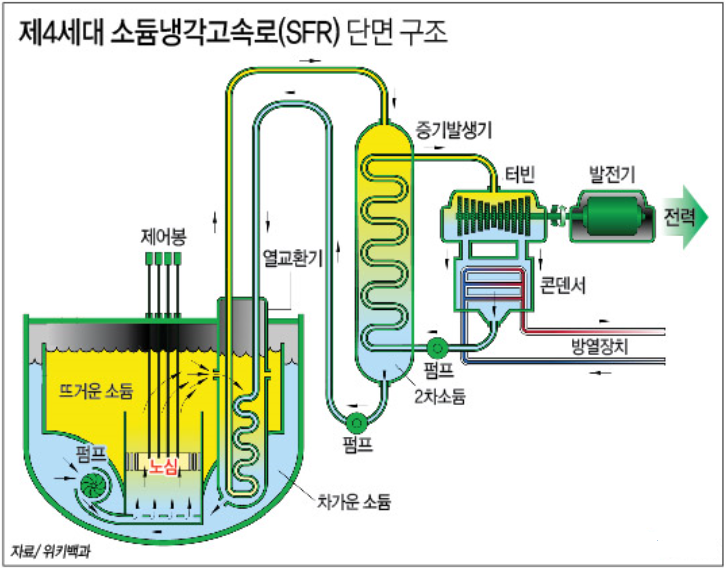
The Sodium-cooled Fast Reactor (SFR) is a reactor that uses liquid sodium as a coolant. It transfers the thermal energy produced from nuclear fission reactions using high-energy fast neutrons to the sodium coolant to generate steam, which then drives turbines to produce electricity. Since the 1990s, the Korea Atomic Energy Research Institute has been developing the fourth-generation nuclear reactor, the SFR, through national projects. It has completed the basic design of the main systems of the 150MWe-class PGSFR (Prototype Generation-IV Sodium-cooled Fast Reactor) and plans to develop a 100MWe-class long-cycle SFR for export to Canada based on this.
The SFR uses high-purity, low-enriched uranium metal fuel, allowing for higher power density compared to light water reactors and enabling long-cycle operation. It also relatively reduces the amount of spent nuclear fuel generated, making it a next-generation nuclear technology recently attracting attention from Microsoft founder Bill Gates and Berkshire Hathaway chairman Warren Buffett.
Alberta, Canada, has been working on plans to utilize SMRs to reduce large amounts of carbon dioxide emissions from the oil industry and fossil fuel power plants, which account for most of its power generation. This is the first agreement reached with developers following Alberta's signing of SMR development cooperation MOUs with New Brunswick, Ontario, and Saskatchewan provinces in Canada last April.
Through this agreement, Hyundai Engineering will undertake the EPC (Engineering, Procurement, and Construction) role for the SFR construction project to be established in Alberta, Canada. The participating institutions, including Hyundai Engineering, will open joint offices in Korea and Canada with KAERI in the near future for technology and human resource exchange and business cooperation. They plan to establish the design and development plan for the small reactor plant and begin the demonstration plant construction project in Alberta from next year. Handong University will promote mutual exchange in talent development and core technology R&D with the University of Calgary. Furthermore, William Gali, Vice President of the University of Calgary, expressed the university’s strong desire to actively cooperate with Korean partners and participate in technology development for Alberta’s SMR project.
Hyundai Engineering is also actively participating in the MMR (Micro Modular Reactor) project, a very small modular reactor based on High Temperature Gas-cooled Reactor (HTGR) technology. It is currently working with the US energy company USNC (Ultra Safe Nuclear Corp) on the design and construction of a 5MWe-class MMR at the Chalk River nuclear research site in Canada. USNC’s MMR passed the first phase of the Vendor Design Review (VDR) by the Canadian Nuclear Safety Commission (CNSC) in February 2019 and applied for the second phase of VDR in June 2021. Hyundai Engineering plans to start detailed design and plant construction in 2022 and complete construction and commissioning by 2026.
A Hyundai Engineering official stated, "Through this MOU signing, Hyundai Engineering has become a leader in the field of Sodium-cooled Fast Reactor technology, recognized as a fourth-generation nuclear innovation technology," adding, "As leading companies and institutions from both Korea and Canada in the small reactor sector come together to collaborate, we plan to focus our capabilities on technology development and commercialization."
© The Asia Business Daily(www.asiae.co.kr). All rights reserved.

















