Loan Total Volume Regulation '21%'... Exceeded by 22 Savings Banks
Quarterly Growth Slows, but Number of Exceeding Firms Increases
Financial Holding Savings Banks Expand Loans by up to 50%
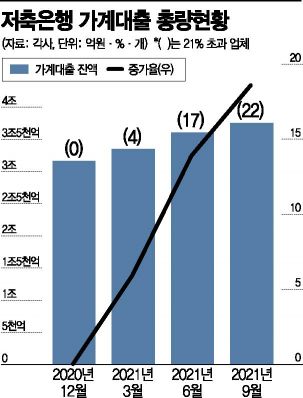
[Asia Economy Reporter Song Seung-seop] The financial authorities' strong demand for a 'total household loan volume regulation' is not properly taking effect in the savings bank industry. Although the overall household loan growth in the sector has slowed, the number of companies benefiting from regulatory spillover effects has actually increased. The financial authorities have stated that they will impose penalties on next year's total loan volume based on compliance, but some savings banks are voicing concerns that if some companies continue to violate the rules next year, the regulation will become meaningless.
According to financial authorities and related industries on the 1st, among the 79 savings banks, 22 exceeded the recommended total household loan volume as of the third quarter. This accounts for 27.8%, an increase of 5 companies (Hana, Sangsangin, Korea Investment, ES, Star Savings Bank) from 17 in the second quarter. Although the quarterly growth rate slowed to 4.0% from 7.6% in the previous quarter, more savings banks exceeded the guidelines when examined by individual companies.
The financial authorities requested the savings bank sector to manage household loans at around 21.1% growth compared to the previous year. High-interest loans, excluding mid-interest and policy products, must be capped within 5.4%.
The savings bank with the highest growth rate was Central Savings Bank, based in the Honam region. Its household loan balance in the third quarter was 9.2 billion KRW, representing a 109.0% increase compared to the end of the previous year. It is virtually impossible to comply with the total volume regulation this year. The growth rate in the first half was already 84.0%, four times the regulatory level, due to increased household loans in the third quarter as well.
Large savings banks also appeared on the list one after another. Among the top five companies by assets, Welcome Savings Bank and Korea Investment Savings Bank recorded growth rates of 21.8% and 28.4%, respectively. Except for Woori Financial Savings Bank, all savings banks affiliated with the five major financial holding companies exceeded the total volume limit. The growth rates of the other four companies were KB Savings Bank (50.0%), Shinhan Savings Bank (35.9%), NH Savings Bank (35.2%), and Hana Savings Bank (21.7%), respectively.
Although total volume was well maintained... Savings banks say "Non-compliant companies benefit"
The increase in violators despite the financial authorities' guidelines is because the household loan total volume regulation is an 'industry-wide' regulation. Even if an individual company exceeds its total volume limit, the primary goal is considered achieved as long as the overall industry total is maintained. As a result, while most companies comply with the financial authorities' total volume regulation, those who violate it gain enormous profits. Additionally, since the total volume regulation is based on the growth rate compared to the end of the previous year, significantly increasing the household loan size this year is advantageous for next year's business.
The financial authorities recognize the problem and intend to take action. If the current situation is left unattended, all companies might conclude that not complying with the regulation is beneficial. Among savings banks that have complied with the regulation, complaints such as "We managed loans strictly fearing exceeding the total volume, but it feels futile" are emerging.
Accordingly, the Financial Supervisory Service has reportedly conducted special management and monitoring while directly warning some companies not to treat the current situation as a business opportunity. They have also established a policy to differentiate next year's household loan total volume regulation by company. Savings banks are expected to receive next year's household loan growth rate limits ranging from 10.8% to 14.8%, depending on compliance.
There are also concerns about effectiveness. Some institutions have already improved loan performance by several tens of percent, and there is worry that companies may again grow by violating regulations as they did this year. A savings bank official said, "The household loan total volume regulation is a guideline, not a legally binding requirement," adding, "There could be savings banks that grow while receiving warnings from the financial authorities."
Meanwhile, as the number of companies subject to lower total volume limits increases, the amount of loans that can be executed the following year is expected to decrease.
© The Asia Business Daily(www.asiae.co.kr). All rights reserved.

















