Visited 'Baemin Academy' Attended by 130,000 People
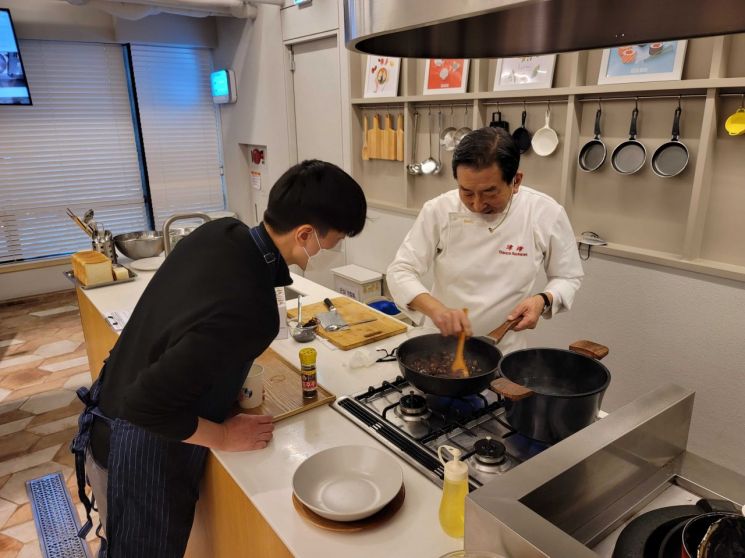
"The temperature for frying Menbosha starts at 150 degrees when putting it in, but rises to 200 degrees when taking it out. When you think it's fully cooked, turn up the heat. Increase the temperature to match the color of the bread." Following Chef Wang Yuksung's words, the busy hands of about ten people standing in front of the cooking station quickly moved, and soon a savory fried aroma began to spread. It takes about 5 minutes for Menbosha to cook, and if you follow Chef Wang, Menbosha made exactly according to the recipe of the Chinese restaurant 'Jinjin,' selected by the Michelin Guide, will soon be placed right before your eyes. However, what is condensed in this short time is the expertise that Chef Wang, a master of Chinese cuisine, has accumulated over a long time. This place, where small and medium-sized business owners who run restaurants gather to learn, is 'Baemin Academy' in Songpa-gu, Seoul.
According to Woowa Brothers, the operator of 'Baedal Minjok,' as of the end of October this year, the cumulative number of graduates from Baemin Academy, which started in 2014, reached about 130,000. About 70,000 people participated annually in online education and real-time non-face-to-face education, and a cumulative 66,000 people participated in offline education. Baemin Academy, which provides various free educational programs to anyone who wants to learn know-how in the food service industry, is widely known as a 'business school' among small and medium-sized food service business owners.
The educational content of Baemin Academy is characterized by being mainly practical and field-oriented, covering everything from food preparation and menu composition to tax and legal affairs, focusing on what is necessary to increase sales and facilitate smooth operations. To experience the 'business school' that has produced about 130,000 graduates, I visited Baemin Academy on the 26th of last month, where cooking methods currently used at the Chinese restaurant Jinjin, which can be immediately applied to restaurant operations, were revealed. On this day, in addition to Menbosha, Jjajangmyeon, which can be considered a basic Chinese dish, was covered. Chef Wang said, "I will pass on the recipe exactly as it is sold at Jinjin," adding, "If you do well, you might even make it tastier than Jinjin."
In the training room equipped with cooking facilities, participants followed Chef Wang as he stir-fried pork in scallion oil, added ginger and soy sauce, and then quickly added onions. Next came zucchini and shrimp. Then, by seasoning with salt, sugar, and seasoning according to their own style, the jjajang sauce was completed. Since Chinese cooking is fast-paced, Chef Wang allowed the cooking process to be recorded on video. He said, "Just because you stir-fry a lot doesn't mean it tastes bad, and just because I stir-fry it doesn't mean it tastes better. It comes out according to the recipe."
Because cooking methods and know-how that can be immediately applied on-site are revealed, competition to participate in Baemin Academy's offline lectures is fierce. Baemin Academy explains that the competition rate is about 20 to 1 each time a lecture is prepared. Most participants are self-employed people who actually run restaurants. On this day, the training room was filled with 12 participants, including one who came all the way from Daejeon and others who run restaurants in Seoul and Gyeonggi Province. Lee Donghee, the owner of a restaurant called 'Lee's Kitchen' in Suyu-dong, said, "Although I mainly cook Japanese-based food, I participated in this Chinese cuisine lecture because I thought it would be an opportunity to experience other foods and ingredients and transform them into my own style," adding, "It is really helpful."
Chef Wang also did not forget to give advice to those challenging restaurant startups. He emphasized, "The most important virtue is to have a service mindset. A restaurant does not just sell food; it sells happiness," and stressed, "It is important to charge a fair price with good ingredients and integrity."
© The Asia Business Daily(www.asiae.co.kr). All rights reserved.
![Clutching a Stolen Dior Bag, Saying "I Hate Being Poor but Real"... The Grotesque Con of a "Human Knockoff" [Slate]](https://cwcontent.asiae.co.kr/asiaresize/183/2026021902243444107_1771435474.jpg)
















