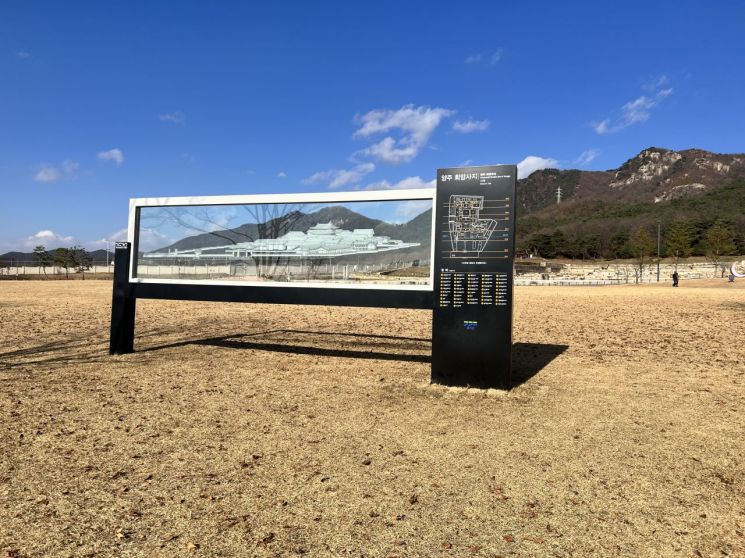
[Asia Economy (Suwon) = Reporter Lee Young-gyu] Gyeonggi-do has installed 'Cultural Heritage Restoration Guideboards' that depict the original form of cultural heritage, which has disappeared over many years, through drawings or text at eight locations including Hoiam Site in Yangju.
Gyeonggi-do announced on the 2nd that as part of a cultural heritage enjoyment policy to overcome COVID-19, it selected eight sites where the original form of cultural heritage had been damaged or worn away, and began producing and installing restoration guideboards in May, recently completing the work.
The cultural heritage sites targeted for guideboard installation are ▲Hoiam Site in Yangju ▲Byeokjegwan Site in Goyang ▲Pasaseong Fortress in Yeoju ▲UN Forces Crematorium Facility in Yeoncheon ▲Jukjusan Fortress (Poru site) in Anseong ▲Anyang Sagwibu ▲Anyang Jungcho Site Three-story Stone Pagoda ▲Wolsajip Woodblocks in Gapyeong.
The Hoiam Site in Yangju is the location of Hoiam Temple, built by the Indian monk Jigong who came from the Yuan Dynasty during the reign of King Chungsuk of Goryeo. Hoiam Temple was the largest temple nationwide from the late Goryeo to mid-Joseon period but was abandoned along with the decline of Buddhism. Accordingly, the province produced drawings of the original form of Hoiam Temple after reviewing literature and consulting experts, allowing visitors to enjoy the panoramic view of the Hoiam Site along with the guideboard.
The province also recreated the original forms as closely as possible through restoration guideboards for Pasaseong Fortress in Yeoju, built during the Silla period and expanded by monk Uieom who gathered warrior monks during the Imjin War, and the UN Forces Crematorium Facility in Yeoncheon where UN soldiers were cremated during the Korean War.
Kim Jin-ki, Director of the Culture, Sports and Tourism Bureau of the province, said, "Tourists will be able to indirectly experience the original form of damaged cultural heritage, enhancing their understanding and approaching it more familiarly. The significance of this restoration guideboard, which raises the historical importance and value of cultural heritage, is profound. We will continue to strive to widely promote and utilize our precious cultural heritage."
© The Asia Business Daily(www.asiae.co.kr). All rights reserved.

















