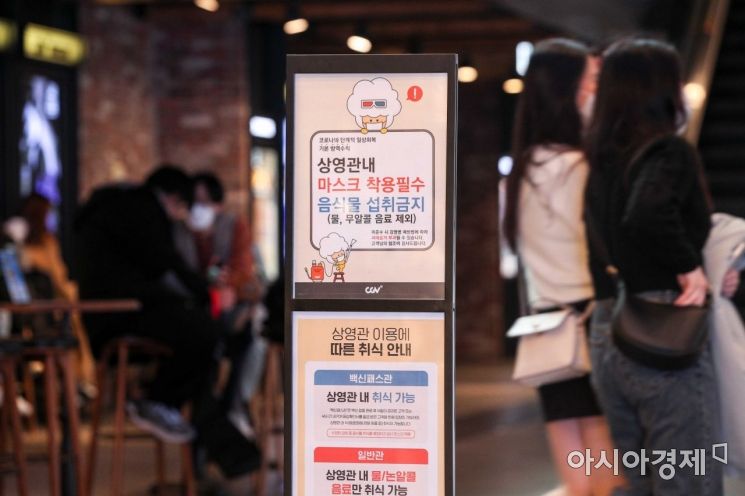
 As the government postponed the transition to Phase 2 of the gradual recovery to daily life (With Corona) and announced special quarantine measures for four weeks due to the worsening COVID-19 situation, a notice regarding food consumption is posted at a movie theater in Seoul on the 30th. Photo by Kang Jin-hyung aymsdream@
[Asia Economy Reporter Seo So-jeong] The government will enforce self-quarantine without exception for vaccinated individuals who have come into contact with confirmed Omicron variant cases, and extend the quarantine period from the current 10 days to 14 days. Additionally, to block the influx of the Omicron variant, all confirmed cases entering the country from overseas will undergo additional whole genome or targeted genome testing.
On the 1st, the government formed the "Inter-Ministerial Task Force (TF) for New Variant Response" and held its first meeting to announce these countermeasures for rapid response to block the influx of the Omicron variant and prevent domestic spread.
Currently, vaccinated individuals are exempt from self-quarantine even if they come into contact with confirmed cases. However, due to the recent increase in breakthrough infections and the growing possibility of Omicron influx, this policy will change to require self-quarantine without exception, even for those fully vaccinated.
To monitor variant overseas influx, all confirmed cases entering from abroad will undergo additional whole genome or targeted genome testing to confirm whether they are infected with the Omicron variant. Among confirmed cases detected in the community, those suspected of having the Omicron variant based on polymerase chain reaction (PCR) test results will also undergo additional whole genome or targeted genome analysis to confirm the variant.
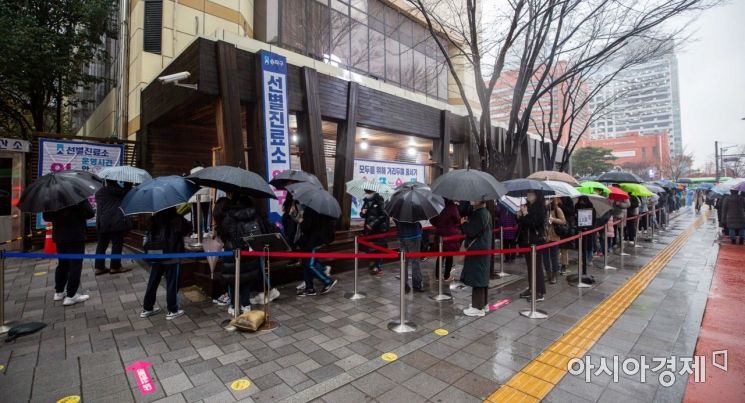 On the 30th, with 3,032 new COVID-19 cases reported, marking three consecutive days of over 3,000 cases, citizens waiting to be tested are lined up at a screening clinic set up at Songpa-gu Public Health Center in Seoul. Photo by Jinhyung Kang aymsdream@
Efforts to develop a specific PCR test for rapid variant identification will be accelerated. Currently, PCR tests can diagnose COVID-19 but cannot determine whether the Omicron variant is present. Therefore, a specific PCR analysis method capable of quickly identifying the Omicron variant will be developed promptly. The analysis of the Omicron genome information has been completed, and on the 29th of last month, expert advisory meetings were held to establish a plan for developing the PCR analysis method. To expedite development, a public-private joint task force supporting variant analysis reagent development was formed on the 30th of last month. The task force will continuously monitor manufacturers' product development status, review efficacy, and plan for distribution.
Furthermore, epidemiological investigations related to Omicron will be strengthened. Currently, contact investigations within 24 hours are completed only for first-priority groups such as family members, colleagues, and vulnerable infection facilities. Going forward, contact investigations and registrations will be completed within 24 hours for all individuals who have come into contact with confirmed Omicron variant cases. Omicron variant patients will be hospitalized in hospitals or residential treatment centers for treatment.
In addition, the Korea Disease Control and Prevention Agency (KDCA) will improve risk assessment methods by incorporating the occurrence and proportion of the Omicron variant into weekly (weekly evaluation) and every four weeks (phase evaluation) risk assessment items conducted by the Central Disaster and Safety Countermeasures Headquarters.
The KDCA stated, "Although additional analysis is needed on the epidemiological and clinical characteristics of the Omicron variant, major international organizations such as the World Health Organization (WHO) maintain that adherence to basic quarantine rules, strengthening social distancing, and rapid vaccination remain crucial in preventing the spread of variant viruses and severe cases." They urged, "Please wear masks, wash hands, ventilate spaces, refrain from unnecessary gatherings, and actively participate in vaccination and booster shots."
Meanwhile, the Inter-Ministerial Task Force for New Variant Response is led by the Director of the Korea Disease Control and Prevention Agency and composed of senior officials from related ministries including the KDCA, Ministry of Health and Welfare, Office for Government Policy Coordination, Ministry of Economy and Finance, Ministry of the Interior and Safety, Ministry of Foreign Affairs, Ministry of Justice, and Ministry of Food and Drug Safety. The task force holds regular weekly and ad hoc meetings to discuss inter-ministerial response measures for monitoring overseas trends, blocking overseas influx, variant surveillance and analysis, and preventing domestic spread. Matters agreed upon by the TF will be promptly implemented after reporting to the Central Disaster and Safety Countermeasures Headquarters.
© The Asia Business Daily(www.asiae.co.kr). All rights reserved.


















