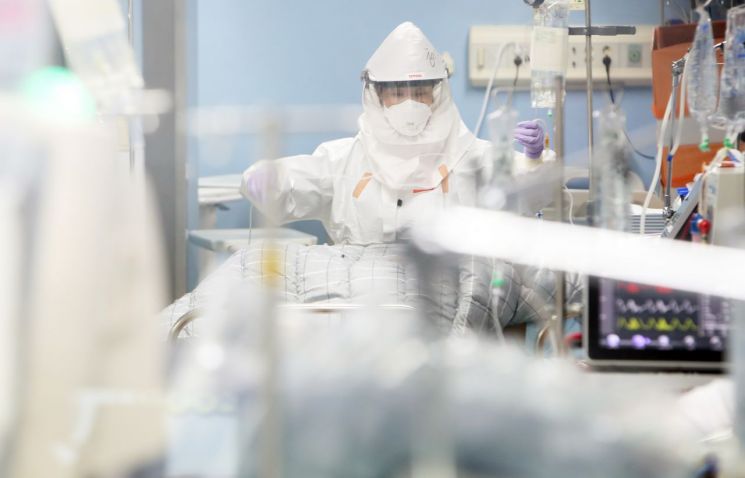
 Medical staff are caring for a patient in the intensive care unit of a COVID-19 dedicated hospital in the Seoul metropolitan area. [Image source=Yonhap News]
[Asia Economy Reporter Lee Chun-hee] As the number of new COVID-19 cases exceeds 5,000 and the number of critically ill patients hospitalized surpasses 700, all hospital beds available for patients have been fully occupied, pushing the medical response system into a state of near collapse.
On the 1st, the number of critically ill patients hospitalized reached 723, an increase of 62 from the previous day, setting a new record. The death toll also rose by 34 from the previous day, bringing the total cumulative deaths to 3,658. The resulting fatality rate has risen to approximately 0.81%.
The utilization rate of intensive care unit (ICU) beds remains at a critical level. As of 5 p.m. the previous day, out of 1,154 ICU beds secured nationwide, 909 beds (78.8%) were in use. In particular, in the metropolitan area, Seoul is at 90.7%, Incheon at 88.6%, and Gyeonggi at 87.6%, with 89.2% (637 beds) of the total 714 beds occupied. Considering the preparation work required for bed turnover such as patient admission and discharge, the situation is effectively one of 'full capacity.'
Especially, the COVID-19 ICU beds in the five major tertiary hospitals in Seoul are also saturated. Seoul Asan Medical Center (41 beds) and Seoul St. Mary’s Hospital (20 beds) have all their severe beds fully occupied. Severance Hospital has only 1 bed left out of 37, Seoul National University Hospital has 5 beds left out of 38, and Samsung Medical Center has only 3 beds left out of 31. Out of a total of 167 beds, 94.6% (158 beds) are in use, effectively at full capacity.
A representative from a tertiary hospital said, "The COVID-19 severe beds have been fully occupied for a long time," adding, "Recently, there have been almost no days when beds are available." Another representative from a general hospital stated, "Besides COVID-19, emergency patients keep coming in, but we cannot accommodate them," and explained, "If a patient shows suspicious symptoms, they must be isolated, but if isolation spaces are full, even if other beds are available, patients have to wait for a long time or be turned away."
The authorities are transferring critically ill patients from the metropolitan area to nearby regions such as Chungcheong and Gangwon, but Daejeon and Sejong have all their 25 and 3 beds fully occupied respectively, and Chungbuk at 93.8%, Chungnam at 92.1%, meaning these areas are also effectively at full capacity, continuing the crisis.
The quarantine authorities explained, "The availability of ICU beds for critically ill patients in the metropolitan area can change in real time depending on discharges and transfers on the day," and added, "Measures to expand ICU beds are ongoing." Son Young-rae, head of the Social Strategy Division at the Central Disaster and Safety Countermeasures Headquarters, said, "As of the previous day, through administrative orders and voluntary orders issued so far, we have identified about 1,300 beds that can be secured by mid-month," and added, "We expect about 50 ICU beds, 190 semi-critical beds, and 1,100 moderate beds."
© The Asia Business Daily(www.asiae.co.kr). All rights reserved.

















