[Asia Economy Reporter Jeong Hyunjin] South Korea's educational competitiveness has declined by five levels over the past five years, running counter to the rise in national competitiveness. In particular, university education remains generally in the lower ranks, from outstanding research paper production performance to faculty and graduate reputation and the level of internationalization, prompting calls for strengthening competitiveness.
On the 2nd, the Federation of Korean Industries (FKI) reported through the 'International Comparison of Korean University Competitiveness' report analyzing the World Competitiveness Report by the Swiss International Institute for Management Development (IMD) that while South Korea's national competitiveness ranking rose from 27th in 2018 to 23rd this year, educational competitiveness fell from 25th to 30th during the same period. Especially in this year's IMD survey, university education competitiveness ranked 47th out of 64 countries, remaining in the lower tier.
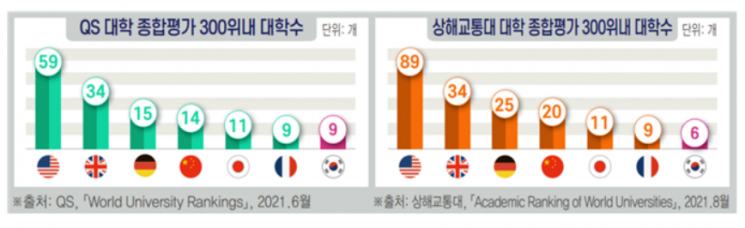
Analyzing universities ranked within the top 300 by global university ranking agencies British QS and China's Shanghai Jiao Tong University, FKI explained that among the seven countries including South Korea, China, and the major five countries (G5) ? the US, Japan, Germany, the UK, and France ? South Korea had the fewest universities included within the top 300. Notably, among the nine Korean universities in the global top 300 this year, six saw their rankings decline compared to the previous year.
According to ranking data released by British QS and Shanghai Jiao Tong University, among the universities ranked within the global top 300 with high publication records in prestigious journals such as Nature and Science, only five were Korean universities. Furthermore, no Korean university within the global top 300 held research achievements recognized by the world's most prestigious awards such as the Nobel Prize or Fields Medal.
Additionally, the reputation of university members and graduates was lower compared to advanced countries. The number of Korean universities within the global top 300 with high reputation scores for faculty and graduates was seven and nine respectively, significantly fewer than the US's 54 and 43. In the indicator reflecting the level of internationalization, such as the proportion of foreign faculty, no Korean university was found among the global top 300, and only one Korean university was among those with a high proportion of foreign students.
FKI emphasized that strengthening university competitiveness is an essential requirement for enhancing national competitiveness. To expand the production of high-quality SCI-level research papers, it is necessary to strengthen faculty capability evaluations and attract outstanding professors, thereby enhancing university research capabilities. They also argued that to cultivate talent that meets corporate demands, fostering academic fields related to the Fourth Industrial Revolution and improving graduate reputation through this is essential. In particular, Korean universities are restricted by the total admission quota regulation within the metropolitan area, limiting the establishment of new departments and expansion of quotas, which needs improvement.
Furthermore, FKI advocated for the realization of university tuition fees, which have been virtually frozen for 13 years, and the activation of a university donation culture to strengthen university finances. Through this, it is possible to enhance the comprehensive competitiveness of universities by attracting overseas scholars, FKI emphasized.
Kim Bongman, Director of International Cooperation at FKI, said, "South Korea's educational competitiveness lags behind national competitiveness, and educational competitiveness must be raised, focusing on university education," adding, "In the era of the Fourth Industrial Revolution and to become a global powerhouse, strengthening university competitiveness is essential. To secure global university competitiveness, a new paradigm must be urgently considered."
© The Asia Business Daily(www.asiae.co.kr). All rights reserved.

















