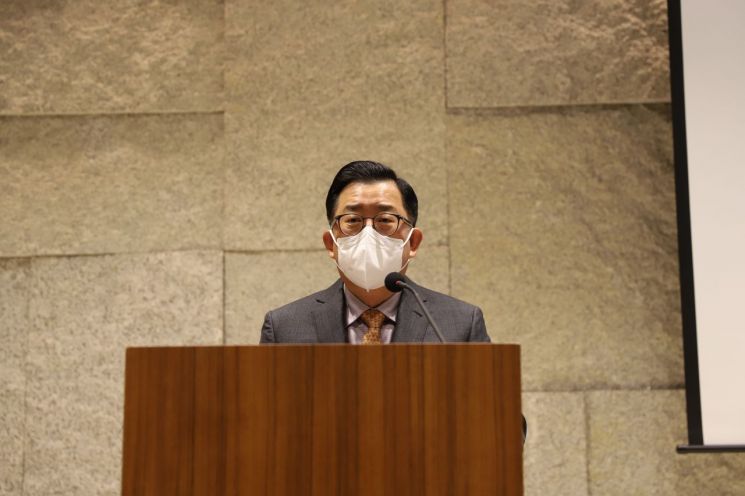
[Asia Economy Reporter Park Jihwan] Kim Young-sik, chairman of the Korean Institute of Certified Public Accountants, stated that the accounting reforms carried out over the past three years have shown tangible results, and that moving forward, efforts will focus on implementing reasonable audits that take into account the difficulties faced by companies.
On the 1st, Chairman Kim said at the first press seminar of 2021 held at the LW Convention Center in Jung-gu, Seoul, "It has been exactly three years since the new External Audit Act, known as Korea's accounting reform, was implemented," adding, "With close cooperation and communication among companies, the accounting industry, and the government, the new system is being stably implemented in the market and is showing visible results." In November 2019, the new External Audit Act was introduced, featuring the introduction of a standard audit hours system and a periodic auditor designation system to improve audit quality and transparency. Notably, after the implementation of the new External Audit Act, Korea ranked 37th out of 64 countries in the 2021 Accounting Transparency Ranking released by the International Institute for Management Development (IMD), rising nine places from 46th the previous year. Compared to 61st place in 2019, which was near the bottom, this is a remarkable 24-step improvement. Chairman Kim emphasized, "Korea's accounting reform has received positive evaluations internationally, as evidenced by the rapid rise in accounting transparency rankings for two consecutive years," and added, "I believe that investors' heightened awareness and deep interest in accounting transparency have also supported the Donghak Ants craze that pushed the stock index above 3000."
However, while companies agree with the purpose of strengthening accounting transparency, they are voicing concerns about the increased audit cost burden, calling for the abolition of the periodic auditor designation system or relaxation of the standard audit hours system. In particular, small and medium-sized enterprises and mid-sized companies are expressing difficulties in business management due to the COVID-19 situation and complaining about the cost burden caused by additional service fees and related personnel recruitment to comply with the new accounting system. Chairman Kim said, "Hourly audit fees have remained stagnant over the past 10 years," and added, "Considering the increase in audit workload and audit risk due to accounting reforms, the recent increase in audit fees and hours can be understood as a normalization process of an abnormal situation."
Chairman Kim plans to devise improvement measures that consider companies' difficulties without compromising the principles of reasonable audits. He stated, "Accounting reform is a global concern, and advanced accounting countries such as the UK, which have transparent corporate governance, are closely watching Korea's accounting reform and are conducting reforms to enhance accounting transparency." He also announced, "On the 10th of this month, ahead of the full-scale audit season, we plan to convene a meeting of accounting firm representatives to share companies' difficulties and discuss ways to implement reasonable audits considering these challenges."
Furthermore, plans are underway to conduct an accurate verification of the achievements of the accounting reform system over the past three years. Chairman Kim emphasized, "Although it may be somewhat early at the initial stage of system implementation, it is necessary to properly review whether the accounting reform has achieved its intended results," and added, "It is also necessary to examine whether Korea's backward corporate management culture, such as corporate ownership and governance, which caused the accounting reform, has changed to the level of advanced accounting countries."
During a Q&A session with reporters regarding accounting reform, Chairman Kim agreed with the financial authorities' move to strengthen the preemptive supervisory system but drew a line on discussing the abolition of the periodic auditor designation system demanded by companies, stating that it is not the right time to discuss it at this point.
Regarding the issue of audit fee burden, Chairman Kim said, "we need to look at why the input time is increasing rather than the absolute increase in audit hours," adding, "For example, a company with poor internal controls may require audit input time to increase more than tenfold." He further stated, "The apparent increase in audit fees is due to a base effect from previously reduced fees," emphasizing, "However, the current level itself is still low compared to advanced countries."
On the direction of the financial authorities' accounting organization restructuring, he said, "Recently, the Financial Supervisory Service announced that it would focus the supervisory system on preemptive supervision, which I think is the right direction," adding, "there is an absolute need to shift to a supervisory system centered on preemptive prevention."
Regarding the criticism from some corporate groups calling for the abolition of the periodic auditor designation system, Chairman Kim said, "If companies' audit committees are properly formed in the future and many accounting professionals are positioned within the committees, it might be possible, but at this point, I think much more time is needed."
Professor Jeon Gyu-an of Soongsil University’s Department of Accounting, who gave a lecture on "Achievements and Challenges of the New External Audit Act after Three Years," evaluated that the new External Audit Act introduced the most meaningful reforms in about 40 years since the enactment of the External Audit Act in 1981, contributing to the improvement of Korea's accounting transparency and audit quality. However, he also mentioned that there were aspects where the reforms became a burden for companies during the normalization process of Korea's accounting audits. Professor Jeon said, "Domestic accounting reform is still in its early stages and has just taken its first step," adding, "It is inappropriate to discuss the sustainability of the periodic auditor designation system, the introduction of standard audit hours, and the strengthening of internal accounting control systems at this time." He further added, "Shareholders and creditors are not adversaries," and "Since companies, shareholders, and creditors are all partners, I hope they understand each other and come up with improvement measures together."
© The Asia Business Daily(www.asiae.co.kr). All rights reserved.

















