KIMS Passes Certification Test
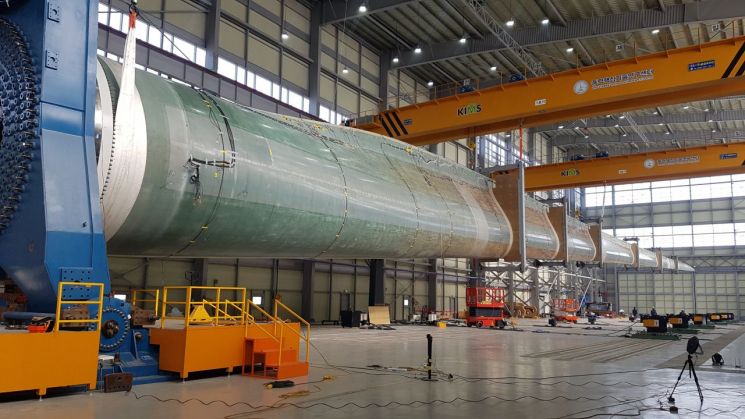 A super-large wind turbine blade approximately 100 meters in length developed by the Korea Institute of Materials Science.
[Asia Economy Reporter Kim Bong-su] Domestic researchers have developed the world's third-largest 100m-class ultra-large wind turbine blade. This technology is attracting attention as it can dramatically improve the productivity of wind power generation, which is the most prominent among renewable energy sources.
The Korea Institute of Materials Science (KIMS) announced on the 1st that the research team led by Park Ji-sang, head of the Wind Power Core Technology Research Center, successfully developed the certification test facility and testing technology for 100m-class ultra-large wind turbine blades for the first time in Korea and completed the static load certification test. This success in the certification test of the 100m-class ultra-large wind turbine blade is the first in Korea and the third worldwide.
Globally, various efforts are being made to develop ultra-large wind turbine blades, but successful cases of certification testing are rare. Currently, only three places have facilities and testing technologies for certification tests of ultra-large wind turbine blades over 100m in length: KIMS, ORE CATAPULT in the UK, and CGC (Yangjiang) in China. Among these, only the UK and Korea have international accredited testing institutions recognized by IECRE (the International Renewable Energy Certification System of the International Standard Organization).
The 100m-class blade for which KIMS completed the certification test is an ultra-large blade developed domestically for the first time through a government-supported project, with a capacity of 8MW and a length of 100m. It was jointly developed by domestic companies and institutions: Doosan Heavy Industries & Construction took charge of the turbine system, Doosan Heavy Industries & Construction and KIMS jointly designed the blade, Human Composite manufactured the blade, and KIMS conducted and completed the certification test.
To achieve carbon neutrality by 2050, a large-scale energy transition centered on wind and solar power is necessary, and wind power is expected to account for the largest share of power generation from 2040 onwards. To utilize wind more cheaply and efficiently, the acceleration of ultra-large wind turbines and the rapid growth of the offshore wind power market have led to fierce competition worldwide to develop ultra-large blades over 100m. The competition to enlarge blades, the key to realizing ultra-large wind turbines, is intense. It is evaluated that the future leader in the wind power industry will be determined by who commercializes ultra-large blades over 100m first.
KIMS plans to complete fatigue load testing and post-fatigue static load testing of the blades and obtain domestic and international certification. Once the blades are stably supplied to the domestic southwestern offshore wind power complex, it is expected to become the world's first case of commercializing blades over 100m in length.
Center Director Park said, "The success of developing a 100m-class domestic blade for large offshore wind turbines means that domestic offshore wind power technology will make a great leap forward and approach the world's top level," adding, "We will strive to create a foothold for domestic wind turbines to enter overseas markets."
© The Asia Business Daily(www.asiae.co.kr). All rights reserved.
![Clutching a Stolen Dior Bag, Saying "I Hate Being Poor but Real"... The Grotesque Con of a "Human Knockoff" [Slate]](https://cwcontent.asiae.co.kr/asiaresize/183/2026021902243444107_1771435474.jpg)
















