National Bureau of Statistics November Manufacturing PMI at 50.1, Non-Manufacturing PMI at 52.3
Concerns Over Economic Slowdown Persist... Q4 Economic Growth Likely Much Lower Than Expected
[Asia Economy Beijing=Special Correspondent Jo Young-shin] China's manufacturing Purchasing Managers' Index (PMI), an indicator of the manufacturing economy, has surpassed the baseline of 50. This is the first time in three months that it has risen above the baseline.
China's National Bureau of Statistics announced on the 30th that the manufacturing PMI for November was recorded at 50.1. The manufacturing PMI, based on surveys of business officials, indicates economic expansion when above the baseline of 50, and economic contraction when below 50.
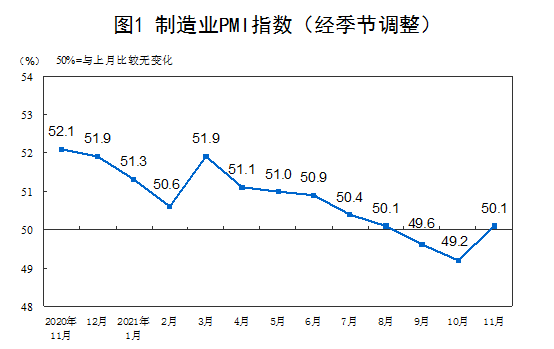
Due to power shortages, rising international raw material prices, sporadic COVID-19 outbreaks, and global supply chain bottlenecks, China's manufacturing PMI fell below the baseline of 50 in September and October.
As coal supply in China stabilized, the manufacturing PMI appears to have exited the economic contraction zone.
The National Bureau of Statistics explained the rise in PMI by stating, "The effects of policies such as strengthening energy supply have appeared, and the power supply and demand situation has somewhat eased," adding, "Some raw material prices have clearly declined." The bureau further evaluated that "the PMI index rose as the energy supply and demand situation improved."
The non-manufacturing PMI for November, announced on the same day, was recorded at 52.3, slightly down from 52.4 in the previous month.
Although the manufacturing PMI has risen above the baseline of 50, the prevailing view is that China's economic slowdown trend will continue. Consumption sectors and fixed asset investment, excluding the manufacturing sector, are still considered below expectations. Accordingly, there is growing credibility to forecasts that the fourth-quarter economic growth rate could be much lower than expected. Concerns are also emerging that it could fall to the 3% range or below.
Wang Tao, UBS's Chief China Economist, recently forecasted in a report that China's fourth-quarter economic growth rate could drop to 2.7%, due to severe real estate market contraction combined with the economic and social impacts of the zero-COVID policy.
Tang Duoduo, Director of the Economic Research Institute at the Chinese Academy of Social Sciences, analyzed that "the rise in international raw material prices, global supply chain crisis, power shortages, and negative factors such as China's real estate and education regulations have overlapped, potentially causing the fourth-quarter growth rate to be significantly lower than initially expected." He also added that despite the Chinese government's active fiscal policies, progress in fiscal spending is lagging due to real estate regulations and other factors.
In fact, Premier Li Keqiang, at the State Council executive meeting held on the 24th, stated, "Downward pressure on the economy in the second half of the year is intense," and instructed, "Hasten the issuance of local government bonds with remaining limits so that funds can be used for major livelihood projects such as expanding domestic demand and promoting consumption."
The gap between the Producer Price Index (PPI) and the export price index is also problematic. While increases in international raw material prices are immediately reflected in the PPI and import price index, the export price index is known to lag by five months. Statistically, export performance appears positive, but the business conditions of manufacturing companies fall short of those figures.
There is also a possibility that the PPI will be transmitted to the Consumer Price Index (CPI). The CPI had shown stability, peaking at 1.3% year-on-year in May, then 1.1% in June, 1.0% in July, 0.8% in August, and 0.7% in September, but it rose sharply by 1.5% last month. If the CPI surges, the fiscal policy room available to the Chinese government will shrink.
© The Asia Business Daily(www.asiae.co.kr). All rights reserved.
![Clutching a Stolen Dior Bag, Saying "I Hate Being Poor but Real"... The Grotesque Con of a "Human Knockoff" [Slate]](https://cwcontent.asiae.co.kr/asiaresize/183/2026021902243444107_1771435474.jpg)
















