On the 30th, the Bank of Korea Announces Analysis of Factors Behind South Korea's Current Account Surplus
[Asia Economy Reporter Jang Sehee] An analysis has emerged that this year's current account surplus will reach about 5% of the Gross Domestic Product (GDP). Although it may gradually decrease moderately, it is expected that the large-scale surplus trend will not weaken in the short term.
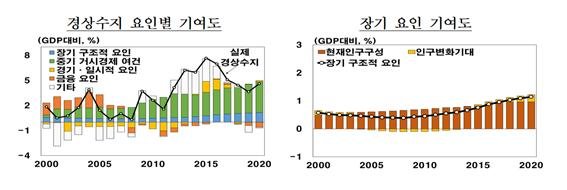
According to the "Analysis of Factors Contributing to South Korea's Current Account Surplus" published on the 30th in the Bank of Korea's Monthly Statistical Bulletin, South Korea's current account has maintained a surplus trend since 2000, with a significant expansion in the surplus from 2012. The ratio of current account surplus to GDP rose from an average of 1.5% between 2000 and 2011 to an average of 5.1% from 2012 to 2021.
This is attributed to long-term structural factors and medium-term macroeconomic conditions since 2012, with most of the current account surplus after 2018 resulting from medium- to long-term factors.
Bank of Korea officials Joo Uk, Min Eunji, and researcher Ahn Heejeong applied the coefficient estimates from an empirical analysis model to South Korean data to analyze the contribution of determinants of the current account. The long-term factors were identified as the demographic composition effect, such as the rising proportion of the core saving population, and the increased saving incentives due to rapid aging.
Medium-term factors were analyzed as the positive turnaround of net external assets and fiscal policies that increased government spending or reduced taxes compared to advanced countries, resulting in a favorable fiscal balance. The expansion of participation in the Global Value Chain (GVC) also contributed to the improvement of the current account by increasing income (savings) through enhanced productivity and export competitiveness.
Furthermore, it is expected that the contribution of demographic structure and fiscal balance to the current account surplus will gradually decrease over a long period in the future.
The rise in the elderly dependency ratio due to aging leads to a decline in household saving rates, causing the surplus contribution to shift to a moderate downward trend, while the fiscal balance's surplus contribution will be very gradually reduced due to expanded social security expenditures.
Meanwhile, net external assets are expected to partially offset the reduction in surplus contributions from demographic structure and fiscal balance, as their surplus contribution shows an increasing trend due to the cumulative effect of the current account surplus.
© The Asia Business Daily(www.asiae.co.kr). All rights reserved.
![Clutching a Stolen Dior Bag, Saying "I Hate Being Poor but Real"... The Grotesque Con of a "Human Knockoff" [Slate]](https://cwcontent.asiae.co.kr/asiaresize/183/2026021902243444107_1771435474.jpg)
















