Financial Forum November Issue Current Issue Analysis Data
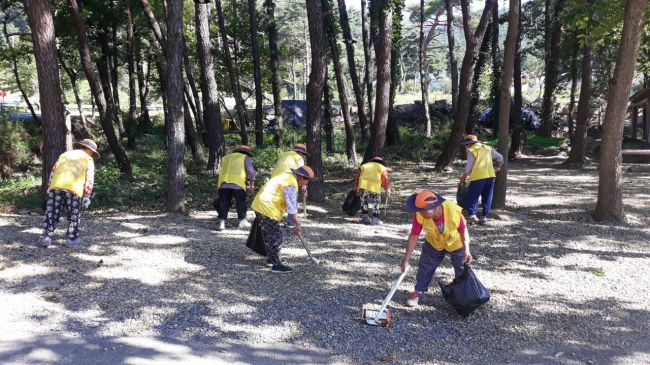
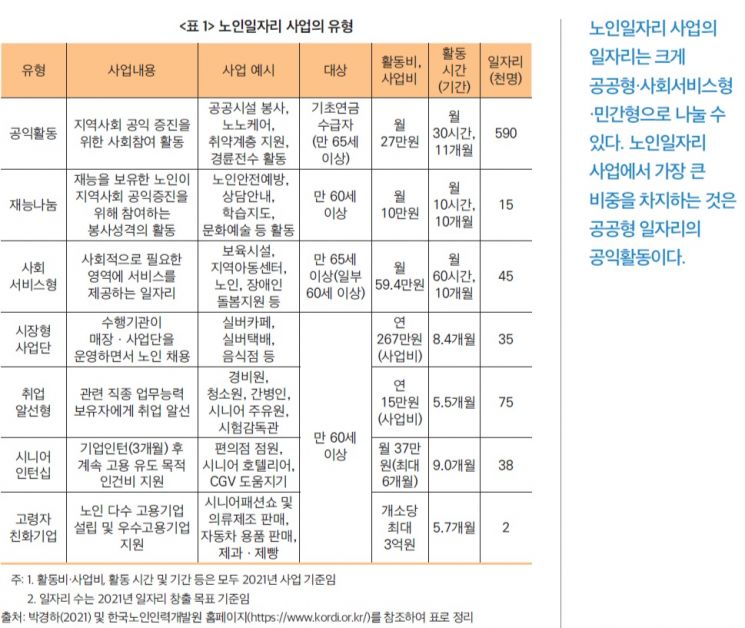
[Sejong=Asia Economy Reporter Moon Chaeseok] A national research institute has pointed out that public job support policies for low-income elderly should be designed to focus on industries with high social demand such as care, education, and health, so that these jobs become a practical means of livelihood for them.
Jo Heepyeong, Associate Research Fellow at the Korea Institute of Public Finance, stated this in the November issue of the Fiscal Forum published by the institute on the 30th, in an analysis titled "The Role of Senior Job Projects in the Elderly Labor Market."
Based on empirical analysis using regional employment surveys, Associate Research Fellow Jo found that from 2013 to 2019, the probability of people aged 65 and over obtaining public jobs increased by an average of 0.2 percentage points (p) annually due to minimum wage hikes. Conversely, the probability of those aged 65 and over being employed in non-public jobs such as wage workers and self-employed decreased by an average of 0.2%p annually.
The issue is whether public jobs effectively serve as a means of livelihood for the elderly or are merely simple social activities like cleaning and garbage collection. It is urgent to enhance the effectiveness of support policies so that public jobs can play a livelihood role for low-income elderly.
Associate Research Fellow Jo emphasized that support should be provided to enable low-income elderly to find employment mainly in social service sectors such as care, education, and health, while also implementing strategies to improve the efficiency of existing private job policy support. He said, "If senior job projects and policies to stabilize elderly employment in the private sector are properly harmonized, it could alleviate elderly poverty and, in the long term, enhance economic vitality through an increase in the economically active population."
© The Asia Business Daily(www.asiae.co.kr). All rights reserved.


















