[Asia Economy Yang Nak-gyu, Military Specialist Reporter] As the U.S. Department of Defense announced the results of the Biden administration's first 'Global Posture Review' (GPR), attention is focusing on the upcoming Security Consultative Meeting (SCM) between South Korea and the U.S. scheduled for the 2nd of next month.
On the 29th (local time), Mara Karlin, Deputy Assistant Secretary of Defense for Policy, stated, "Secretary of Defense Lloyd Austin will engage in productive discussions including deterrence policy," adding, "I do not think there is any reason to mention any changes beforehand."
Coincidentally, the day the Department of Defense announced the GPR results was just one day before Secretary of Defense Lloyd Austin's visit to South Korea to attend the SCM. Because of this, the upcoming SCM is expected to include discussions not only on changes to the deployment of U.S. Forces Korea but also on the U.S. nuclear umbrella policy.
Extended deterrence, which concretizes the nuclear umbrella from a military strategic perspective, has been included in the SCM joint statements since 2006. Last year's statement reaffirmed "the United States' continued commitment that the U.S. Secretary of Defense will employ all categories of military capabilities, including nuclear, conventional, and missile defense capabilities, to provide extended deterrence to South Korea."
Furthermore, discussions on the transfer of wartime operational control (OPCON) are also expected at this SCM. According to the Department of Defense, this year's SCM will discuss ▲ cooperation on North Korea policy for the complete denuclearization of the Korean Peninsula and the establishment of permanent peace ▲ promotion of OPCON transfer based on conditions ▲ measures to enhance defense cooperation for the comprehensive and mutually beneficial development of the South Korea-U.S. alliance.
Within and outside the military, there is an assessment that the U.S. first reviewed the permanent stationing of U.S. Forces Korea due to delays in the second phase of Full Operational Capability (FOC) verification for OPCON transfer caused by COVID-19.
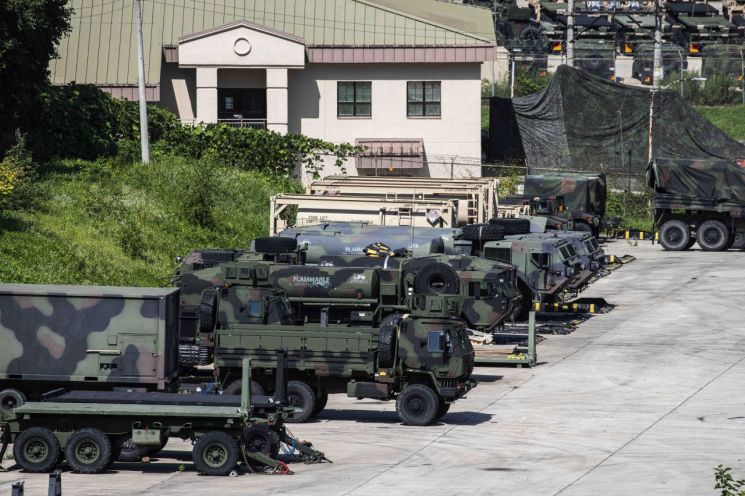
The permanently stationed units approved by U.S. Secretary of Defense Lloyd Austin include the Apache attack helicopter unit (an aviation battalion of the 2nd Infantry Division of U.S. Forces Korea) and the artillery brigade (201st Fires Brigade). Concerns were raised that these units' combat power might weaken due to the inability to conduct proper combined U.S.-South Korea exercises because of COVID-19. If converted to permanently stationed units, their combat power and wartime response capabilities could be further enhanced.
In particular, the controversial rumors about the reduction of U.S. Forces Korea are expected to be dismissed. Since the inauguration of the Biden administration, the U.S. Senate and House of Representatives have removed the reduction restriction clause in the National Defense Authorization Act (NDAA) that prohibited the use of funds if U.S. Forces Korea were reduced below 28,500 personnel.
© The Asia Business Daily(www.asiae.co.kr). All rights reserved.