Reaffirming Position to Maintain Current Size of USFK
Transition to Permanent Stationing of Rotational Units to Strengthen Deterrence Against China
"Secretary Austin to Visit Korea Soon, Discussing ROK-US-Japan Cooperation and Response to China"
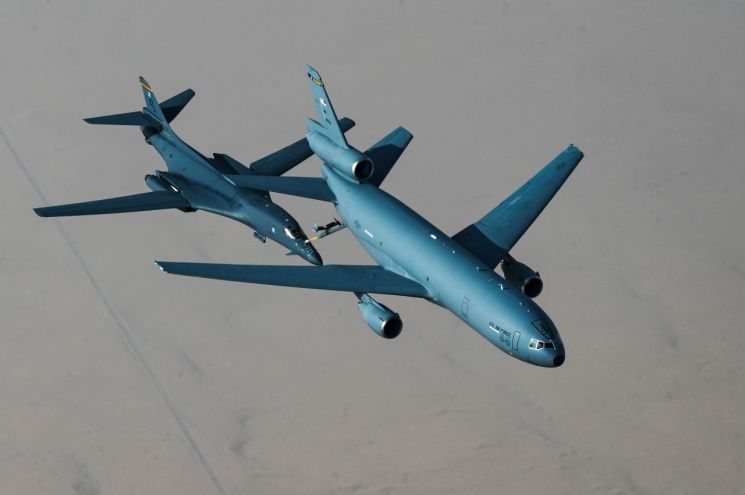
[Asia Economy Reporter Lee Hyun-woo] The U.S. Department of Defense reaffirmed that there is no change in the nuclear umbrella policy for South Korea to deter North Korea's nuclear threat and emphasized strengthening trilateral cooperation among South Korea, the United States, and Japan. Along with this, it announced the conversion of the Apache attack helicopter units and artillery brigade headquarters, which had been rotationally deployed to South Korea, into permanently stationed units aimed at enhancing capabilities to counter China. This is interpreted as a strategic move to strengthen the encirclement of China by enhancing the capabilities of U.S. forces stationed in the Indo-Pacific region, including Australia and Guam, alongside strengthening the U.S. Forces Korea's combat power.
On the 29th (local time), Mara Karlin, U.S. Deputy Assistant Secretary of Defense for Policy, announced the results of the comprehensive review of overseas U.S. military deployments and forces, known as the 'Global Posture Review (GPR).' Deputy Assistant Secretary Karlin emphasized, "The results of this review primarily include directives to strengthen alliance cooperation to deter potential Chinese military aggression and to counter the threat from North Korea in the Indo-Pacific region."
In particular, the review included the conversion of some rotationally deployed units in South Korea into permanently stationed units to enhance U.S. Forces Korea's capabilities. Deputy Assistant Secretary Karlin explained, "The approval of Secretary of Defense Lloyd Austin was included for converting the rotationally deployed Apache attack helicopter units and artillery brigade headquarters into permanent units," adding, "The upcoming National Security Strategy review will also express deep concerns regarding North Korea."
Additionally, the position that there is no change in the nuclear umbrella policy for South Korea was emphasized. He stated, "Our extended deterrence for close allies is an absolutely critical matter," and added, "There is nothing to discuss regarding any changes to the nuclear umbrella policy for South Korea." He further stressed, "The current deployment of U.S. Forces Korea is very robust and effective, and at this point, there is no intention to announce any changes; it is a very prudent deployment."
This statement is interpreted as an effort to dispel concerns about the reduction of U.S. Forces Korea, which had been raised domestically and internationally. Earlier this year, shortly after the inauguration of the Joe Biden administration, concerns about the reduction of U.S. Forces Korea were raised when the restriction clause in the National Defense Authorization Act (NDAA), which prevented the use of funds if the U.S. Forces Korea were reduced below the current level of 28,500 personnel, was removed in both the Senate and the House of Representatives.
The U.S. Department of Defense also announced plans to strengthen U.S. military forces in the Pacific island regions, including Australia and Guam, alongside enhancing U.S. Forces Korea's capabilities. Deputy Assistant Secretary Karlin added, "The GPR includes plans for base expansion, infrastructure enhancement, and aircraft deployment in Australia, Guam, and the Pacific island regions."
© The Asia Business Daily(www.asiae.co.kr). All rights reserved.
![Clutching a Stolen Dior Bag, Saying "I Hate Being Poor but Real"... The Grotesque Con of a "Human Knockoff" [Slate]](https://cwcontent.asiae.co.kr/asiaresize/183/2026021902243444107_1771435474.jpg)
















