Statistics Korea Announces October 2021 Industrial Activity Trends
"Substitute Holidays and Base Effects... Too Early to Judge Economic Downturn"
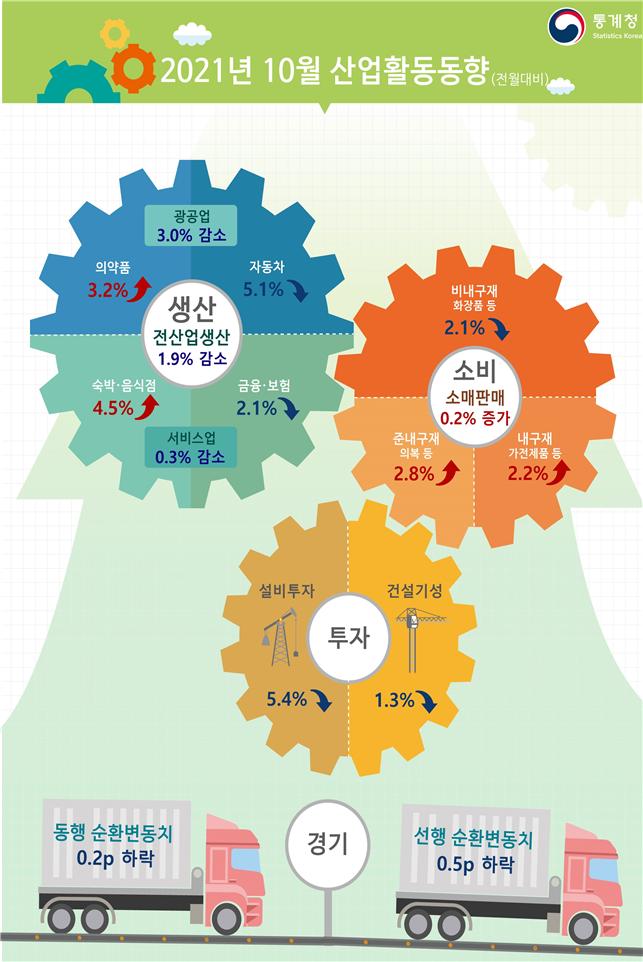
[Sejong=Asia Economy Reporter Kim Hyun-jung] With both manufacturing and service production declining, total industrial production in October fell 1.9% compared to the previous month, marking the largest drop in 18 months. Although the economic recovery and improvement trend observed in September showed signs of stalling, the government explained that the base effect and the impact of substitute holidays must also be taken into account.
According to the Industrial Activity Trends report by Statistics Korea on the 30th, the total industrial production index (seasonally adjusted, excluding agriculture, forestry, and fisheries) for October was 110.8 (2015=100), down 1.9% from the previous month. This is the largest decline in a year and a half since April last year (-2.0%). Total industrial production had decreased by 0.7% and 0.1% in July and August respectively, rebounded by 1.1% in September, but turned downward again in October.
Oh Woon-seon, Director of Economic Trend Statistics at Statistics Korea, explained, "Key indicators excluding consumption, such as production and investment, weakened compared to the previous month, showing signs of the recent economic recovery trend stalling." However, he added, "The October slump should be viewed considering the base effect from the high level in September and the reduced working days due to the designation of substitute holidays. It is premature to judge the economic trend based solely on October's figures."
Manufacturing declined 3.1%, continuing its downward trend for the fourth consecutive month since July, affected by global supply chain issues. The service sector, which had increased by 1.4% in the previous month, turned to a 0.3% decrease in October. Public administration fell 8.9% due to base effects from quarterly defense lease payments, and construction decreased by 1.3%.
On the other hand, the retail sales index (seasonally adjusted), which reflects consumer trends, rose 0.2% from the previous month to 121.5 (2015=100). Although the retail sales index maintained its upward trend following a 2.4% increase in September, the growth rate significantly weakened.
Facility investment and construction output decreased by 5.4% and 1.3%, respectively. The decline in facility investment is the largest in 17 months since May last year (-5.7%).
The coincident index, which indicates the current economic condition, stood at 101.0, and the leading index, which predicts future economic trends, was 101.6, both down by 0.2 points and 0.5 points, respectively.
Director Oh stated, "We do not see the improvement trend in the economy as broken. Exports remain strong, and consumer sentiment is improving with expanded vaccination, so the recovery trend is expected to continue." However, he cautioned, "Uncertainty regarding the domestic COVID-19 situation is increasing, and downside pressures remain due to external issues such as global supply chain disruptions and rising international raw material prices, making future economic trends uncertain."
© The Asia Business Daily(www.asiae.co.kr). All rights reserved.
![Clutching a Stolen Dior Bag, Saying "I Hate Being Poor but Real"... The Grotesque Con of a "Human Knockoff" [Slate]](https://cwcontent.asiae.co.kr/asiaresize/183/2026021902243444107_1771435474.jpg)
















