Expansion and Restoration of Traditional Forest Linked with Yudang Park, Establishing It as a Representative Tourist Attraction of Gwangyang-eup
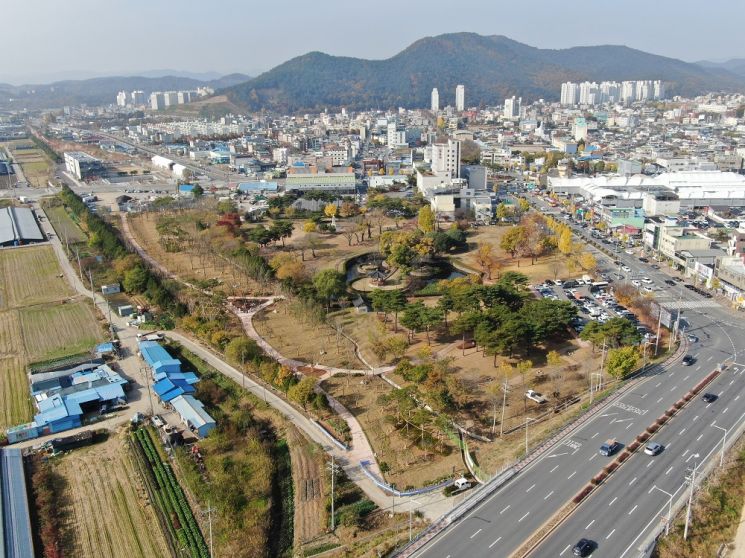
[Asia Economy Honam Reporting Headquarters, Reporter Heo Seon-sik] Gwangyang City, Jeollanam-do announced that it has created a fine dust blocking forest by utilizing the former Gwangyang Station abandoned railway site around Yudang Park, where the natural monument No. 235, Gwangyang Eup Water and Ipopnamu (Chinese fringe tree) are located.
Since 2016, the approximately 4km section of the Gyeongjeon Line abandoned railway from the Suncheon boundary Dongil Tunnel to the Driver’s License Examination Office, Jeonnam Provincial Museum of Art, and Yudang Park has been connected as a single green axis, attracting attention as a new forest landscape resource.
Yudang Park, a designated cultural heritage area, is a regional attraction where the atmosphere and scenery harmonize. In 1547, Park Se-hu, the magistrate of Gwangyang, planted old trees such as Zelkova, Phellodendron amurense, and Ipopnamu to serve as a windbreak forest to block sea breezes and to prevent Japanese pirates from spotting the walled town from the sea.
Since the abandonment of the Gyeongjeon Line in July 2016, the area around Yudang Park had been neglected for a long time, with various waste deposits damaging the urban landscape, leading to a continuous call for the creation of an urban forest.
The city invested a total project cost of 2.4 billion KRW to expand and restore Korea’s unique traditional forest, where 400-500 year-old Zelkova and Phellodendron amurense trees coexist. After expert technical consultations, cultural heritage alteration reviews by the Cultural Heritage Administration, and sample surveys of buried cultural assets, the project started in mid-June and completed the forest creation by the end of November.
Based on the traditional tree species distributed in the existing Yudang Park, 327 large trees of seven species including Ipopnamu and Zelkova, 14,506 shrubs of two species such as azalea and red holly, and 15,920 herbaceous plants of three species including Liriope and Lycoris radiata were planted to create the atmosphere of a traditional forest.
Additionally, a new 400m trail was constructed connecting to the existing Yudang Park walking path, and 13 benches, 16 security lights, information boards, and tree nameplates were installed considering the convenience of visitors.
Kim Jae-bok, Director of the Greenery Division, said, “The abandoned railway site has been reborn as an urban forest in the living area, and we hope it will become a representative tourist attraction of the Gwangyang Eup area linked with the nearby Provincial Museum of Art and Yudang Park.” He added, “We will continue to strive to improve citizens’ quality of life through continuous green infrastructure development.”
Meanwhile, Gwangyang City has completed the creation of a total of 7 hectares of fine dust blocking forests this year to systematically respond to climate change such as fine dust reduction and urban heat island mitigation. Next year, it plans to invest a total project cost of 4 billion KRW to create 4 hectares of facility green space in the Jungmadong area.
Asia Economy Honam Reporting Headquarters, Reporter Heo Seon-sik hss79@asiae.co.kr
© The Asia Business Daily(www.asiae.co.kr). All rights reserved.

















