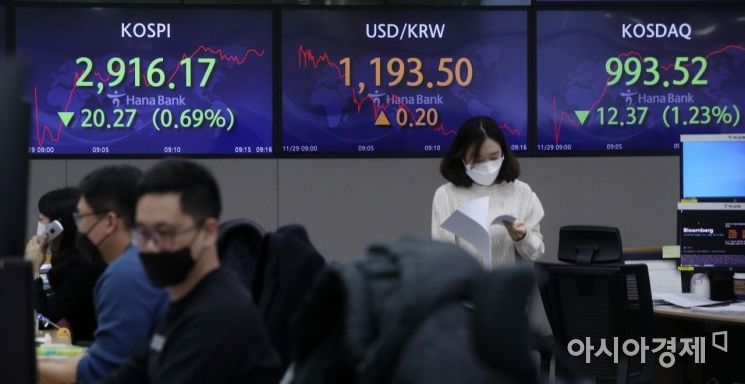
 On the 29th, when the KOSPI started lower due to fears of the Omicron variant of the COVID-19 virus, the dealing room of Hana Bank in Jung-gu, Seoul was seen. On that day, the KOSPI opened at 2,906.15, down 30.29 points (1.03%). The won-dollar exchange rate opened at 1,195.5 won, up 2.2 won. Photo by Kim Hyun-min kimhyun81@
[Asia Economy Reporter Lee Seon-ae] On the 29th, the KOSPI, which started with a drop of more than 1%, is reducing its losses. It started at the 2900 level, fell below 2890 during the session, but then recovered to the 2920 level.
As of 9:51 AM, the KOSPI is down 0.56% at 2919.86. During the session, it broke below the 2900 level and touched the 2890 level. This is the first time in about 10 months since January 4th (2869.11) that the KOSPI has fallen below 2900 during trading. However, it then reduced its losses and rose back to the 2920 level.
This is attributed to net buying by foreigners and institutions. Foreign investors have a net buying advantage of 54.1 billion KRW and 140.2 billion KRW in the KOSPI and KOSDAQ markets, respectively. Institutions are also recording net purchases of 721.9 billion KRW and 2 billion KRW in the two markets, respectively. Only individual investors are showing signs of panic selling, with net selling of 741.7 billion KRW and 187.3 billion KRW in the KOSPI and KOSDAQ markets, respectively.
The market is closely watching the spread of Omicron. Shin Seung-jin, a researcher at Samsung Securities, explained, "If lockdowns due to variant viruses expand in the future, supply chain bottleneck issues may re-emerge," adding, "This could lead to renewed concerns about a global economic slowdown." Seo Sang-young, a researcher at Mirae Asset Securities, also said, "We need to continuously monitor whether the spread extends to Southeast Asia and China, as this could affect supply chain issues," expressing concern that "In the worst case, if these points spread, panic selling could expand."
© The Asia Business Daily(www.asiae.co.kr). All rights reserved.
![User Who Sold Erroneously Deposited Bitcoins to Repay Debt and Fund Entertainment... What Did the Supreme Court Decide in 2021? [Legal Issue Check]](https://cwcontent.asiae.co.kr/asiaresize/183/2026020910431234020_1770601391.png)















