Stock Market Volatility Expands Amid Ant Two-Heart Shrinkage... Focus on Powell's Congressional Testimony This Week
US Federal Funds Rate Futures Market "Fed Rate Hike Shifted from June to September Next Year"
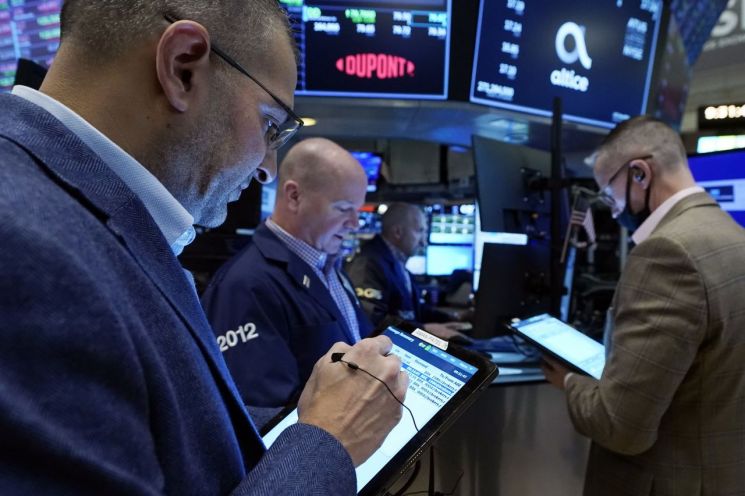
[Asia Economy New York=Correspondent Baek Jong-min, Reporter Park Byung-hee] The newly emerged COVID-19 Omicron variant is becoming a variable in the global stock market, which had been on the rise, due to the increased uncertainty that financial markets dislike the most. In particular, concerns are being raised that volatility may increase as the investment sentiment of individual investors, who have gained influence in the U.S. stock market this year, weakens.
On the 28th (local time), the Wall Street Journal (WSJ) published an analysis article explaining that the reason major indices on the New York Stock Exchange all plunged by over 2% on the 26th was related to the expansion of margin trading by individuals.
WSJ focused on the fact that since last year, many individual investors have entered the stock market, significantly increasing not only cash stock margin trading but also options trading. It evaluated that last week's market plunge revealed the vulnerability of the stock market, which had maintained an upward trend since the COVID-19 outbreak. The cause of the vulnerability WSJ warned about is the excessive expansion of margin trading and increased borrowing transactions.
According to the Financial Industry Regulatory Authority (FINRA), the U.S. financial supervisory authority, as of October, the loan amount for margin trading in the U.S. reached $935.9 billion, a 42% increase compared to the same period last year. As loans increased, individual investors' cash holdings dropped to 46% of borrowed funds, the lowest level since 1997. This means that individual margin trading was substantial.
Jason Joffe, head of Sundial Capital Research, explained, "When stock trading through borrowing increases, if the market shakes, investors become confused and start panic selling." The U.S. central bank, the Federal Reserve (Fed), also mentioned concerns about excessive margin trading among younger generations in its recently released financial stability report. The Fed warned that since young investors tend to have aggressive investment tendencies, they are more likely to face forced liquidation during market downturns.
With the Omicron variant emerging as a new variable, Fed Chair Jerome Powell is scheduled to testify before Congress this week about the economy. He will appear before the U.S. Senate Banking Committee on the 30th and the House Financial Services Committee hearing on the 1st of next month. Attention is focused on what stance Chair Powell will take regarding the Omicron variant. U.S. Treasury Secretary Janet Yellen is also expected to attend the hearings alongside Chair Powell.
Before appearing before Congress, Chair Powell is scheduled to deliver a speech on the 29th at an online video conference commemorating the opening of the New York Innovation Center (NYIC). NYIC was established as part of a strategic collaboration between the Federal Reserve Bank of New York and the Bank for International Settlements (BIS) to develop financial technology and services.
Already, in the U.S. federal funds futures market, there is a forecast that the timing of the Fed's first interest rate hike since the COVID-19 pandemic will be delayed due to the Omicron variant. According to Bloomberg News, after news of the Omicron variant spread, the expected timing for a 0.25 percentage point increase in the U.S. benchmark interest rate, as predicted by the federal funds futures market, was pushed back from June to September next year.
The possibility of the Bank of England (BOE) raising its benchmark interest rate in December this year is also becoming uncertain. On the 26th, the probability of a BOE rate hike in December reflected in the UK interest rate futures market dropped to 55%, down from 75% just on the 25th.
The Fed will hold its final monetary policy meeting of the year on December 14-15, and the BOE will hold its last meeting on December 16.
© The Asia Business Daily(www.asiae.co.kr). All rights reserved.
![Clutching a Stolen Dior Bag, Saying "I Hate Being Poor but Real"... The Grotesque Con of a "Human Knockoff" [Slate]](https://cwcontent.asiae.co.kr/asiaresize/183/2026021902243444107_1771435474.jpg)











