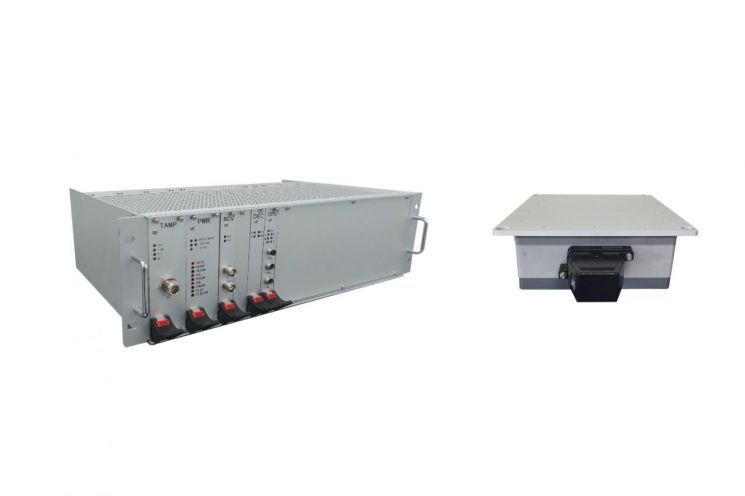
[Asia Economy Reporter Jeong Hyunjin] Hyundai Rotem announced on the 29th that it has succeeded in the localization development of the core component of the Korean Train Control System (KTCS), the balise transmission module (BTM), a ground signal receiving device for trains that was previously dependent on imports.
The train control system detects the operating position of trains and controls the distance between trains to prevent collision accidents and maintain safe operation. The balise transmission module, which Hyundai Rotem has now localized, is a device that receives ground information such as the train's location and speed limits, and is a key component necessary for the safe operation of trains.
This component has been entirely imported since the automatic train protection (ATP) signaling system, which automatically adjusts the distance between trains, was introduced in Korea in 2003. Accordingly, Hyundai Rotem began localization development in 2017 and, after more than five years, secured the first independently certified model in Korea. The component developed by Hyundai Rotem has quality and performance equivalent to overseas competitors' products and has passed low-temperature tests down to minus 40 degrees Celsius, enabling operation at lower temperatures than imported products.
With the success of localization, Hyundai Rotem expects to establish a stable maintenance system and achieve import substitution effects. The domestic market size for onboard signal devices is projected to reach approximately 500 billion KRW by 2027, and localization of the balise transmission module is expected to generate about 15 billion KRW in import substitution effects.
This month, Hyundai Rotem received SIL 4 certification, the highest safety integrity level, for the balise transmission module from Ricardo Certification, an international railway safety evaluation organization based in the UK, securing product reliability. Additionally, the module was designed to meet the European Union (EU) Technical Specifications for Interoperability (TSI) standards for railways, raising expectations for exports of the balise transmission module to Europe.
Starting with the pilot operation project of the Korean Train Signal System on the Jeolla Line (Iksan~Yeosu Expo, 180 km), scheduled for completion next year, Hyundai Rotem plans to expand the application of the balise transmission module to domestic projects such as the Daegu metropolitan railroad electric trains, KTX-Eum, EMU-320, and new overseas lines, targeting the global train signal system market.
A Hyundai Rotem official stated, "The global railway signal system market is dominated by a few companies with the latest technologies such as Alstom, Siemens, and Hitachi," adding, "This research achievement internalizes train signal system technology domestically, reducing costs and breaking free from technological dependence, laying the foundation to enter the global market." He continued, "We will do our best to secure additional business orders based on continuous research and development."
© The Asia Business Daily(www.asiae.co.kr). All rights reserved.

















