On the 29th, 'Policy Forum on Dual Structure Reform of the Labor Market and Labor-Management Relations' Held
[Sejong=Asia Economy Reporter Moon Chaeseok] There has been a call for labor unions to unify their channels in tripartite dialogues just like employers. It was also pointed out that competition and internal conflicts between the Federation of Korean Trade Unions and the Korean Confederation of Trade Unions were decisive reasons why the outcomes of tripartite social dialogues were not significant.
On the morning of the same day at 11 a.m., the Job Solidarity held a policy forum titled "Reform of the Dual Structure of the Labor Market and Labor Relations" at the Korea Press Center in Jung-gu, Seoul, making these claims. Job Solidarity is an organization involving Kim Daehwan, Honorary Professor at Inha University and former Minister of Employment and Labor during the Roh Moo-hyun administration (Standing Representative), Lee Geunmyeon, former head of the Ministry of Personnel Management (Advisor), and Kim Taegi, Honorary Professor of Economics at Dankook University (Executive Director).
Professor Kim Taegi explained the structural problems of Korean labor unions, which are mainly organized by enterprise unions, with excessive influence from unions in large corporations and the public sector, and suggested improvements in his presentation titled "Reform of the Dual Structure of the Labor Market and the Role of Labor Unions." According to him, Korean unions appear to be industrial unions on the surface but are actually operated on an enterprise basis. A small number within the company monopolize decision-making, and non-regular workers are excluded from union membership.
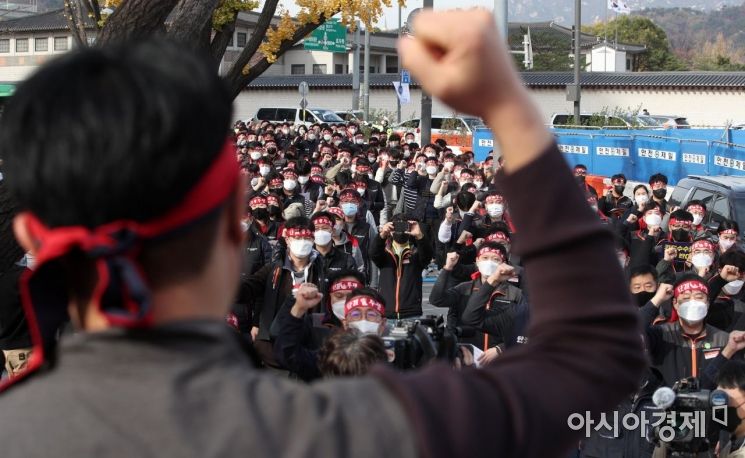
The concentration of unions in the public sector and large corporations is also problematic. According to him, the average number of union members at workplaces affiliated with the Korean Confederation of Trade Unions is about 1,800, which is five times more than that of the Federation of Korean Trade Unions. The unionization rate is 70% in the public sector and 10% in the private sector, a gap of about seven times. This disparity is larger than five times in the U.S., four times in France, and twice in Norway. In private companies, the unionization rate exceeds 70% for workplaces with more than 1,000 employees and 57% for those with more than 300 employees, but it is only 15% for 100?299 employees and 0.2% for fewer than 30 employees. Meanwhile, 67% of all Korean workers work at companies with fewer than 30 employees, and only 9.7% work at large corporations with more than 300 employees. This means that large corporations with fewer workers control the unions.
Professor Kim emphasized that unions should also change their governance to strengthen social responsibility. He said that union operations should be rationalized through wage increases and information disclosure. Professor Kim stated, "Because information on union operations was not disclosed, distrust arose internally, which manifested as unreasonable wage increases and demands for employment protection, shifting the burden onto economically and socially vulnerable groups and causing a rich-get-richer, poor-get-poorer phenomenon in labor. To resolve these contradictions, it is necessary to strengthen union leadership and integrate unions between unions and between regular and non-regular workers."
Professor Kim argued that unions should also unify their channels in tripartite dialogues to enhance the outcomes of social dialogue. Fundamentally, to resolve the dual structure of the labor market (such as disparities between regular and non-regular workers), a proper balance of power between labor and management must be established in the job policy decision-making process. He emphasized, "Social dialogue among labor, management, and government is necessary, but the government must secure a balance of interests between labor and management. Both employers and unions should unify their channels in tripartite dialogues to increase effectiveness."
However, there are deep disagreements between labor and management regarding the "single bargaining channel" system. Companies argue that having a representative union among multiple unions participate in bargaining has improved bargaining efficiency and reduced unnecessary social costs. On the other hand, labor groups have consistently expressed concerns that the "single bargaining channel for multiple unions" system, implemented in 2011 and now 10 years old, infringes on the three labor rights and fundamentally has problems with unifying bargaining channels.
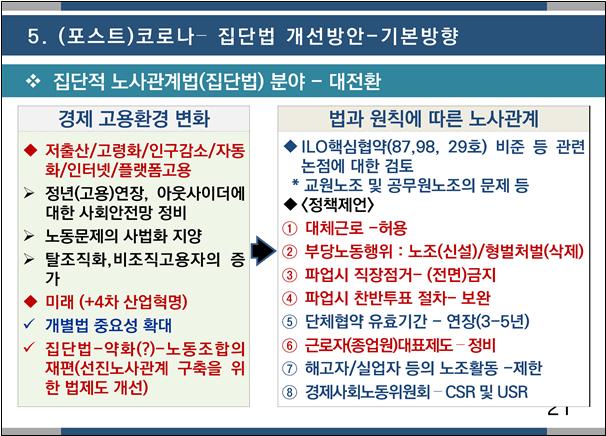
Professor Lee Seunggil of Ajou University School of Law suggested the need for reform of the "collective labor relations law" in his presentation titled "Reform of the Dual Structure of Labor Relations and Tasks of Labor Law." Professor Lee proposed the following: full allowance of replacement labor during strike periods; establishment of a "unfair labor practice by unions" clause in the law; removal of criminal penalties for employer lockouts; extension of the validity period of collective agreements from 3 years to 3?5 years; introduction of provisions to refuse workplace access to non-active union members such as dismissed or unemployed workers; and provisions to refuse collective bargaining demands for hiring or reinstatement of non-active union members.
© The Asia Business Daily(www.asiae.co.kr). All rights reserved.


















